Search This Blog

Showing posts with label DRC Bonobos. Show all posts

Monday, July 6, 2009

Wild Bonobos


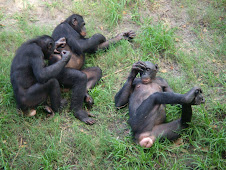
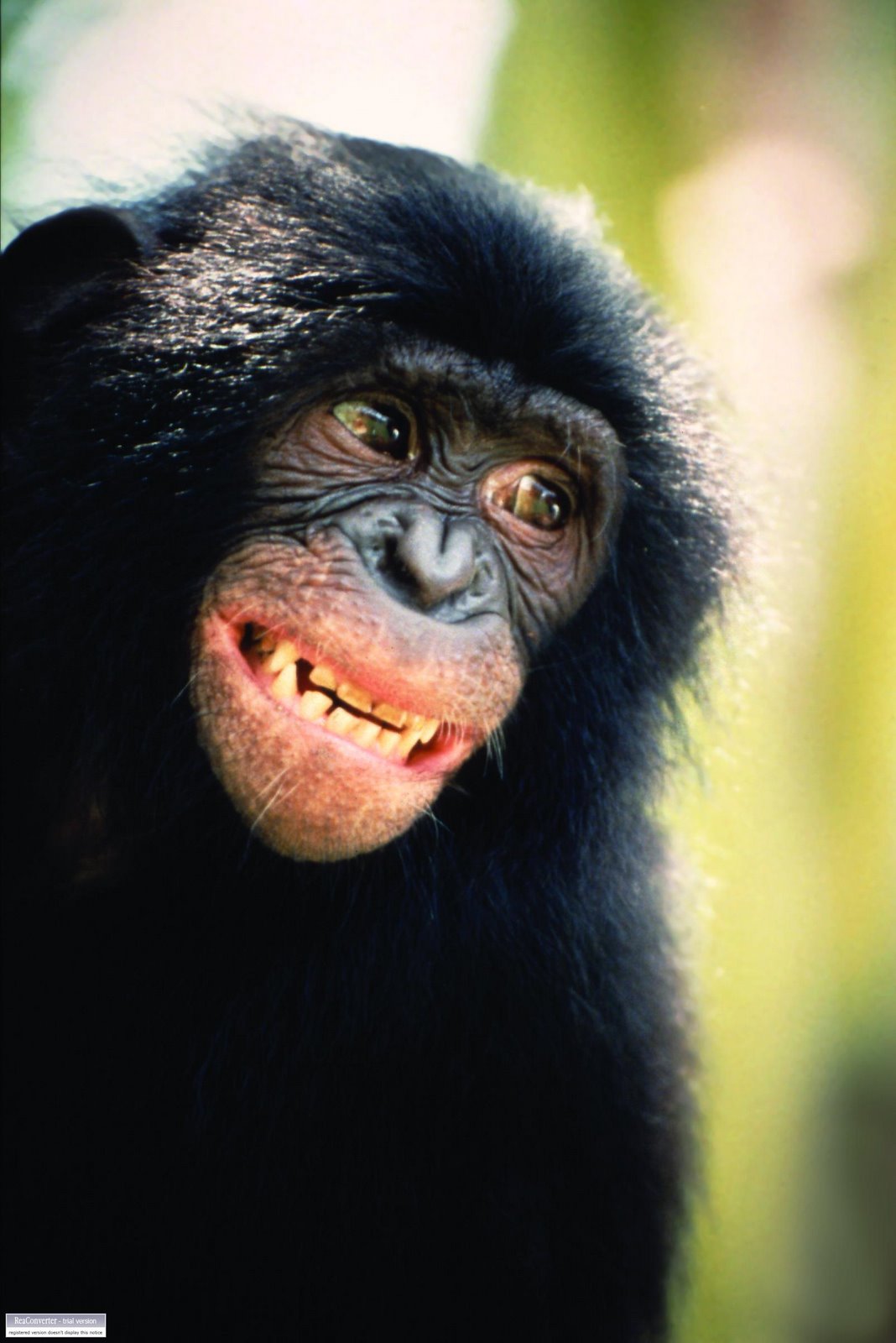
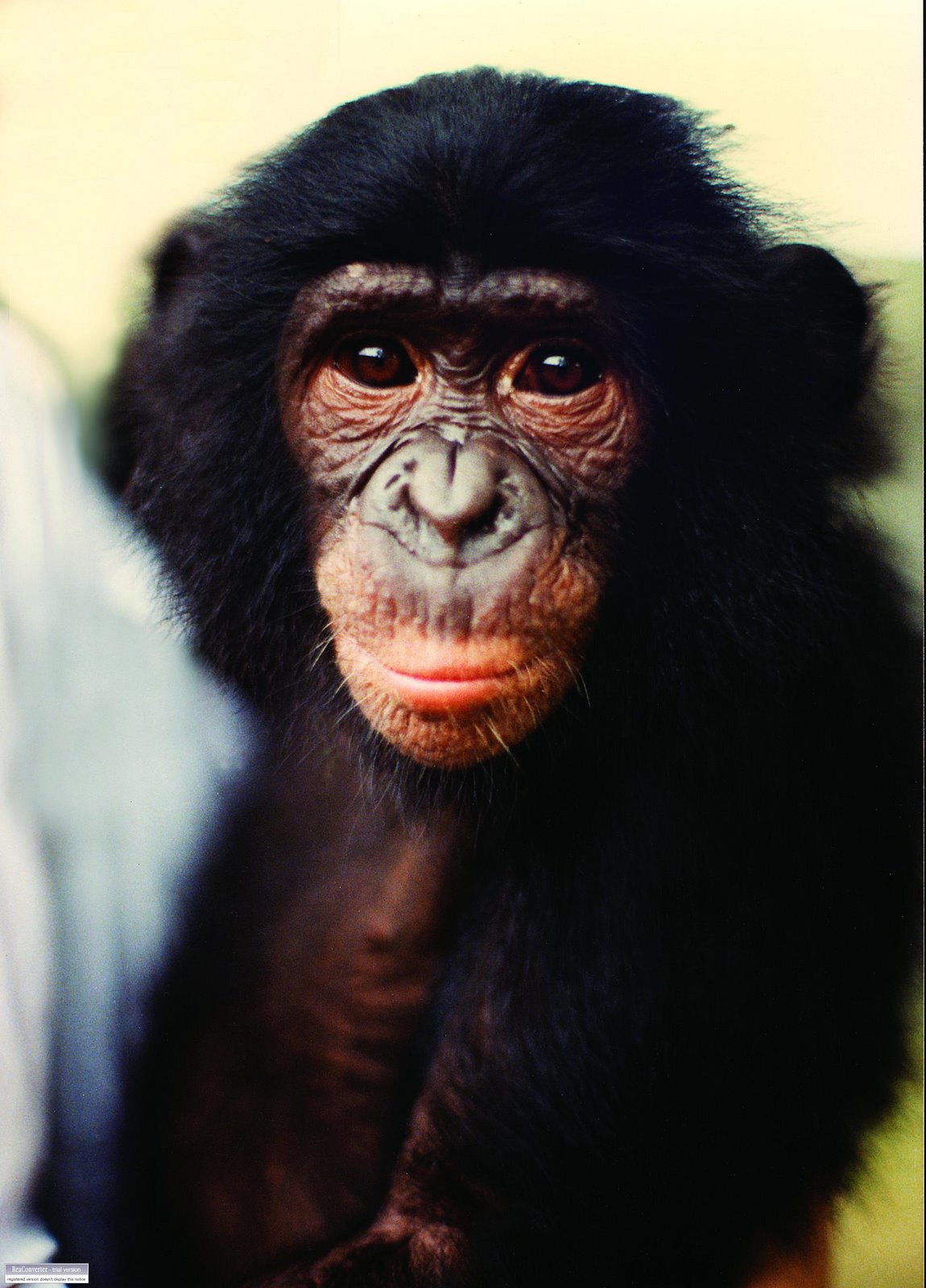
These images are of wild bonobos that are being studied by Dr. Jo Thompson, Director of the Lukuru Wildlife Research Project. The first is a young male with his mother. Males stay with their mothers their entire lives, and their rank in the group is tied to her social status. A high ranking female will raise high ranking sons. (Daughters go "out into the world" when they reach puberty, and join another group).

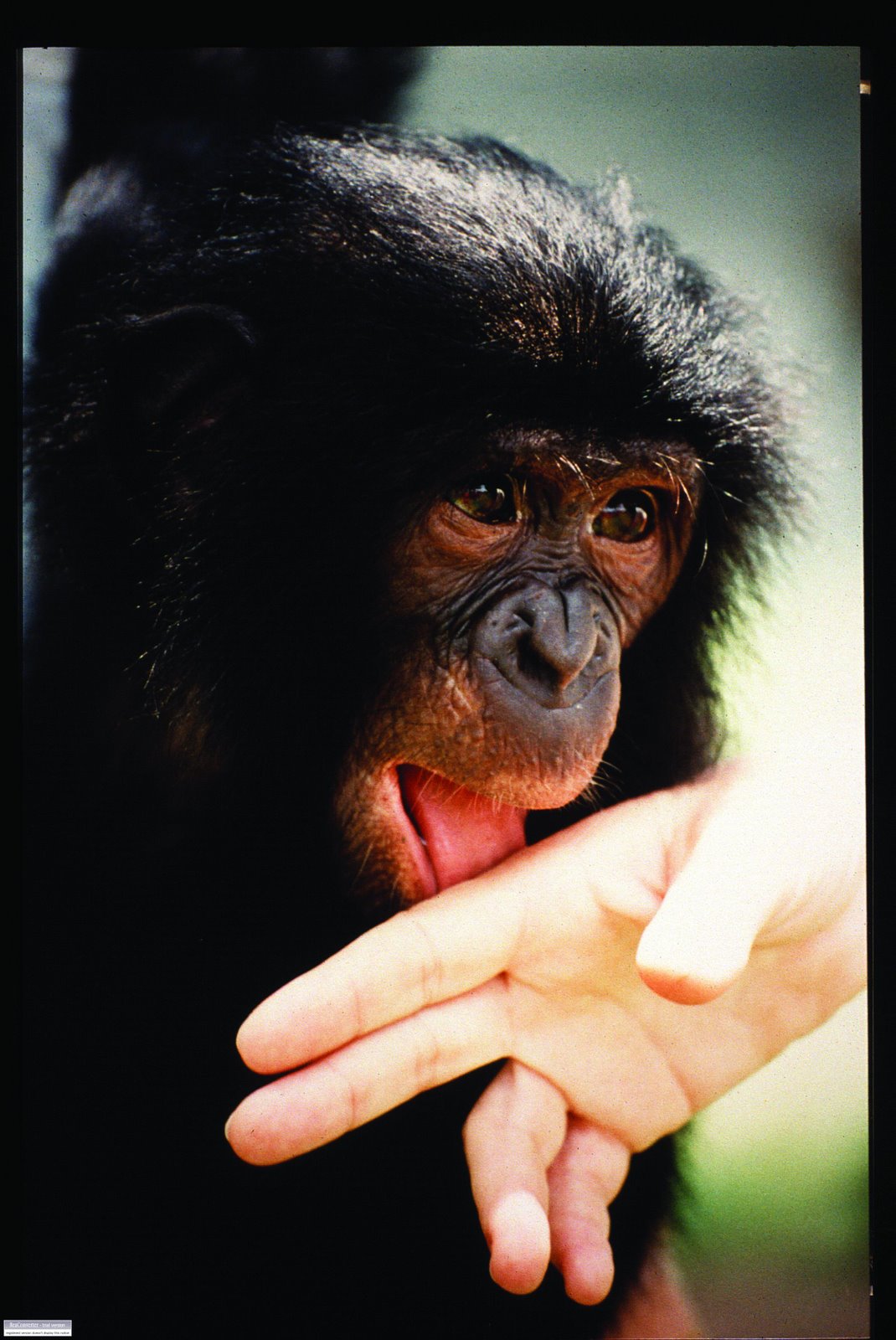
The second photograph illustrates one of the saving fortunes for the bonobo. Because of its ability to walk upright for many strides, some local Congolese peoples will not kill or eat the bonobo. They tell stories about the closeness of humans to bonobos; that it is an "ancestor," saved the human ancestor, or was, once upon a time, a servant of man.

The last photograph shows two female bonobos in "G-G" rubbing, or "genito-genital" rubbing, one of many different positions and combinations of sex in the species. The species' frequent use of sexual relations (with or without penetration) serves to reduce tension whenever there is stress, such as competition over resources. In bonobo society, males and females, young and old, will pantomime sex as a greeting, as reassurance, or a "thank-you" in exchange for food.

In the bonobo world, females are dominant, and sisterly bonds will compel them to gang up on any male that would dare question their authority. This unique twist in the animal kingdom intrigues primatologists, sexual evolutionary scientists, and the rest of us.

Photos by R. Ross

Wednesday, June 3, 2009

Bonobo Meals in Kinshasa

The bonobos in Kinshasa, Zaire (now the Democratic Republic of the Congo) received, to the best of our ability, a nutritious diet. We used ovens normally used to sterilize laboratory glassware to bake a bread that was made from wheat flour mixed with powdered milk and a vitamin/mineral "premix." We also added a small amount of blood or meat meal.

The "bread" was the concentrate base that provided protein and essential vitamins and minerals for optimal health and growth for the young bonobos. Small amounts of calorie dense, starchy, or high protein foods such as eggs, peanuts, manioc, corn, cooked rice, squash, and pumpkin were also eaten. The bonobos were given imported whole grains, raisins, cereals, and bird seed that was blended together. This was called the "scatter mix" because it was spread out on the ground for the animals to pick through, as an occupational activity.

The bulk of the diet consisted of locally available fruits and leafy greens. These included papaya, oranges, bananas, sugar cane, pineapple, spinach, hibiscus leaves, amaranth leaves and a wide variety of other indigenous fruits, greens, and vegetables. The goal of of the diet was to provide 25 different foodstuffs per day. The diverse array of local products made this a reasonable goal, but one that varied in composition tremendously throughout the seasons.

Imported foods, such as apples, were too expensive to feed the bonobos. Other foods such as carrots, lettuce, cucumbers, eggplant, tomatoes, and watermelon were grown for sale to expatriates, but they were largely too costly for animal food.

The dishes above are being prepared, to be stored in a refrigerator until use. The plates represented the three "squares" given per day to each animal. They were topped off with the more bulky greens that were given at odd intervals. The bonobos were fed five or six times per day.

Photo by D. Messinger

Friday, March 27, 2009

Oh, La, La, We've Moved!

When the six bonobos left Africa on loan, Kizito drew the animals traveling to Europe. Rosie carrying a backpack, is seen in front, followed by mother Zuani with the baby Liboso on her back. Hani and Molaso are hauling suitcases, and, in the rear, Mwindu is dancing to a boom box, without a care on his mind.

The letter that accompanied the tongue-in-cheek cartoon was mailed to all of the bonobo friends that I had made over the years. It was to inform them that the bonobos had arrived safely in Holland, and that a 25 year collaborative contract had been signed, to provide long-term funding for bonobos in the Democratic of the Congo:

"A change of address! We finally left our cramped quarters at I.N.R.B. in Kinshasa on 2 March 1998 for a two story condo in Apenheul Primate park in Holland. The maids here tidy up daily and provide room service, starting with hot tea every morning.

"Balanced meals include succulent delicacies like kiwi, chicory, persimmon, celery, and grapes. The beds are special -- imagine choosing between straw lofts, canvas hammocks, thick rubber shelves, swinging nets and giant hanging Baskets! Our rooms (We wouldn't call them cages) are full of climbing poles, games, ropes, puzzles, swings, and toys. The floor is deep in wood chips so we can dig. Our new caretakers have promised a vacation each summer on an island complete with trees, pond, grass, stream, boulders, herb garden, marsh...what more could a bonobo ask for?

"Here in Holland, we've already made new friends with four resident bonobos -- Mobukisi, Joey, Lomela, and Jill, who is expecting. Speaking of which, with the excitement of getting ready to leave, I didn't have time to announce our new arrival...yes, I'm a mother now! Liboso (for the "first one" born in captivity in the Congo) entered this world in mid-January. Some people were surprised that I had no trouble, as I am still slight in frame at only 17 kg! (37 pounds). All my bonobo girlfriends want to help raise my baby.

"News from the rest of us -- Molaso is jealous of my little family and has gone off of birth control. (She had problems with spontaneous abortions and the doctor had put her on the pill.) Rosie is a typical teenager with new friends and Mwindu and Hani are glad to have guys to hang out with. A real clown, Mwindu has already come up with new twists on "catch me!"

"Part of the reason for our move is that we've been promoted! We are now "Bonobo Ambassadors" for a half million annual Apenhuel visitors. The job is strictly 9 to 5, and pretty relaxing, just being ourselves, and doing what bonobos do naturally. We can take a break from work anytime we want by going downstairs to escape the gaze of our admiring public. The only thing we miss is sugarcane, but all in all, there are no complaints.

"Well, that is not quite true. We miss our neighbors in Kinshasa, but we heard that they will be moving soon to better accommodations. On the serious side, Apenheul will provide permanent care for the bonobos left behind at I.N.R.B. Our hearts will always be in the Congo and because of this, Apenheul has guaranteed support for research and studies to benefit bonobos and other Congolese animals for the next quarter century. So we six fortunate ones feel like a catalyst for a lot of future good happenings in our homeland!"

Monday, February 2, 2009

Bonobo Blood Work

Under light anesthesia, sick bonobos in Kinshasa, Zaire were examined in an effort to diagnose and treat their conditions. Blood work on orphaned babies, as pictured above, usually revealed anemia, which was related to a protein deficient diet.

Photo by B. Messinger

Wednesday, January 28, 2009

Rat-Trap Cat

Around the bonobos, this cat was our idea of pest control. He slept during the day, and patrolled for rats and mice at night. In Zaire (now the Democratic Republic of the Congo), cats were feared and abused, because of a rumor that they carried tuberculosis in their fur. (This disease misconception came from cats' purr, the sound that people imagined came from damaged, tubercular lungs).

Outdoor cats are controversial, because they are indiscriminate hunters, taking rodents as well as song birds. However, over 30 years of research has shown that it is impossible to eliminate feral cats, because the "holes" created by their removal are quickly filled by new cats moving in. The best alternative is to neuter, vaccinate, and feed the ferals, thus creating a permanent, managed colony.

In Jacksonville, the city's Animal Control is now promoting such a program, and the Jacksonville Zoo and Gardens is following this lead by monitoring a vet-checked population of resident cats. Any animals that hunt song birds will be found homes.

Photo by D. Messinger

Sunday, January 25, 2009

Village Names for Bonobos

Zaire (now the Democratic of the Congo) is said to have 400 different dialects. One of the tactics I used to get people to open up, was to show interest in village culture and language. I asked people bringing apes to Kinshasa what their name for their animal was. I listed a name as "verified" if it was confirmed by two different interviews, or was a name documented in the literature. Some of the names sounded similar, such as "Elia," "Eja," and "Edia." Other names were "Keza," "Yatole," "Emana," and "Mbanda."

Anywhere in Zaire, there was an overlay of several languages. There was the dialect, a regional language, and French, the official national language. Lingala was one the country's regional languages, so the Lingala "Mokomboso" was used throughout bonobo territory for the species.


The French language distinguished between the "white-faced chimpanzee," and the "black-faced chimpanzee," (bonobo). It was confusing, because many villagers only knew their kind of local "chimpanzee" and were not aware that there were actually two species. That is why I tried to interview people from known localities, with animals of known species, to determine the actual local names.

Tuesday, January 20, 2009

Bonobos in the Backyard

Behind the animalerie where the orphaned bonobos lived was a bamboo grove, grassy yard, and a few trees. When the bonobos were young, they would get playtime outside, where they could run about and climb the trees. Always, they were accompanied by a caretaker.

Photos by D. Messinger

Sunday, January 11, 2009

Grooming and Endorphins


Molaso, an adolescent female bonobo, seems thrilled to "groom" my arm and head. This photo was taken in 1994 in Kinshasa, Zaire (now the Democratic Republic of the Congo).

Studies suggest that grooming reduces stress because the pulling of hair releases endorphins, the body's natural pain-killers. I can attest that Molaso would start by looking intently for small grit (I sprinkled sand on my arms to test this), but then finish by plucking single hairs.

Interestingly, many bonobos groom the hair from each other's forehead, perhaps because they like to gaze into each other's eyes. This may not be an artifact of captivity, because I have seen photographs of wild bonobos with bare brows.

Photo by B. Messinger

Sunday, January 4, 2009

Bonobos with Substitute Mother

Baby apes have a critical need for affection and the orphaned bonobos I saw in Zaire (now the Democratic Republic of the Congo) were no exception. They did best with a human "mother" who could provide them a sense of security and emotional stability. Stani was a good substitute mother because of his calm demeanor and because he truly loved his babies.

Photo by D. Messinger

Thursday, December 18, 2008

Skansen Zoo Keeper with Bonobo

Tytte Hellman was a zookeeper at the Skansen Aqvariet in Stockholm, Sweden. In anticipation of Skansen receiving six bonobos on loan, she came to meet them in Kinshasa, Zaire (now the Democratic Republic of the Congo). Tytte is seen with Tshilomba, a young bonobo who is chewing a length of sugar cane.

Tytte got along famously with the youngest bonobos, but Mwindo, the biggest male, decided that she was a newbie to be tested. Mwindo had developed a bad habit, due to the reactions of visitors (whose exaggerated shouts of dismay only fueled his sense of humor) by throwing whatever was closest at hand. His aim was excellent. Every time he saw the soft spoken Tytte, he launched stuff at her, some of it not so nice.

Because Tytte's time in Kinshasa was brief, we attempted a course in manners. To win his favor, Tytte fed Mwindo his favorite foods for several days, but it made no difference. It seemed that the nicer Tytte was, the more he took advantage of her.


We only had a few more days before Tytte had to return, so we came up with a plan to establish what should have been normal -- females are dominant in bonobo society. The event was carefully engineered -- yelling loudly, Tytte entered the service area with a blow-up plastic snake.

The sight of the shiny green snake that Tytte brandished was so unexpected that Mwindo immediately went into a submissive posture, flattening against the ground. In true bonobo fashion, Mwindo dry-humped the floor, screaming in a shrill voice. I was watching, and recognized the behavior that this male always did when he was felt insecure and needed to ease the tension.

As planned, Tytte immediately "apologized" to Mwindo and offered him treats. From that instant, Tytte assumed status as a ranking female. And in typical bonobo fashion, Mwindo accepted the apology that she was chanting, "I'm so, so sorry, Mwindo to scare you. I'm sorry, have a banana to make it feel better. I won't do it again."

Although the introduction worked well, the six bonobos were not destined to go to Sweden.

Tuesday, December 2, 2008

Bonobo Mwindu

Mwindu was one of the six bonobos that went to Holland, on a breeding loan from the Congolese government, in 1998. The keeper gave him his name, "black" for his extremely dark face. Mwindu was a playful young male who had suffered from severe malnutrition. From Grains of Golden Sand:

"I never completely trusted the moody Mwindu after he reached puberty, but we still played a “chase-me” game—a weaving, bouncing, feinting kind of dance, each on our own side of the cage. Mwindu adored attention and enjoyed being scratched. He would approach the bars and cling from them upside down for me to tickle his belly. Soon, I rewarded him with a tickle only when he placed his mouth in a “bite” over the bars and held completely still. I figured that, hanging upside down with his teeth affixed to a steel bar, he was incapable of hurting me. (His pose also gave me the chance to give him a quick exam, including checking the inside of his mouth.) Indeed, Mwindu never made an aggressive move while I was scratching him. Throughout the exercise, he would chortle with pleasure.

Photo: D. Messinger

Friday, November 28, 2008

Bonobo with Treat

In Kinshasa, the young bonobos that I saw were cared for days or weeks before they were picked up by their owners. This young male clutches a length of sugar cane. He is being coaxed with food -- I am looking down so as to not threaten him. At first, the animals were usually fearful of humans, but within a short time, they would seek affection -- a basic biological drive of young primates.

Sunday, November 16, 2008

WWF Bonobo Stamp

In early 1997, as Zaire was preparing for the takeover of an invading army (yes, we in the capital knew that it was inevitable, months ahead of time. Most of the people were tired of Mobutu's dictatorship, and were warily looking forward to the change under another regime), the World Wildlife Fund issued a bonobo first day cover.

In Zaire (it became the Democratic Republic of the Congo in 1997), I lived through three uprisings -- in 1991, 1993, and 1997, not to count the spillover in 1994 in the east, from "ethnic cleansing in Rwanda." Many other nations in central Africa have been drawn into the fracas and millions have died. The people continue to suffer to this day.

The bonobo, as other wildlife in the country, has not fared well under a land in conflict. Gorillas, elephants, rhinos, hippos, primates, and antelopes have been hunted for food by hungry populations, where there are no longer any rules except that of survival. Some conservationists claim that peace and political stability are the key to saving Congolese wild animal populations.

Sunday, November 2, 2008

Bonobo Molaso, the Tramp

One of the older bonobos that I cared for had come in with severe health problems. From Grains of Golden Sand:

"The keepers named her Molaso, which brought a wry grin to Lingalaphones* because it means “pretty girl” (or, alternatively, “trollop”, “hussy”, “tramp”). For years, Molaso had difficulty eating because she had lost many teeth from illness. As she matured, I was pleased to note the eruption of a complete adult dentition."

Years later, Molaso was one of the lucky six who found a new home in Holland, at the Apenheul Primate Park. I heard through the grapevine that there was an embarrassing moment in front of some Congolese visitors, when they learned the name: Molaso. Apparently, it was politically incorrect -- My workers had innocently interpreted her very sexy, normal bonobo behavior.

*Lingala is one of four official dialects used in Zaire. It was the military, trading, and most common local tongue in Kinshasa.

Photo by: D. Messinger

Tuesday, October 21, 2008

Gallery Forest

This photograph was taken in Bandundu, the Democratic of the Congo (formerly Zaire), where the tropical rain forest transitions into grassy savanna. The terrain is a patchwork of forest and grassland. The higher elevations of the hills have savanna that is cut abruptly, as if snipped by scissors, into the forest. All around, the hilltops look like the bare heads of tonsured priests.

The southernmost research study site of bonobos, at Lukuru, has a mosaic of forest and grassland similar to the above. Historically, bonobos may have extended south, even into the country of present day Angola, along forested river corridors, but there is no proof of this today.

Photo by D. Messinger

Wednesday, October 1, 2008

First Day Issue Bonobo

Ironically, in early 1997, as the rebel army under Kabila was advancing toward Kinshasa, the World Wildlife Fund, in collaboration with the Zairian government, issued a special series of four bonobo postage stamps. Within a few months, the country was no longer Zaire -- and the future of the bonobos was under the thumb of another political system.

In a way, this story serves to illustrate how the future of the bonobo (as well as other endemics such as okapi, the Congo peacock, aquatic genet, and Grauer's gorilla) is tied up with the politics of a single country. Much of the problems for wild animals in the Democratic Republic of the Congo -- once Zaire -- continue to be related to the ongoing instability of the region.

Thursday, September 25, 2008

Housing for Orphaned Bonobos

This was the building for the orphaned bonobos in Kinshasa. There were eight cages (four foot by eight foot, by eight foot high), four on a side, and an open-air work space. Each unit had a metal roof that covered half of the space as well as a central hallway.

I loved living so close that I could walk to work every day. Immediately behind the bonobo building was a large tract of land -- probably five acres -- that contained a never completed guest complex, a meeting hall, the sheep pasture, and my studio apartment.

Photo by D. Messinger

Friday, September 19, 2008

Moving Day for the Bonobos

It was moving day, March 8th, 1998, and the six bonobos were being shipped to Holland. I am taking blood from bonobo Zuani (to accompany the shipment so that the animals would not be subjected to another anesthesia upon arrival). Ria, the keeper from the Apenheul Primate Park is trying to sooth baby Liboso that is seen as a black blob on the sleeping Zuani's belly.

The airline officials thought that the mother would get stressed and injure or kill the baby. Their recommendation was that we separate the two within a crate. I refused, saying the devoted ape mother would hurt her baby trying to pull it through to her. The Apenhuel officials signed a paper accepting the risk and the two were crated together. As we predicted, they both arrived in Europe in great shape.

Wednesday, September 17, 2008

Veterinary Workup: Bonobo 4146

Any bonobo or chimpanzee that was anesthetized for testing received a complete exam. Because the animals were housed at a human medical facility, I had access to physicians and quality laboratory diagnostics.

The paperwork above was for # 4146, an eight pound female bonobo that stayed at our clinic for three days. As noted, she was from Basunkusu, and had a small flat tail bud. She had a "cheeky" appearance with unusual fatty pads at the corners of the mouth.

Her temperature was subnormal, at 96.8, and she had swollen lymph glands below the throat, on the right side. She had no external parasites, the lungs sounded good and the heart rate was 100 beats per minute. As part of a simple test for long term malnutrition, I tugged on her hair to see if it came out too easily. Her hair was relatively hard to pull, but she did have puffiness under the eyes, indicating of lack of protein, as well as pale mucus membranes, a sign of anemia.

The erupted teeth were diagrammed. This showed that the bonobo was cutting her first lower molars, which meant that she was older than her weight would indicate. The bonobo had severe gingivitis, a common problem with malnourished baby apes, with exposed roots on three teeth on the upper right. This corresponded to the swollen lymph glands.

The owner brought the bonobo in an extremely small cage. He said that she had been losing weight, but had good stools. He said she coughed occasionally, and had no appetite, but drank water well. When she first arrived, she was very thirsty and drank a lot of liquids.

The bar code on the right side is the ten-digit number of the transponder that I implanted at the left shoulder, the same type of permanent identification that is used on cats and dogs. This was done to track the animals that entered the (illegal) pet trade; if they ever appeared outside the country and were scanned, their origin would be known.

Unfortunately, blood work was not done on 4146, but signs of parasites were found in the stool -- hookworms, roundworms, and whipworms. The animal was discharged with medications and advice.

One interesting comment is that reading back over these notes, I remembered that Zairians referred to animals as "it." In contrast, Americans often use "she" and "he," for known gender animals. For this post, I went back and changed the pronouns from "it" to the more personal "he" and "she."

Saturday, September 13, 2008

Footprint, Bonobo 4013

In Kinshasa, when I anesthetized a bonobo for an exam, I also tested ways to permanently identify them. I tried "fingerprinting," rather, "footprinting," for a unique identification. I used regular India ink, brushed it on with a paint brush, and then pressed the foot to a sheet of paper. I preferred the feet because of the anatomical abnormalities seen, such as the bent little toe above, that could not be straightened out.

The footprint was also a way to look at the webbing between the digits, a common bonobo characteristic. Number 4013 had webbing between the first and second toes, half-way to the first knuckle joints.