Search This Blog

Friday, April 24, 2009

Bonobo Lucy Walking with Ball


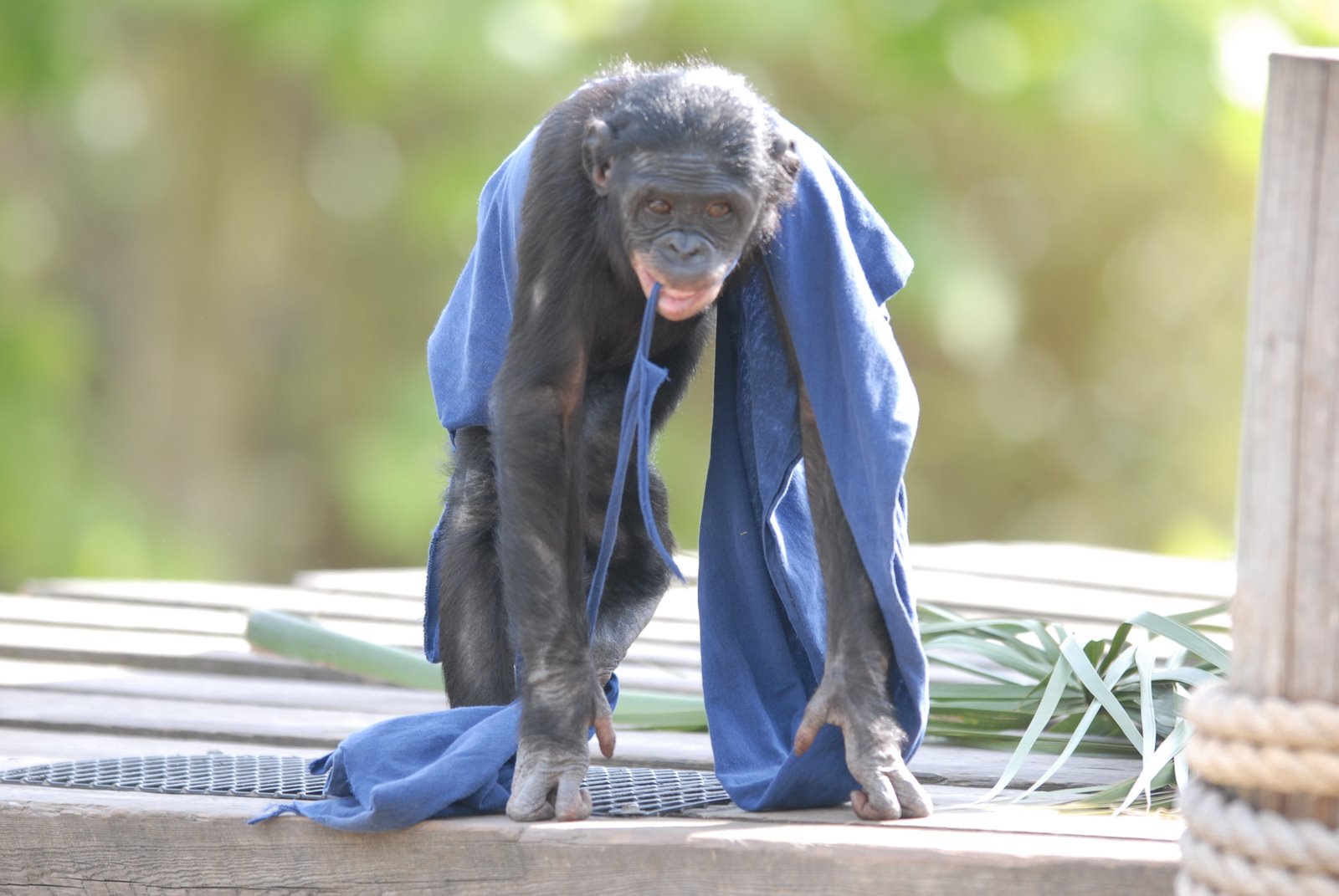
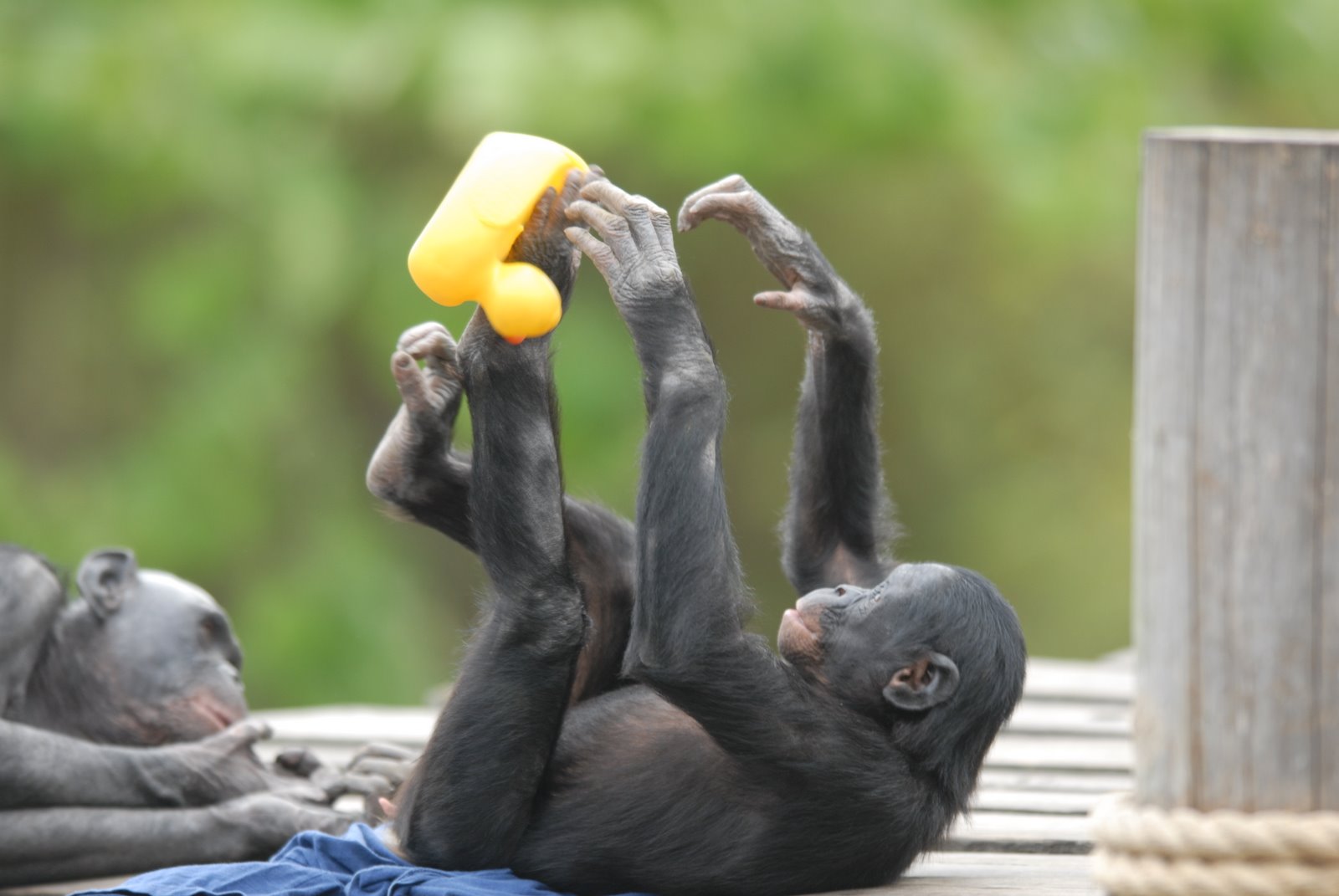
Lucy, a five year old bonobo at the Jacksonville Zoo and Gardens shows off her ability to stand upright while she passes a ball behind her back, then continues to carry it in front. Her capacity to walk upright while manipulating a large object is unique, and something that the local peoples of the Democratic Republic of the Congo comment on as being "human-like."

Photo by M. Brickner

Wednesday, April 22, 2009

Rain Rain Go Away

The world's rainforests straddle a narrow belt along the equator, and represent only six percent of the earth's landmass. I do not know exactly how much it rained where I was, but I guessed that it must have been around 100 inches a year. There was the "big wet" which was around six months long, the "little wet," around three months long, and the "dry" season, also three months long.

Traveling and working among the local peoples of Zaire, now the Democratic of the Congo, slowed me down and made me appreciate the elements. For example, no matter the urgency, everything came to a halt when it rained. Weather it was working, or meeting, or going to school, conducting business, or taking a trip -- nothing happened when it rained.

The above photographs shows a village, where I was cooped up in a hut for several days, while it rained, and rained, and rained. I was working with the local people, trapping small mammals for a monkeypox study, and we were all stuck. Such was the life of the village -- people were not bored; they sat around and talked, sang, worked on small projects, ate, and slept. The kids fiddled around with small home made toys or helped the women with indoor tasks.

Sometimes I use these images in presentations to describe the life in a Congolese village. The last photo comes with the remark, "Well, at least we had running water!"

Photos by D. Messinger

Monday, April 20, 2009

Monkeypox Office at Night

In this photo, I am preparing the notes from the day's work, during a long field trip in Zaire (now the Democratic Republic of the Congo) to study human habits in relationship to the rodents found around the villages and agricultural areas. Because there was no electricity where I worked, lighting was limited to kerosene lanterns.

The large notebook mapped out the location of nests, and distance from a point along a transect, of the rope squirrels that we were studying. Due to many variables, the time spent in an single location was too short to learn actual density of the squirrels, but this was a quick way to get relative density indications for various areas that I studied.

The folding table belonged to our team and was the "office." This photo was taken outdoors, in front of the main house of the village chief. Like other local activities such as cooking, relaxing, working, and visiting, my study was not done in a hut. Mud huts were primarily for sleeping and for escaping the torrential equatorial rains.

One of the things not seen was my audience. The people -- adults, kids, and assorted dogs and chickens hung around to see what I was doing. They would quietly talk, work, or play and keep me company, partially as a favor. In the culture, being alone was anathema. And I was a stranger, doing strange, and unfathomable things, that would be talked about for years. I always had onlooking eyes, even here in the soft nighttime air under the stars.

Saturday, April 18, 2009

Thank You, Forest Doctor!


In the early 1990's, The Zairian Institute for the Conservation of Nature sponsored a educational pamphlet tied to a census of eastern lowland gorillas led by Jeff Hall of the Wildlife Conservation Society (Bronx Zoo). Kizito and I wrote and illustrated a culturally sensitive story that talked about gorillas and elephants. We used a play on words with "Monganga" which was the word for "Doctor" as well as the brand name of a popular bar soap.

The cover featured a forest scene with a village family. The riches of the forest were symbolically represented with a spear, fish, and a basket heaped with the harvest. The text reads:

"WE SHARE THE FOREST We have known our forest for many, many years. It is our home and will be the home of our children and children's children. The forest is bountiful to those who understand it. Here we find everything we need. We hunt and fish for the animals that feed us. Our forest gives us medicine, fruit, rope, nuts, paints, and candles.

"In return, we share the forest with other creatures. We need to take good care of our land so it will continue to sustain us. The following pages will describe the two largest animals we find in the forest. See how they are part of our world.

(Page two) "THE GIFT OF THE ELEPHANT The elephant is the largest animal in the forest. He is also its great protector. He could be called "Monganga Ya Zamba" (Forest Doctor) for the care he gives it.

"He is practically the master constructor of the forest, if you like. He knocks down trees to eat, which makes clearings for the sun to penetrate and start new plant life.

"But the greatest gift of our doctor is in his droppings. For these contain large seeds of giant fruits which only the elephant is capable of eating. These seeds are not digested, but deposited in the dung, which is ideal for germination. Some trees in our forest can only be planted by first passing through an elephant. (The illustration here is of a seeding thinking, "Thanks, forest doctor!" as it sprouts up from an elephant pile, complete with flies).

(Page three) "The gorilla is renown the world over for his huge size, his strength, and his intelligence. In truth, the gorilla does not use his enormous powers for aggression. The dominant male will charge anything that endangers his family. But he stops short, only to threaten with a roar. His size alone is enough to deter enemies.

"Gorilla infants pass their childhood with few worries. They spend their first years learning how to be a gorilla. They follow the family's examples to learn what is edible, what to fear and avoid (like snakes and toxic plants) and most importantly, how to become good parents themselves. Gorillas eat leaves, fruits, shoots, stems, flowers, and ants.

(Page four) "This man is a zoologist. His name is Sabuni and he is studying the relationship between large mammals and plants. In this image you can see that Sabuni has a certain rapport with an adult male gorilla! This is, because, near Bukavu and near Goma, specialists have habituated some groups to the presence of humans. Quietly and calmly approached, the gorillas do not flee.

"Often the zoologist wonders about the use of the surrounding forest. How will man take care of it in the next century, he asks? What will happen to us that depend on the forest if gorillas and elephants were no more?"

Our pamphlet was a labor of love. It was printed in Swahili and tested for interpretation by the intended audience. Humans and the relationship with and benefit from the forest was emphasized. It was printed in at a Kinshasa printer, and used only two colors, green and black, which meant delicate half-tones done by hand to achieve the greys and light greens. It. Even the spacing of the text around the half circle above the gorilla had to be adjusted one letter at a time on a template, due to lack of sophisticated computer software.

Wednesday, April 15, 2009

Lucy Bonobo Bonded to Mother


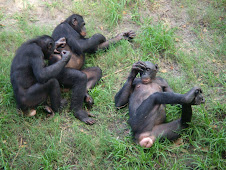
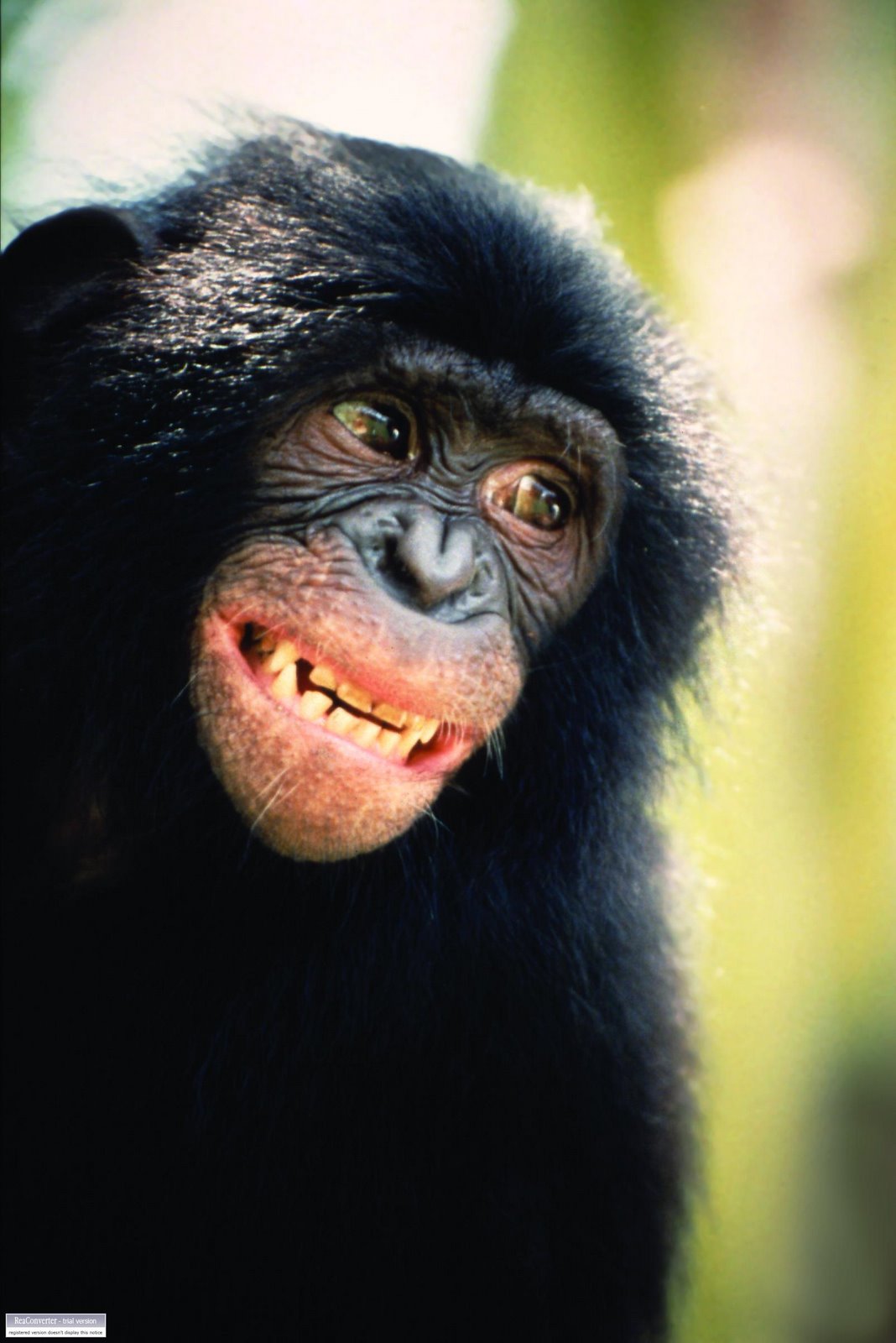
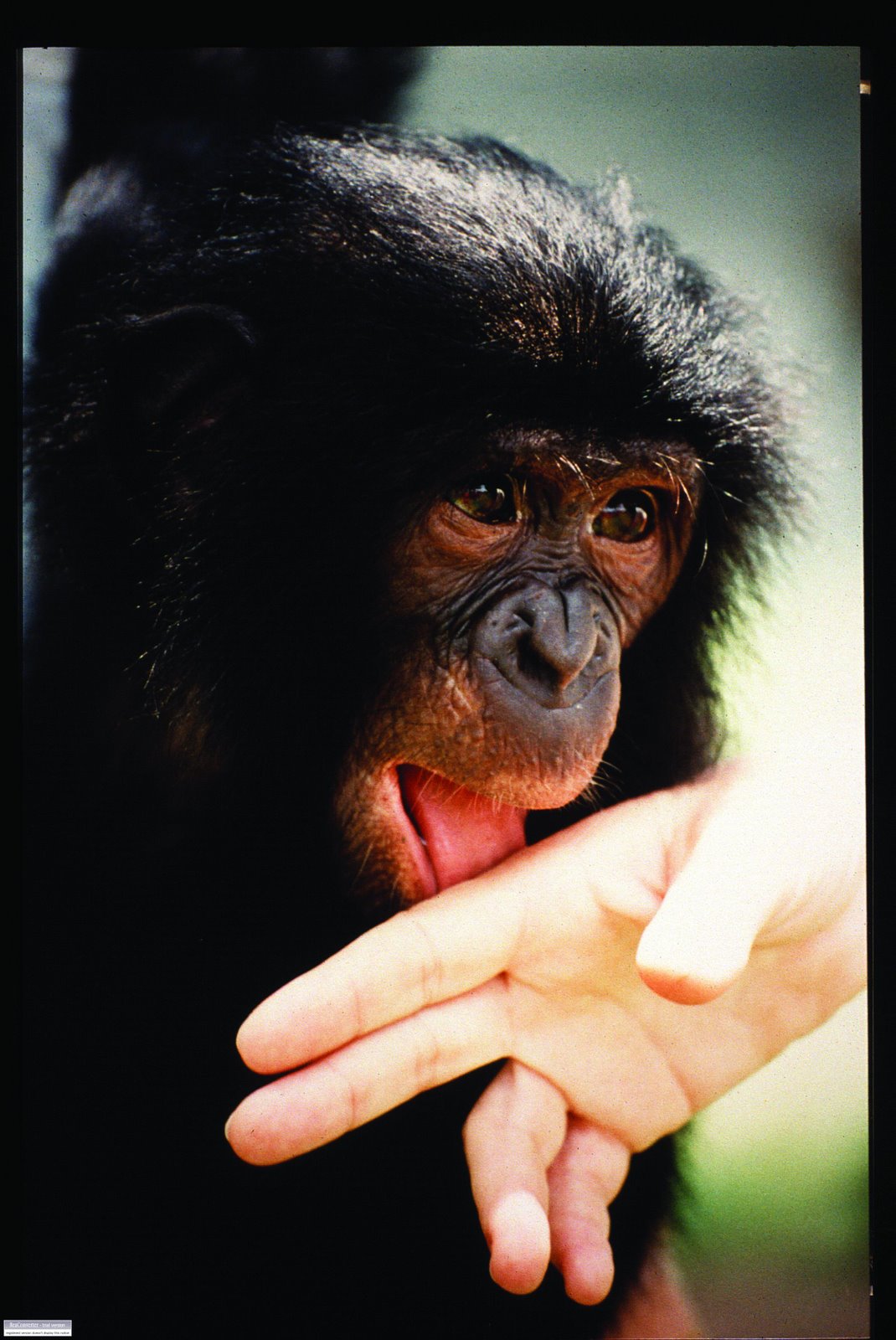
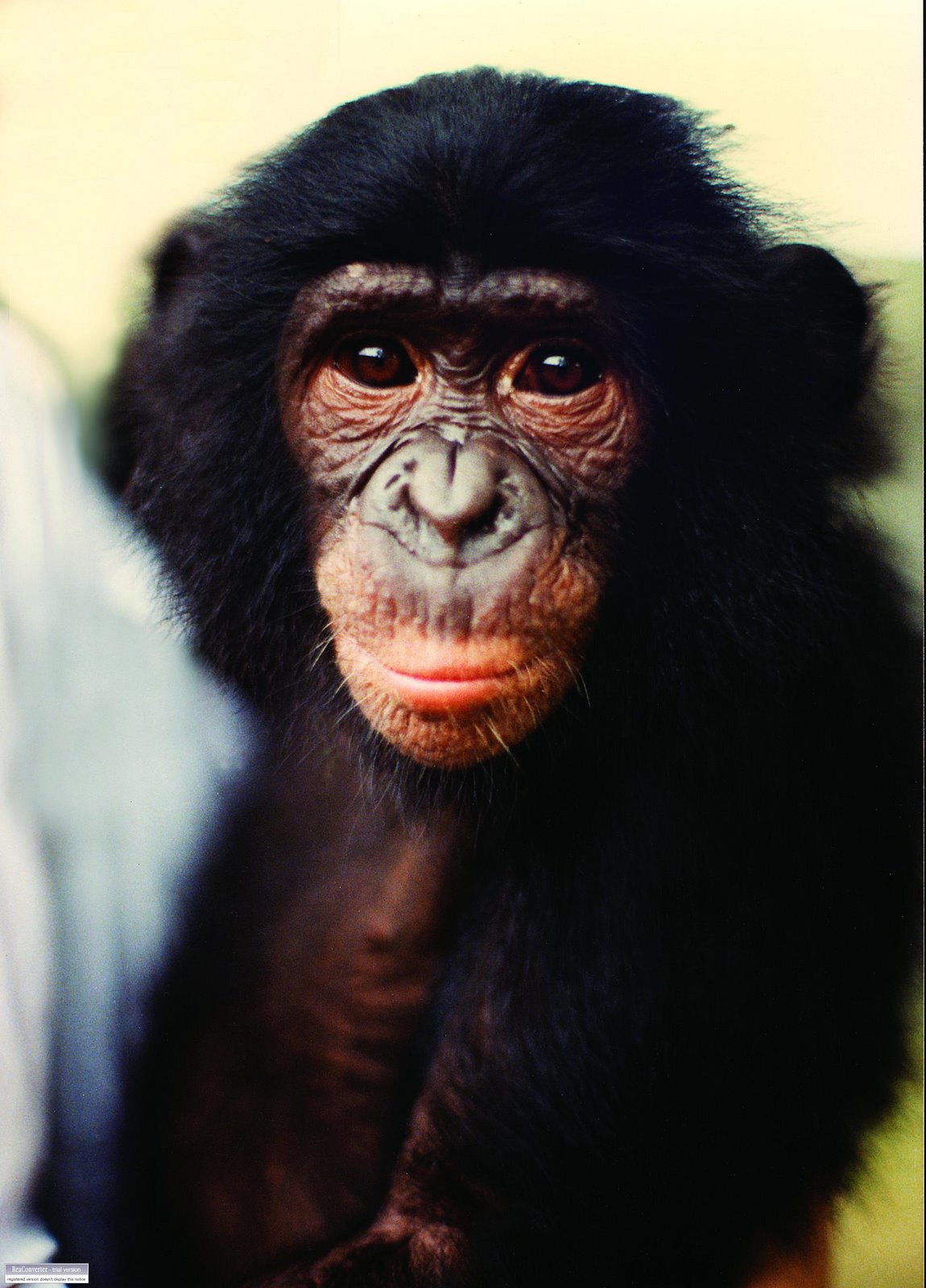
Lucy, a five year old bonobo at the Jacksonville Zoo and Gardens is still bonded to her mother, as seen in the top photo where Lucy has her arm draped over Lorel's back. In the middle, the two each have an arm over the other, while Lorel carries a coconut in her other hand. In the bottom image, the two have reverted to a earlier time when the mother carries her baby, piggy-back style. Lucy is getting too heavy for this, but the behavior is still seen from time to time. The weaning of a young bonobo is a slow, gentle process.

Photos by M. Brickner

Monday, April 13, 2009

The Snorting Gazelle


Speke's gazelles were named after John Speke, an African explorer who looked for the source of the Nile, but ended up naming a bird, a rodent, and an antelope. Speke's are endangered, and the wild numbers are estimated in the low ten thousands. They are found in small, fragmented populations in the horn of Africa, (Somalia and Ethiopia). The largest threat to their survival is the loss of grazing due to the encroachment of livestock.

This little female Speke's gazelle was born at the Jacksonville Zoo and Gardens last week. She is getting a daily catch-up and weighing (she is around three pounds; the scale reads in metric) for the first week of life, following a protocol established by the St. Louis Zoo.

Only four founding animals had been imported into this country in the late 60's and early 70's, so the resulting inbreeding led to problems including low birth weights, lack of viability, and low fertility. In the 1980's, under guidance of the SSP (Species Survival Plan) the St. Louis Zoo instituted a risky, but critically important program to rapidly breed all of the animals, to produce a large number of offspring, quickly. Over one hundred Speke's gazelles have been born at the St. Louis Zoo. Those with fatal defects did not survive, but the others had not inherited the harmful genes. The plan worked and over two to three generations, the problems had largely disappeared.

The most noticeable feature of this nearly two foot tall antelope is the three to five folds of skin that form the bridge of the nose. This can be inflated into a resonating chamber for the loud, explosive gunshot sneeze that the gazelle uses in alarm. It is also thought to be used to help in cooling because Speke's gazelles live in hot, dry semi-desert habitat. They are also crepuscular (active at dawn and dusk) to help conserve moisture.

Both sexes have S shaped horns, but the male's is noticeably heavier at the base. The gestation is six to seven months and the single, (rarely twin) offspring is weaned at two to three months, Their lifespan is twelve years.

Our little female is staying in an off-exhibit area that is visible from the train. She is often hidden in the grass (a protection defense to avoid predation), but has already started playing, and "pronking" about the yard, with all four feet raised off of the ground in a series of high bounds (also adaptive, to escape predation when being chased).

Photos by Jacksonville Zoo and Gardens