Saturday, May 9, 2009
Wednesday, May 6, 2009
Dancing with Bats

I always like the top photo, because it looks like I am doing some kind of barefoot water ballet. Instead, Moseli, a nurse, and I were mist-netting for bats. I was a volunteer in the Peace Corps, on loan to the World Health Organization (WHO). We were trying to determine the wild animal reservoir for the virus that caused monkeypox in Zaire (now the Democratic Republic of the Congo).The mist net was so fine, that it was nearly invisible to the eye, and was typically strung across streams, which were used by many species of bats as highways (as opposed to dense forests, where there were many impediments to flights). A mist net could be bunched up into the size of a fist, and it was easily torn by the captured bats, which we extricated with care.
The bottom photo is Moseli holding a male hammer-headed bat, the largest bat in Africa. The males, weighing up to one pound, are twice the size of the females. They are sexually dimorphic, with males having large square heads, and a huge larynx that extends into the thorax, displacing the lungs and heart. The voice box is used to produce the loud calls to attract females.
Hammer-headed bats meet at "leks," or mating arenas, for copulation. The males gather first, in small groups, where they spread out and establish their territory. They call loudly, with honking, croaking squawks. The females follow the sounds that can be heard from a great distance and come to the lek to select their mate.
Lekking (from Swedish "to play") is a promiscuous mating system that is either classical, where visual cues are used, like the tail display of peafowl or exploded, where the attractant is vocal, such as that of the hammer-headed bat.
Monday, May 4, 2009
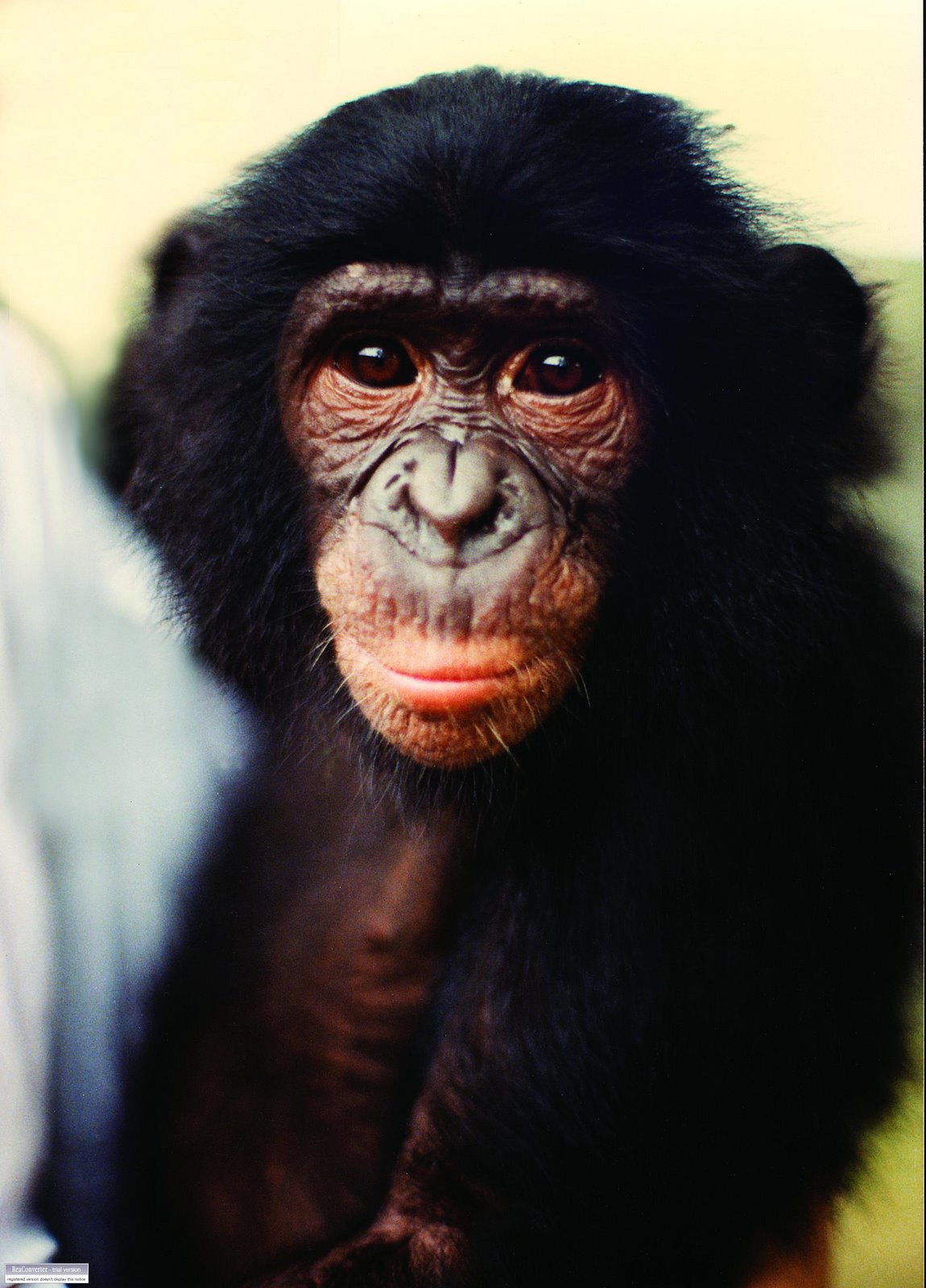
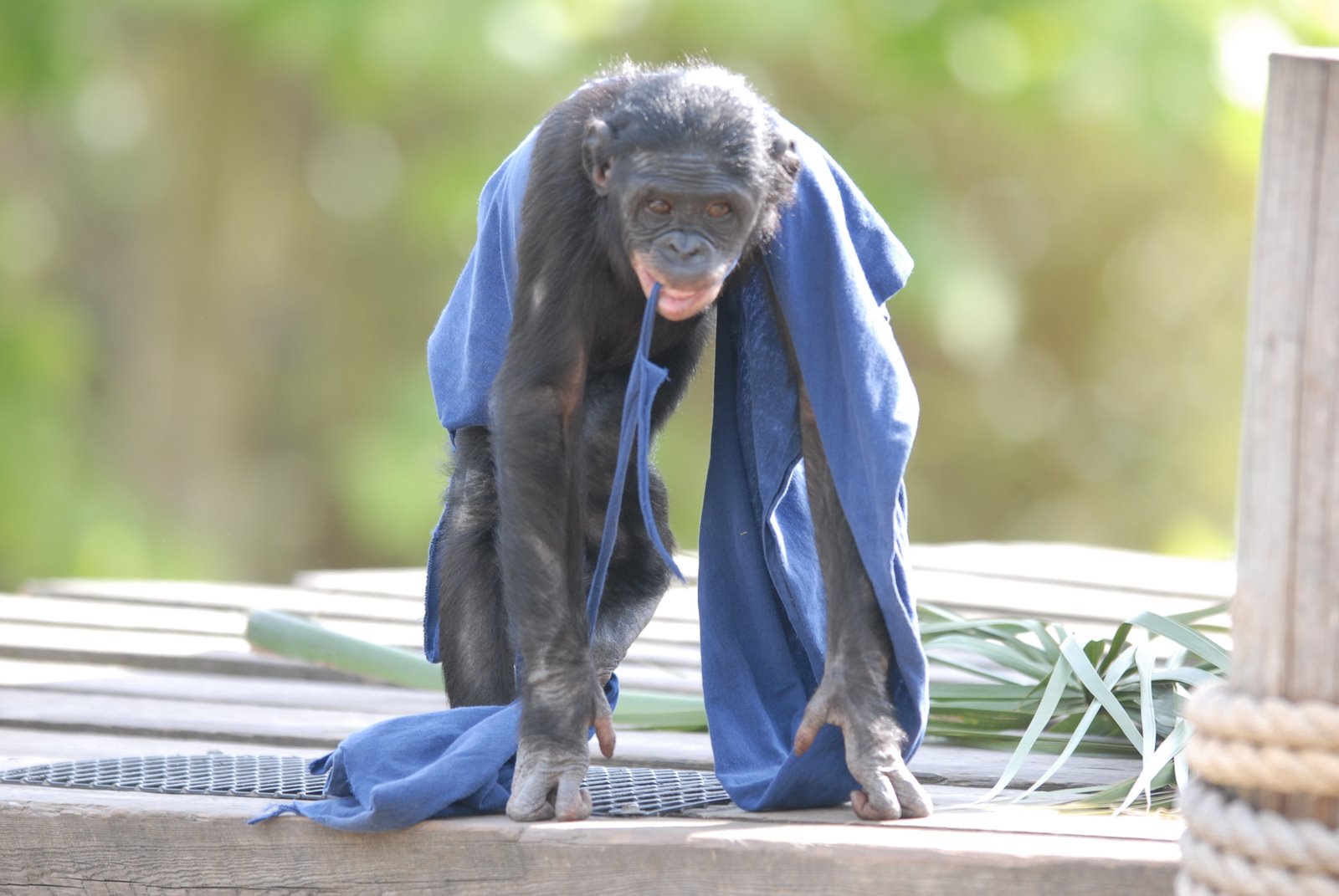
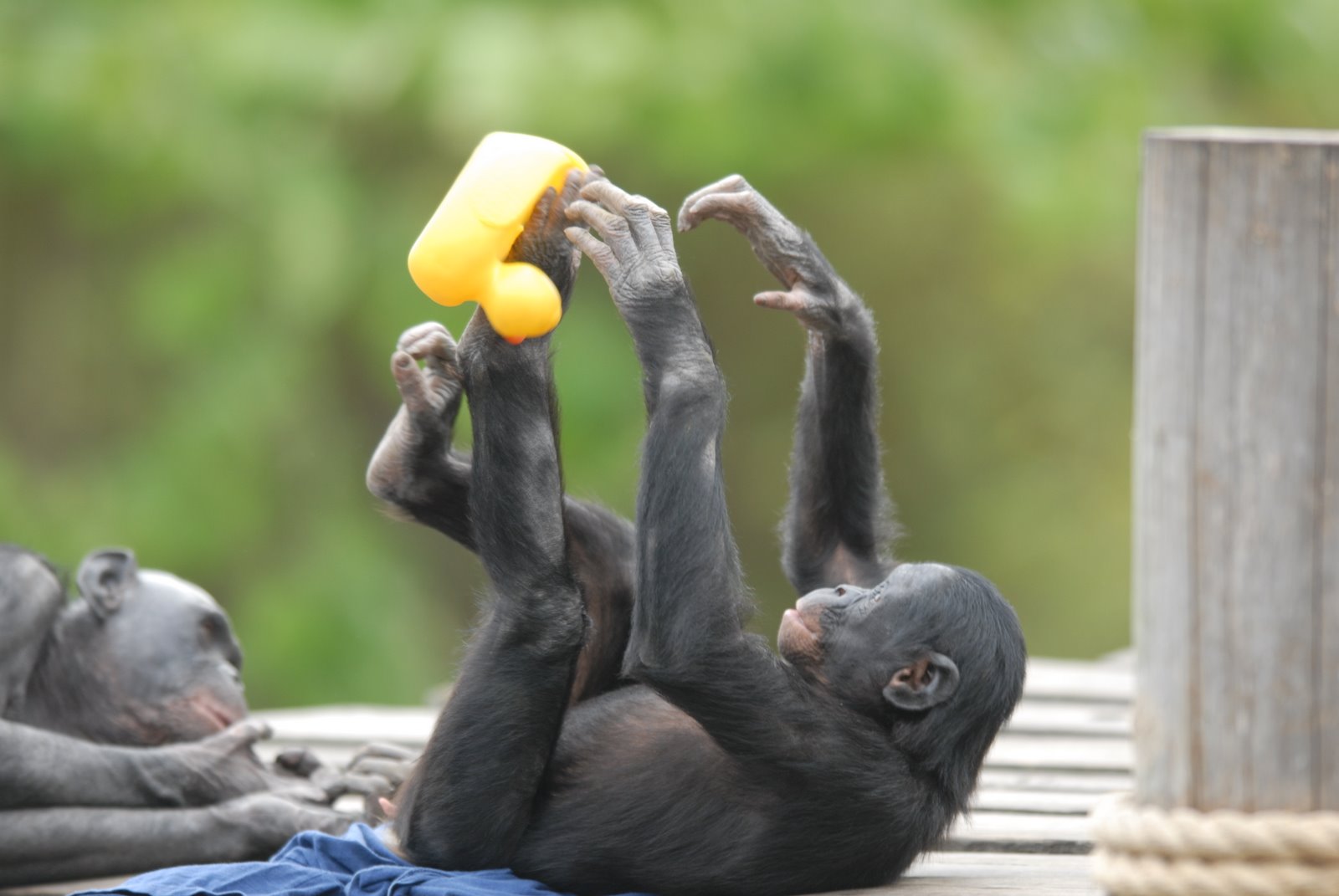
Lucy Bonobo Nursing Mom
In the past, captive bonobo babies were taken from their mothers to be raised by humans, partly because the females, no longer lactating, would become pregnant again, and partly to attract visitors. "Pulling" infants, with the exception of legitimate medical reasons, is no longer allowed by the American Zoo and Aquarium Association (AZA) bonobo Species Survival Plan (SSP).
Photo by M. Brickner
Saturday, May 2, 2009
Wednesday, April 29, 2009
Trappping Rats Around a Village
The focus of the search for the wild animal reservoir of monkeypox was on rodents that lived around the villages and in the nearby agricultural fields. Mungbau, the chauffeur, is seen with the live traps that we loaned out to the village youth to set in the surrounding area. They were given in batches of ten to fifteen traps per trapper.Mungbau, (with the supervision of the team's pet genet), is checking each trap to make sure that they are in order before they are handed out. The traps were numbered to help track them. The local hunters were easy to train, and we paid them for their knowledge of the forest and the wildlife via the catch they brought in each day.
The villagers used their own bait and knew how to mount traps high up in trees, along waterways, around trails, and in brush piles. They had a much higher catch than we could have realized if we had done the work ourselves. The rats were identified, euthanized, and processed for their organs and blood for identification of monkeypox virus and antibodies.
Photo by D. Messinger
Monday, April 27, 2009
Water Conservation in the Savanna
While a Peace Corps volunteer in Zaire, now the Democratic Republic of the Congo, I had the opportunity to travel widely. I learned to appreciate the geographical, political, and cultural contrasts in that huge nation, the third largest on the African continent.Although the Congo is known for rainforest in the center "basin," the north, east, and, especially south, has large stretches of scrub land and savanna, where water is scarce. In such a landscape the villages are few and far between. Here, the people are linked to the nearest permanent water, which might be a sweaty, hot, one-hour trek. In these places, bathing and washing clothes was done at the "source" while drinking and cooking water had to be hauled back to the huts. Water was transported in pots, pails, pans, and gourds, carried on women's (and girl's) heads. .
Water was so precious that I once stopped to take a picture of an ingenious method used for a thatched roof in the southern Bandundu region of the Congo. The thirsty people had fashioned a sort of gutter with split giant bamboo. A leaf spout connected it to a gourd. One also notices the use of bamboo and grass instead of the wood and clay from the wet regions to the north.
Photo by D. Messinger
Subscribe to:
Posts (Atom)