Search This Blog

Wednesday, May 13, 2009

An Abandoned Village

This village, photographed in the vicinity of Djolu, Zaire (now the Democratic Republic of the Congo) was at the edge of the secondary forest on a tertiary road. As explained, the entire village had been abandoned when the chief had died -- the people had picked up all of their belongings and moved to a new site. It was said that a village might also move when the local resources had been exhausted as the result of too much human pressure on the fragile ecosystem.

That is one of the reasons that the maps I saw were so inaccurate. Villages named no longer existed as depicted, or they had moved to another place, and were the same name, or the name had been changed to "big such-and-such" or "new such-and-such." A perfect case of recycling, the left behind houses decayed and melted back into the earth, and eventually the land was engulfed again by forest.

Photo by D. Messinger

Monday, May 11, 2009

Otter in the Tube!


These three giant otters are enjoying taking turns in a carpet tube given as "enrichment." They are brothers, of two different litters, born at the Philadelphia Zoo, and placed on loan to the Jacksonville Zoo and Gardens. After these photographs were taken, one of the siblings was transferred to the Dallas World Aquarium, to be paired with a female for breeding.

Giant otters love tight spaces, the more cramped the better. When I visited the Philadelphia Zoo in 2007, the staff showed off a small wooden box, about two feet on each side. They said that it was amazing that all of their giant otters -- parents, and cubs from both litters -- would crowd into the den to sleep.

Photos by M. Beshel

Saturday, May 9, 2009

Lucy Bonobo Agile on Roof


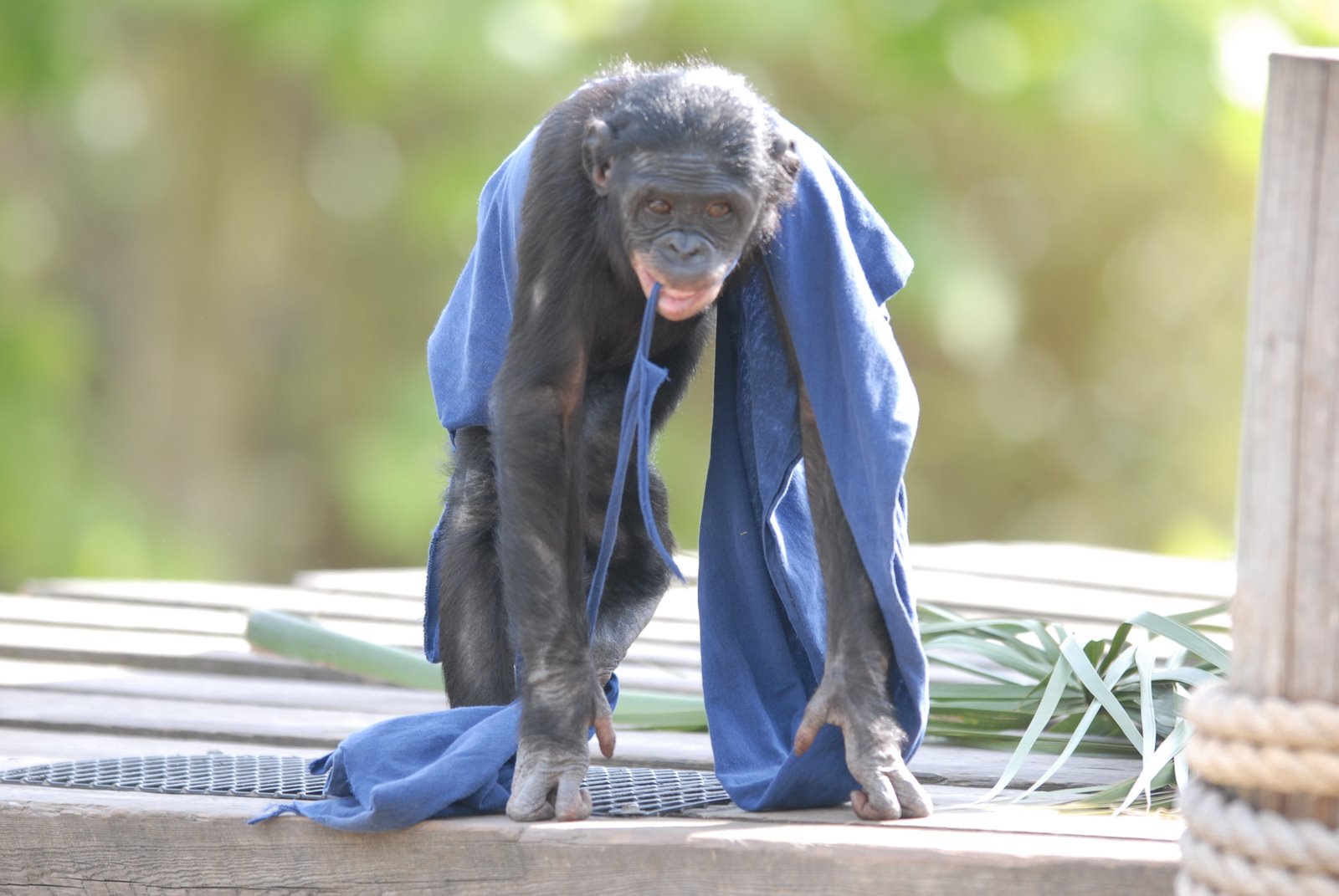
Lucy, a young bonobo at the Jacksonville Zoo and Gardens carefully descends the rooftop at the highest point of the resting platform and shade structure on exhibit. Bonobos are extremely agile and they do not appear to fear heights.
Photo by M. Brickner

Wednesday, May 6, 2009

Dancing with Bats


I always like the top photo, because it looks like I am doing some kind of barefoot water ballet. Instead, Moseli, a nurse, and I were mist-netting for bats. I was a volunteer in the Peace Corps, on loan to the World Health Organization (WHO). We were trying to determine the wild animal reservoir for the virus that caused monkeypox in Zaire (now the Democratic Republic of the Congo).

The mist net was so fine, that it was nearly invisible to the eye, and was typically strung across streams, which were used by many species of bats as highways (as opposed to dense forests, where there were many impediments to flights). A mist net could be bunched up into the size of a fist, and it was easily torn by the captured bats, which we extricated with care.

The bottom photo is Moseli holding a male hammer-headed bat, the largest bat in Africa. The males, weighing up to one pound, are twice the size of the females. They are sexually dimorphic, with males having large square heads, and a huge larynx that extends into the thorax, displacing the lungs and heart. The voice box is used to produce the loud calls to attract females.

Hammer-headed bats meet at "leks," or mating arenas, for copulation. The males gather first, in small groups, where they spread out and establish their territory. They call loudly, with honking, croaking squawks. The females follow the sounds that can be heard from a great distance and come to the lek to select their mate.

Lekking (from Swedish "to play") is a promiscuous mating system that is either classical, where visual cues are used, like the tail display of peafowl or exploded, where the attractant is vocal, such as that of the hammer-headed bat.

Monday, May 4, 2009

Lucy Bonobo Nursing Mom

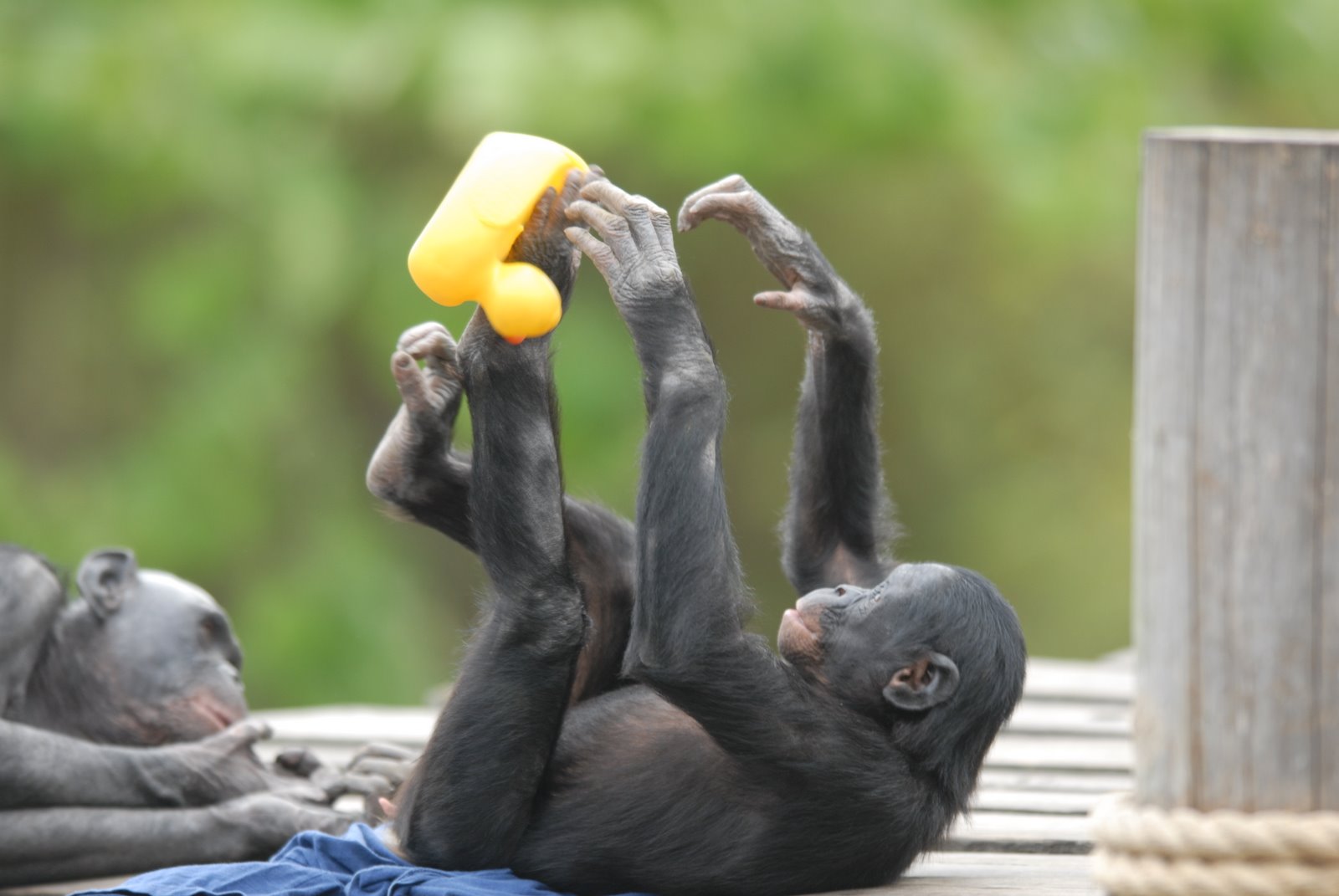
Lucy, a five-year old bonobo at the Jacksonville Zoo and Gardens is still nursing her mother, Lorel. Although it seems like a long time for weaning, five years is not unusual for this highly social, highly intelligent ape. A lengthy dependency on mother insures enough time to learn bonobo skills, but it also means that each female can only give birth to a small number of offspring (nursing inhibits pregnancy) in the wild.

In the past, captive bonobo babies were taken from their mothers to be raised by humans, partly because the females, no longer lactating, would become pregnant again, and partly to attract visitors. "Pulling" infants, with the exception of legitimate medical reasons, is no longer allowed by the American Zoo and Aquarium Association (AZA) bonobo Species Survival Plan (SSP).

Photo by M. Brickner

Saturday, May 2, 2009

Lucy Tight-Walking Rope


Lucy, a young bonobo at the Jacksonville Zoo and Gardens, shows off her astonishing sense of balance in this series of photographs. Not only does she agilely balance her way up a rope, but she does it with a ball in her left hand!

Photos by M. Brickner