Search This Blog

Saturday, June 6, 2009

Birds Appreciate Enrichment

These images are highlights of the monthly special enrichment day at the Jacksonville Zoo and Gardens, and provides insights into normal animal behavior. These birds -- a hadada ibis and a harpy eagle -- naturally manipulate the "toys" provided as they would manipulate items in the wild.

The hadada ibis is a widespread African species that feeds by tweezers-like probing in soil with its long, sensitive bill. When the bill touches a prey item, there is a rapid, almost instantaneous "bill snap." If the prey is small, the ibis may do a head toss, flipping it in the air, then neatly catching it. Or, it drops it, while simultaneously moving the head forward, so that the food item ends up in the mouth.

If, however, the hadada ibis finds something too big to handle easily, it uses the bill like a tool. It will hammer, shake, rip, and otherwise dismember the prey so it can be swallowed in pieces. Our hadada in the photo uses its bill to pull the cheerios off of the sting, to eat them one by one.

The harpy eagle weighs up to twenty pounds, one of the largest raptors in the world. Harpies live in deep forests in central and South America and they hunt by perching quietly and waiting for monkeys, sloths, birds, iguanas, or large rodents to pass by. They then ambush the prey in a swift, surprise flight. The bird's talons are up to five inches long and extremely powerful.

The harpy in the image above is excited when given a new item to play with, such as the pinata football. He will use his talons to grab and crush the cardboard, just as he would kill a prey item in the wild.

Photos by D. Bear-Hull

Wednesday, June 3, 2009

Bonobo Meals in Kinshasa

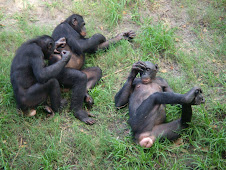
The bonobos in Kinshasa, Zaire (now the Democratic Republic of the Congo) received, to the best of our ability, a nutritious diet. We used ovens normally used to sterilize laboratory glassware to bake a bread that was made from wheat flour mixed with powdered milk and a vitamin/mineral "premix." We also added a small amount of blood or meat meal.

The "bread" was the concentrate base that provided protein and essential vitamins and minerals for optimal health and growth for the young bonobos. Small amounts of calorie dense, starchy, or high protein foods such as eggs, peanuts, manioc, corn, cooked rice, squash, and pumpkin were also eaten. The bonobos were given imported whole grains, raisins, cereals, and bird seed that was blended together. This was called the "scatter mix" because it was spread out on the ground for the animals to pick through, as an occupational activity.

The bulk of the diet consisted of locally available fruits and leafy greens. These included papaya, oranges, bananas, sugar cane, pineapple, spinach, hibiscus leaves, amaranth leaves and a wide variety of other indigenous fruits, greens, and vegetables. The goal of of the diet was to provide 25 different foodstuffs per day. The diverse array of local products made this a reasonable goal, but one that varied in composition tremendously throughout the seasons.

Imported foods, such as apples, were too expensive to feed the bonobos. Other foods such as carrots, lettuce, cucumbers, eggplant, tomatoes, and watermelon were grown for sale to expatriates, but they were largely too costly for animal food.

The dishes above are being prepared, to be stored in a refrigerator until use. The plates represented the three "squares" given per day to each animal. They were topped off with the more bulky greens that were given at odd intervals. The bonobos were fed five or six times per day.

Photo by D. Messinger

Monday, June 1, 2009

Manatee and Calf Return to the Wild

The Jacksonville Zoo and Gardens has a very successful, very active volunteer team of employees who help officials with stranded, injured, or otherwise compromised marine mammals in northeast Florida. In this case, a mother and calf were found cold stressed, this past February, near an outfall of a water plant (the water here is a degree or two warmer than the surrounding river. Manatees have an uncanny ability to find these spots -- but they quickly become death traps, because they cannot endure the winter temperatures for long and there is little food for them).

The Zoo team helped to rescue the pair and transport them to Sea World in Orlando, where they were successfully rehabilitated. Finally, four and a half months later, on the 28 of May, the two animals were returned to the area, to be released back to the wild not far from where they had been originally found. In the photo, the calf is carried in a sling to the edge of Julington Creek.

State officials, Sea World biologists, and four members of the Jacksonville Zoo and Gardens team all shared in the exhilaration of having made a difference for wild animals. As reported by J. Fleming, a keeper and team member:

"A quick plan of action was shared by the Sea World leader and we quickly got to work, The calf weighed ~ 400 pounds, while the cow weighed over 1,500 lbs, (she's huge)! After unloading them onto the boat ramp and into the shallows, the cow, named Bella, swam off followed shortly thereafter by the calf, Edward. We saw them surface for air as they swam away in a western direction. It was an awesome experience and a privilege to a part of a positive outcome."

Photo by: H. Zirhut

Saturday, May 30, 2009

It Takes a Village to Save a Species


Dr. Jo Thompson, PhD, studies bonobos in the Democratic Republic of the Congo. She involves the local people in grassroots decisions about protecting the bonobo, and she provides benefits like employment and community improvement. The photos show Thompson with her workers and the park guards that she supports. From a recent email, Jo writes about how she works at obtaining consensus from the villagers.

"For now we continue to support the work of ICCN in the Anga Secteur of Parc National de la Salonga, strengthen our relationship with the Iyaelima people living exclusively inside the national park, continue lobbying and monitoring across the whole of the Lukuru zone of influence and maintain our focused energies around the Bososandja forest block. In addition, we meet annually with the greater population of the region; a formal reunion with the local population, representatives of all clans, traditional chiefs, and authorities.

"This typically involves a three-day commitment of exchange. We update the communities on the activities of the Lukuru Project, discuss their ideas about our role, and exchange assurances. The population reports on their conservation activities and challenges. So for example, last year we discussed the problem of poachers around Yasa for commercial bushmeat trade.

"The annual meetings involve a lot of back-and-forth, emotion and shared humor. Over the course of the days of meeting, the population sequesters themselves periodically to talk amongst themselves and then come back to me formally with thoughts. Often their requests are either out of the purview of the Lukuru Project or unrealistic. But, we always strive to have a common outcome.

"Some of the current obligations made on behalf of the Lukuru Project are:

1) I have agreed to bring an engineer to Yasa to evaluate the suitability for sinking a tube well.

2) I have agreed to research the process of making soap. There will be further discussion about this based on what I learn.

3) The population has requested that the Lukuru Project have a professional garde formation. I have agreed to recruit addition personnel for the Bososandja. This will entail formal training and equipping.

4) The population wants assistance to build houses to help host guests in the future.

5) I have agreed to provide tin roofing for the school and help develop the curriculum. They requested that I build a house for the Lukuru Project in the village."

Photos by R. Ross

Wednesday, May 27, 2009

Meta, the Crocodile Girl

Meta, Fille de Croco, was the first "conservation tale" told in Bleu/Blanc. This story, told as a cartoon, was in a series, with each episode ending in a cliffhanger that built interest in reading the upcoming issue.

The story is somewhat familiar: Meta, an orphan, was overworked and mistreated by her aunt. She lost a plate while washing dishes at the river, and was told to not come home until she found it. Despondent, the girl ended up searching for the plate on the savanna, where she had adventures with helpful crocodiles, elephants, and zebras. The story ends well, with Meta finding plates to take back to the village.

The artwork and story of Meta was a cut above anything locally available, and that translated to a large readership for Bleu/Blanc. It was estimated that every magazine was shared with friends, family, and neighbors, with at least ten readers per issue.

Monday, May 25, 2009

Lowry Park Zoo Manatee video


The Lowry Park Zoo is one of the places were injured, incapacitated, or infant manatees are transported to be rehabilitated. Some of the animals are returned to the wild at the same site that they were taken, and fitted with tracking devices to monitor their progress. Other manatees have such debilitating wounds that they must remain in captivity, so they are placed on permanent exhibit loan to any one of several institutions that can hold them.

A large network of collaborating specialists participate in the surveillance, research, rescue, transport, rehabilitation, and finally, release or long-term care of these slow moving mammals. Those animals on exhibit in zoos serve as educational messages about how human interaction is harmful to manatees (the most common natural hazard is red tide).

Mankind is responsible for the outflow of warmed water from industry or water treatment plants that can prevent normal migration for winter, causing cold stress and death. Manatees can get caught in or ingest fishing equipment. By far, the most dangerous thing for manatees are boats. White propeller scars on the back of animals or missing parts of flippers and tails attest to the cruel reality of "boat strike" injuries.

The video shows one, then two more manatees feeding on romaine lettuce, and then the same animals from above, in the public area of Lowry Park Zoo. The propeller scars are clearly seen. At the Zoo, severely compromised animals in rehabilitation are kept in "medical" tanks off exhibit.

Video by: D. Messinger