Search This Blog

Saturday, May 30, 2009

It Takes a Village to Save a Species


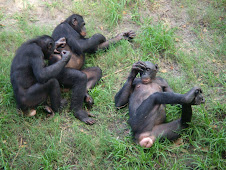
Dr. Jo Thompson, PhD, studies bonobos in the Democratic Republic of the Congo. She involves the local people in grassroots decisions about protecting the bonobo, and she provides benefits like employment and community improvement. The photos show Thompson with her workers and the park guards that she supports. From a recent email, Jo writes about how she works at obtaining consensus from the villagers.

"For now we continue to support the work of ICCN in the Anga Secteur of Parc National de la Salonga, strengthen our relationship with the Iyaelima people living exclusively inside the national park, continue lobbying and monitoring across the whole of the Lukuru zone of influence and maintain our focused energies around the Bososandja forest block. In addition, we meet annually with the greater population of the region; a formal reunion with the local population, representatives of all clans, traditional chiefs, and authorities.

"This typically involves a three-day commitment of exchange. We update the communities on the activities of the Lukuru Project, discuss their ideas about our role, and exchange assurances. The population reports on their conservation activities and challenges. So for example, last year we discussed the problem of poachers around Yasa for commercial bushmeat trade.

"The annual meetings involve a lot of back-and-forth, emotion and shared humor. Over the course of the days of meeting, the population sequesters themselves periodically to talk amongst themselves and then come back to me formally with thoughts. Often their requests are either out of the purview of the Lukuru Project or unrealistic. But, we always strive to have a common outcome.

"Some of the current obligations made on behalf of the Lukuru Project are:

1) I have agreed to bring an engineer to Yasa to evaluate the suitability for sinking a tube well.

2) I have agreed to research the process of making soap. There will be further discussion about this based on what I learn.

3) The population has requested that the Lukuru Project have a professional garde formation. I have agreed to recruit addition personnel for the Bososandja. This will entail formal training and equipping.

4) The population wants assistance to build houses to help host guests in the future.

5) I have agreed to provide tin roofing for the school and help develop the curriculum. They requested that I build a house for the Lukuru Project in the village."

Photos by R. Ross

Wednesday, May 27, 2009

Meta, the Crocodile Girl

Meta, Fille de Croco, was the first "conservation tale" told in Bleu/Blanc. This story, told as a cartoon, was in a series, with each episode ending in a cliffhanger that built interest in reading the upcoming issue.

The story is somewhat familiar: Meta, an orphan, was overworked and mistreated by her aunt. She lost a plate while washing dishes at the river, and was told to not come home until she found it. Despondent, the girl ended up searching for the plate on the savanna, where she had adventures with helpful crocodiles, elephants, and zebras. The story ends well, with Meta finding plates to take back to the village.

The artwork and story of Meta was a cut above anything locally available, and that translated to a large readership for Bleu/Blanc. It was estimated that every magazine was shared with friends, family, and neighbors, with at least ten readers per issue.

Monday, May 25, 2009

Lowry Park Zoo Manatee video


The Lowry Park Zoo is one of the places were injured, incapacitated, or infant manatees are transported to be rehabilitated. Some of the animals are returned to the wild at the same site that they were taken, and fitted with tracking devices to monitor their progress. Other manatees have such debilitating wounds that they must remain in captivity, so they are placed on permanent exhibit loan to any one of several institutions that can hold them.

A large network of collaborating specialists participate in the surveillance, research, rescue, transport, rehabilitation, and finally, release or long-term care of these slow moving mammals. Those animals on exhibit in zoos serve as educational messages about how human interaction is harmful to manatees (the most common natural hazard is red tide).

Mankind is responsible for the outflow of warmed water from industry or water treatment plants that can prevent normal migration for winter, causing cold stress and death. Manatees can get caught in or ingest fishing equipment. By far, the most dangerous thing for manatees are boats. White propeller scars on the back of animals or missing parts of flippers and tails attest to the cruel reality of "boat strike" injuries.

The video shows one, then two more manatees feeding on romaine lettuce, and then the same animals from above, in the public area of Lowry Park Zoo. The propeller scars are clearly seen. At the Zoo, severely compromised animals in rehabilitation are kept in "medical" tanks off exhibit.

Video by: D. Messinger

Sunday, May 24, 2009

Columbus Zoo Conservation Report


To meet American Zoo and Aquarium Association (AZA) standards, member institutions must include conservation as a key element in their mission statement. Some facilities now produce annual conservation reports that show how the institution is helping conserve wild populations.

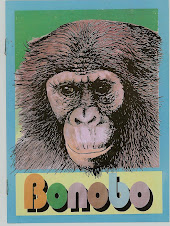
The above is an annual conservation report from the Columbus Zoo, a leader in in situ (range country) conservation. The beautifully illustrated booklet features the bonobo. AZA zoos and aquariums are supporting sustainable biodiversity and are sharing their stories with members and visitors.

To learn more about Lola ya Bonobo, see
http://www.friendsofbonobos.org/index.htm

Thursday, May 21, 2009

Florida Panther in a Tree


White Oak Conservation Center, in north-east Florida, is a first-class research and breeding facility devoted to wildlife and habitat preservation. Located on 7,400 acres, with 600 acres developed for animals, the Center is an American Zoo and Aquarium (AZA) related facility with projects around the world, as well as locally.

White Oak is the only place in the country where injured or sick Florida panthers are nursed back to health and then rehabilitated back to the wild, in collaboration with the US Fish and Wildlife Service. This endangered cat, high up in a tree, is seen in a 17 acre fenced pen. From this pen, a dozen total have been radio-collared and returned to the location of their capture. The hard stare of the cat belies its precarious position in only 5% of the original home range, in South Florida, where there is little suitable habitat left.

This species is not without controversy, because its status as a "subspecies" is not clear. Some scientists claim that all of the North American panthers (cougar, mountain lion, catamount, puma are synonyms) should be lumped into one species. At an estimated population of only 80 to 100 animals, the probable inbreeding has been mitigated by the infusion of Texas cougar genes. Consequences of inbreeding in the Florida panther has been cardiac disease and low sperm counts in males.

For more information about the White Oak Conservation Center, visit
http://www.wocenter.org/index.asp?id=wocc/animals.asp

Photos by: D. Loeb

Wednesday, May 20, 2009

Truck Stuck


Traveling the "bush" for six months, stopping in remote villages to conduct research on monkeypox, meant that one needed to carry all needed supplies and equipment, including a portable short-wave radio to keep in touch with the World Health Office in the capital. Negotiating impassible roads in the center of Zaire (now the Democratic Republic of the Congo) meant that the equipment included metal skids, shovels, an electric wench, and a chainsaw for situations.

The top photograph shows the Toyota high-centering in a sandy road in Bandundu. Digging, putting grass, skids, or other traction under the wheels or using the "come-along" were all options. Often, when the ruts were very deep, the best tactic was to strike out across the virgin savanna on a parallel track. The unbroken grass provided good traction for a new road, but, over time, the ruts would get deeper and more eroded, until that, too, was abandoned for another path. In some places, there would be a dozen side-by-side roads, wandering and twisting through the savanna, in various stages of wear. It was a challenge to chose the best road.

The middle picture shows where we fell through a small bridge over a stream. Here, it was impossible to extricate ourselves, so after a few hours, we managed to signal our distress to a village, a few miles distant. The villagers were all to happy to enjoy the excitement of a passing vehicle, busted through a rotten spot on their bridge. Joking and laughing at their fortune, they picked up the truck's rear end and placed it back on better timbers.

Where was I? I was knee deep in the water, cooling off, taking pictures, and laughing at the absurdity of it all. I suspected that the villagers may had actually set up the bridge as a truck trap. There were so few vehicles passing in this area -- only a couple a month -- that perhaps this was the local taxation. Being Zaire, it was not out of bounds for Zairians to go to extraordinary lengths for a few dollars.

The last image is of the "one that didn't make it." Mungbau, the driver had to stop and get his picture taken by the upside down cab and trailer of what must have been a horrific accident. Usually, the metal from abandoned trucks was pulled off and recycled, but this area was too remote for such piracy.

Photos by: D. Messinger