skip to main |
skip to sidebar
 The children's magazine, Bleu/Blanc (for the blue and white uniform of students) was designed to create a thirst for reading, through stories, puzzles, cartoons, and quizzes. Natural history subjects on the local fauna and flora were mixed in with topics that were sought after by the readers, like relationships between boys and girls, scholastics, and health.
In the Congolese culture, animals were not valued, so even this special "bonobo" issue had other subjects to intice readers. We had to slip in the animal stories in small doses.
 This postcard illustrates a key mission of modern zoos -- to connect the zoogoer to animals in an impactful way. The use of glass enables the public to get very close to wild animals that they will never be able to appreciate in any other way. In the wild, an encounter such at this would be highly dangerous, yet in a zoo, it is a safe "thrill."
Creating a connection to wildlife is a powerful tool for today's zoo. If a zoo links its animal collection to conservation projects in range countries, it comes full circle with an environmental message. The visitor can springboard from emotion (awe, admiration, respect) to actions (sustainable biodiversity). Actions do not have to be dramatic: "green" locally focused behaviors are a first positive step.


 You can't put a hog in a zoo--
There's no telling what he will do.
He may get loud
And charge at the crowd
Or just lie there not looking at you.
Roy Blount, Jr
The Jacksonville Zoo and Gardens has two female warthogs; a three year old female and an eleven year old female, who lost her companion last year. Warthogs are one of my favorite animals, because of their endearing "pigness." I used to raise pigs and enjoy watching the Zoo's warthogs acting like swine every time I visit them.
Pigs have a startle reaction to unusual situations, and they avoid confrontation by fleeing. The first reaction of a warthogs, also, is to try to escape by running away. They run with their tails stiffly raised, like a flag. The younger female is athletic and she sometimes shows off her racing form as she laps the exhibit early in the morning.
The pig family is social, and like all social species, there is always a hierarchy. The two "communicate" their differences head to head, through a series of squeals, grunts, low chattering, and high-pitched groans. They push each other fiercely, as if to test the other's ground hugging frame. The elder places her head high upon the younger's forehead, as if to say, "I'm the top hog here!"
But, after some jousting, the two make their peace, and settle down to the business of the day -- sleeping, plowing up the dirt in the yard, and waiting for the keeper to distribute a treat or two, which comes at odd times, and is pretty much hog heaven.
Photos by J. Reed


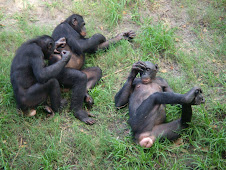
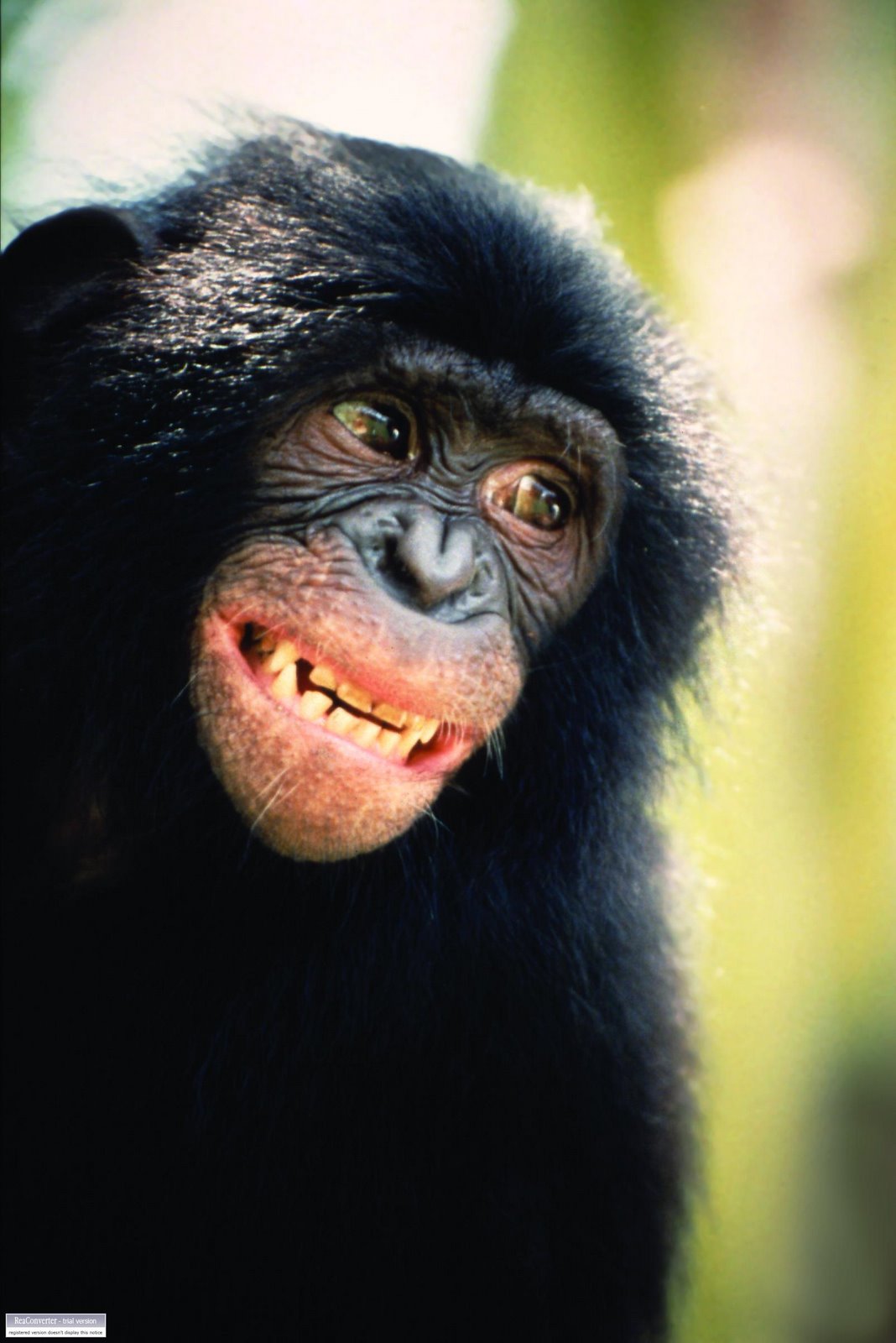
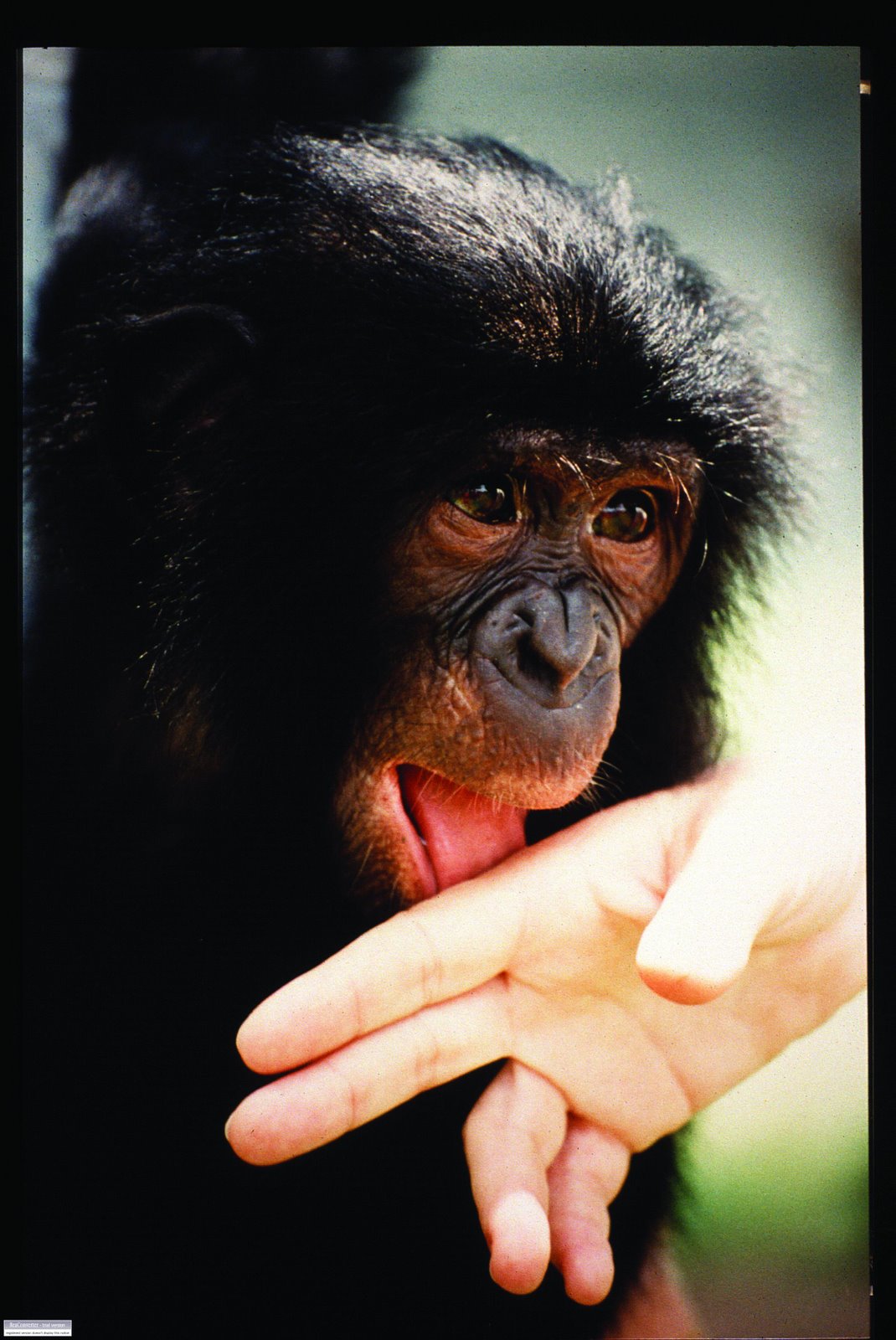
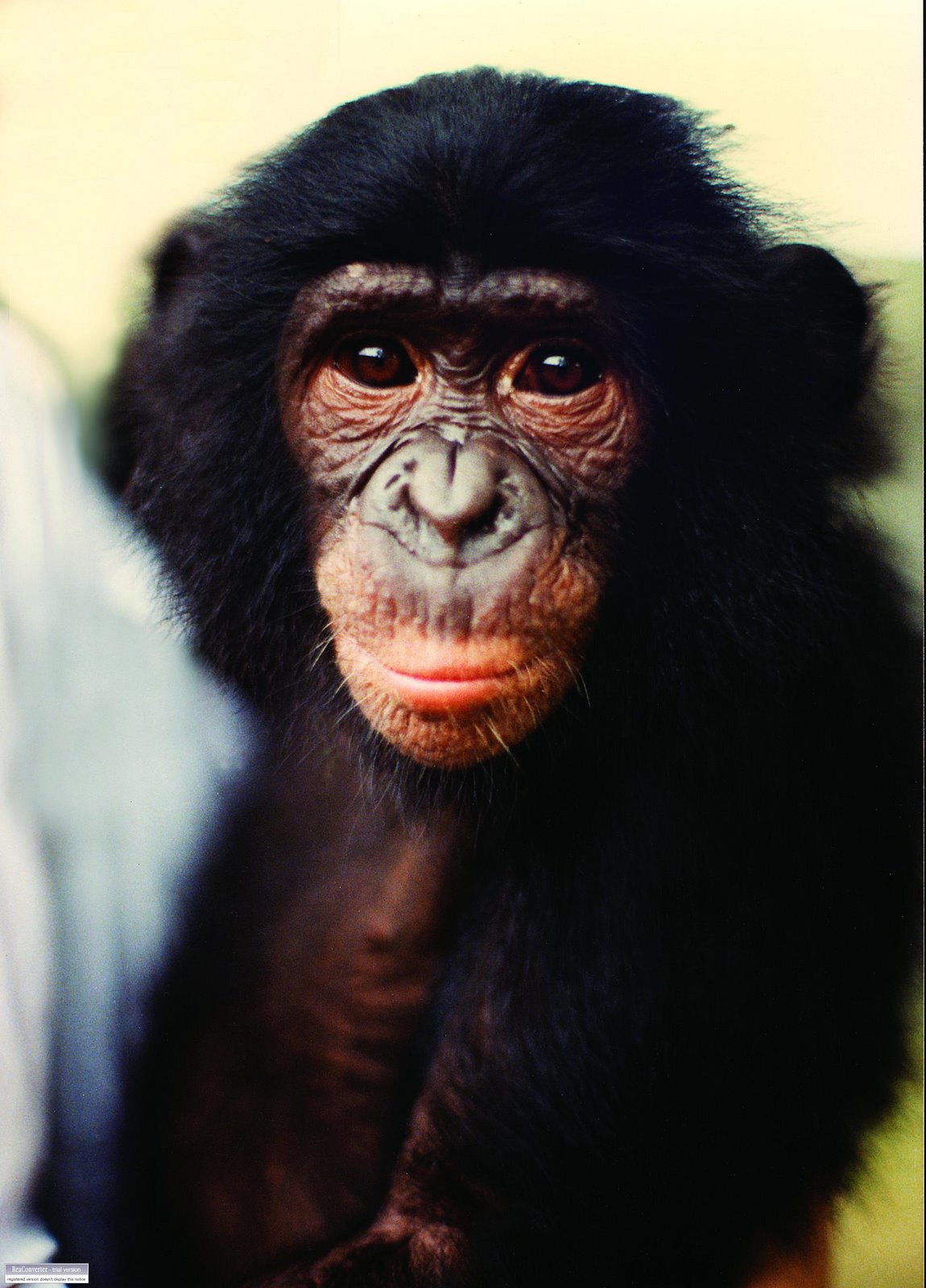
 These images are of wild bonobos that are being studied by Dr. Jo Thompson, Director of the Lukuru Wildlife Research Project. The first is a young male with his mother. Males stay with their mothers their entire lives, and their rank in the group is tied to her social status. A high ranking female will raise high ranking sons. (Daughters go "out into the world" when they reach puberty, and join another group).
The second photograph illustrates one of the saving fortunes for the bonobo. Because of its ability to walk upright for many strides, some local Congolese peoples will not kill or eat the bonobo. They tell stories about the closeness of humans to bonobos; that it is an "ancestor," saved the human ancestor, or was, once upon a time, a servant of man.
The last photograph shows two female bonobos in "G-G" rubbing, or "genito-genital" rubbing, one of many different positions and combinations of sex in the species. The species' frequent use of sexual relations (with or without penetration) serves to reduce tension whenever there is stress, such as competition over resources. In bonobo society, males and females, young and old, will pantomime sex as a greeting, as reassurance, or a "thank-you" in exchange for food.
In the bonobo world, females are dominant, and sisterly bonds will compel them to gang up on any male that would dare question their authority. This unique twist in the animal kingdom intrigues primatologists, sexual evolutionary scientists, and the rest of us.
Photos by R. Ross


 These awesome frogs are featured on a calender produced by the Amphibian project coordinated by several major international conservation groups and Zoos worldwide. Globally, amphibians are severely threatened by various threats including loss of habitat, pollution, climate change, and an infectious fungus called chytridiomycosis or "chytrid" (pronounced "kit-rid")
The first frog is a spiny-headed Treefrog, from cloud forests of central America. The male calls from pockets of water -- typically bromeliads or tree holes -- high up in the canopy. The female deposits her eggs just above the water line and when the tadpoles hatch, they wiggle free and drop into the water. The mother will return to the pool and lay unfertilized eggs, which her babies feed upon, and they become frogs in 60 days.
The second photograph is of an Ankafana Bright-eyed Frog from Madagascar. Lime-green, it blends with the foliage that it hides in during the day. The Bright-eyed frog is always found along streams in various habitats from degraded secondary to pristine primary forest. Luckily, this frog occurs in protected areas.
The last image is of the striking Australian Lace-lid Treefrog, with its unique eye camouflage, from North Queensland, Australia. It has disappeared from the uplands, but is still found at lower elevations, where it lives along fast-moving streams in the rainforest. The lace-lid was declared an endangered species in 1999, but the reason for its sharp decline is unknown.
Frogs are a diverse, beautiful group of animals that are important to ecosystems both for the prey (mostly insects) that they eat, and for being a food source for vertebrates. This represents a biological diversity crisis second only to the extinction of the dinosaurs.
Photos by B. Kubicki, P. Naskrecki, and J. Rowley
 CONNECT is the monthly magazine of the American Association of Zoos and Aquariums (AZA). In March, the giant otter was featured on the cover in an announcement about the species being displayed in a new exhibit at the Miami Metrozoo's Amazon & Beyond exhibit. Miami is only the fourth American facility to hold the charismatic giant otters, after the Philadelphia Zoo, the Dallas World Aquarium, and the Jacksonville Zoo and Gardens.
The $50 million dollar project, now finished after two years of construction, showcases jaguars, howler monkeys, hummingbirds, Orinoco crocodiles, harpy eagles, giant anteaters, and fruit bats on 27 acres, which is divided into three sections -- Cloud Forest, the Amazon Forest, and the Atlantic Forest.
 The children's magazine, Bleu/Blanc (for the blue and white uniform of students) was designed to create a thirst for reading, through stories, puzzles, cartoons, and quizzes. Natural history subjects on the local fauna and flora were mixed in with topics that were sought after by the readers, like relationships between boys and girls, scholastics, and health.