skip to main |
skip to sidebar

 I did a little of this and a little of that to make ends meet in Kinshasa, Zaire (now the Democratic of the Congo). The top image, a pen and ink drawing for the Bleu/Blanc magazine, was for an article about the local flies and pet dogs. The canine grimaces in pain as the biting flies buzz around its bleeding ears. The text recommends a daytime shelter (because the flies avoid the dark) and consulting a vet for a repellent product.
The second image, taken from a pencil drawing, depicts the stripped hindquarters of the okapi, a giraffe for the Ituri region of the country. The okapi artwork was used for a school notebook that was distributed by the cellphone company called Telecel.
Art by D. Messinger
 The children's magazine received thousands of pieces of mail from readers, who answered the quiz questions, told us about themselves, and even mentioned how much they appreciated Bleu/Blanc.
The above was an opinion to a question on bonobo conservation. After many years, my French is rusty, but I translate the formal, stiff French of a student as the following:
"Yes, bonobos are really in danger of extermination. For my part, to furnish you with what I think, one must analyse what is the cause of their extermination. First, there is the deforestation: yes, as trees play an important role for man, and serves for many uses, notably in the timber industries, etc.... By consequence, we must also hold that if the habitual deforestation continues, there will be enormous consequences for the nature, for the environment, and certainly on the fauna. Thus the people there (the deforesters) must understand the consequences and try to assure the protection of the life of our chimpanzees (bonobos).
"Secondly, the poaching: we must add to poaching; the stupidity and superstition. But when we look at poaching or the hunting of these animals, we must know that this is tied to various reasons, notably thought of as a way of life or a fashion of living. Why is this?
"The communities that live on the borders (of the Park) also called riverains (river people) are poor, and for the most part, they are hit by the unemployment and the lack of sufficient food , in brief, all of these country people are neglected. By the fact that they don't have anything to do, the poaching of these animals notably, the bonobos, have become their job, which is stupid and superstitious.
"This is why the government must take measures for these previous citations, for example, supply jobs equally to these thousands of country people, particularly the riverains. To kill the bonobo for the reason to acquire power from magic rituals, I find this absurd and insignificant. And also, one must have these people know that they themselves are destroying a good part of our fauna... our treasure. Thus, I solicit the intervention of the government as quick as possible, especially for the specific cases, to forbid them seriously in a manner that their (bonobo) protection and conservation will be assured."
What amazes me is that in spite of the wordiness of his letter (students use a flowery French), this student expresses his ideas on risks to bonobos, which includes the use of animal parts for "magic." Typically, bonobo bones (from kills) or fingers and toes (from living infants taken from mothers) were put in babies bath water to "make them strong." He recommends a strong hand of the government to provide jobs and protect the bonobo.
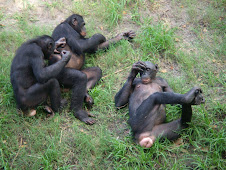
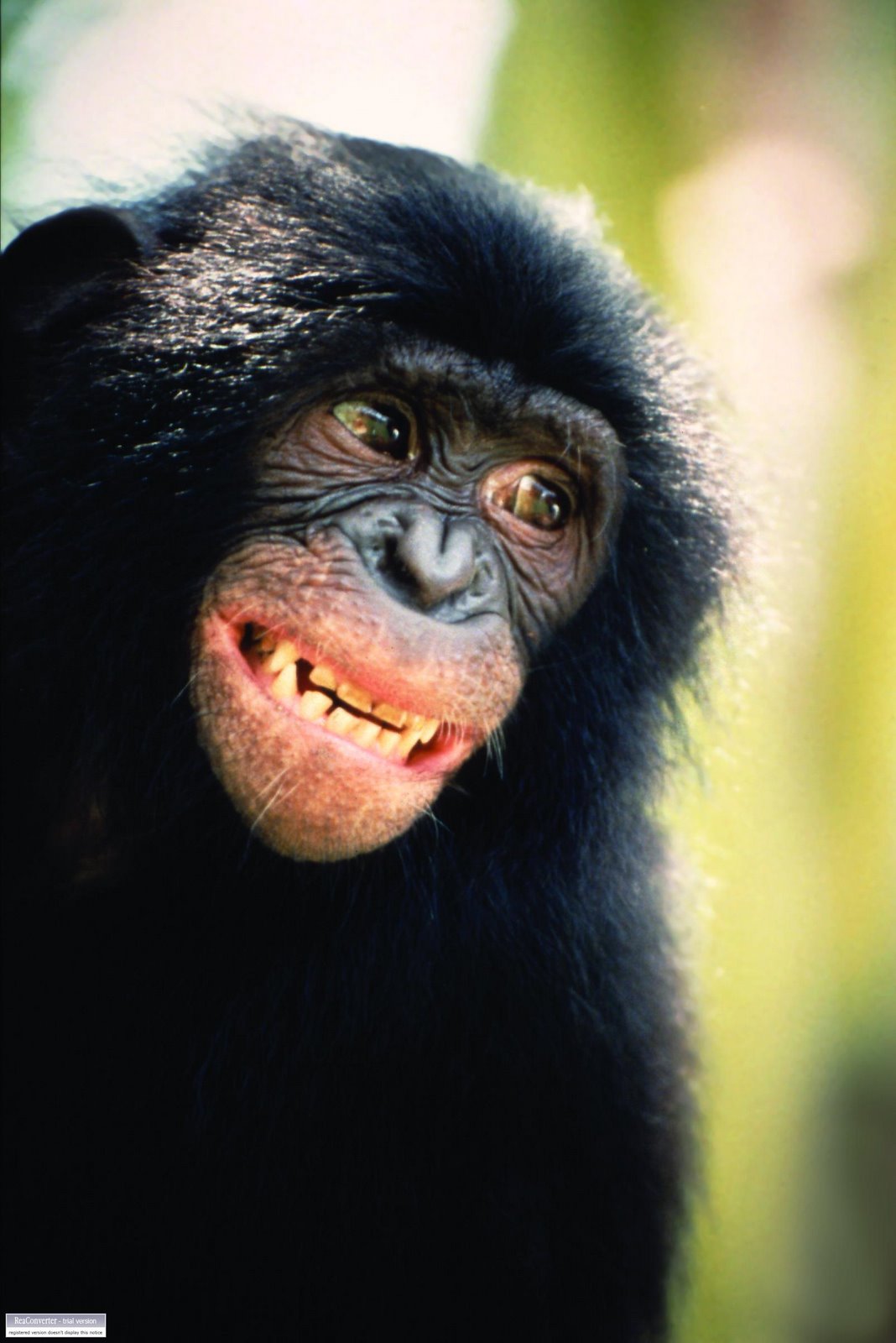
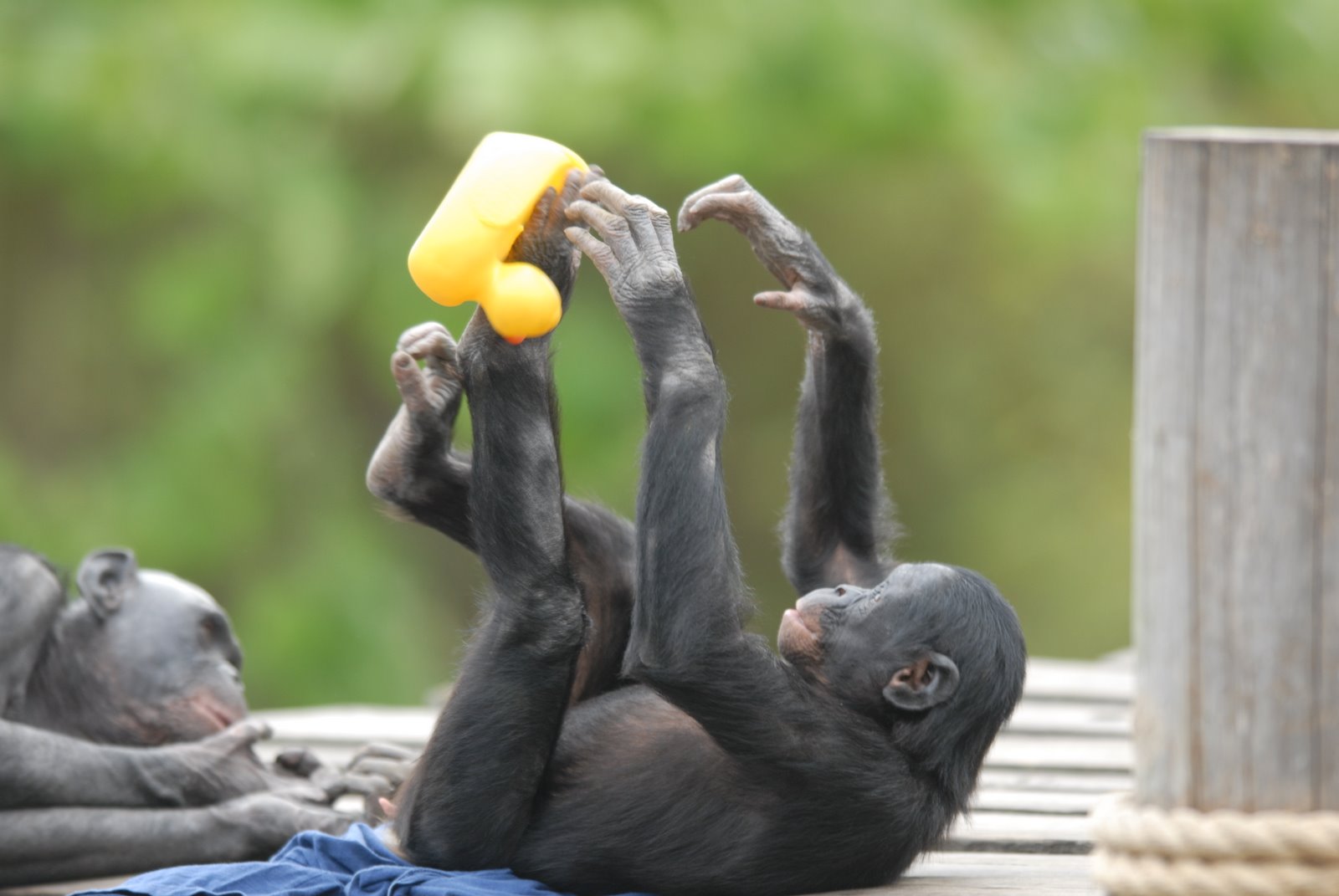
 Lucy, a young bonobo at the Jacksonville Zoo and Gardens uses her teeth to tear apart a hunk of wood on exhibit. The curious and inventive bonobos investigate and use "found" objects in their environment to exercise, explore, and play.
Photo by M. Brickner
 The children's magazine, Bleu/Blanc (for the blue and white uniform of students) was designed to create a thirst for reading, through stories, puzzles, cartoons, and quizzes. Natural history subjects on the local fauna and flora were mixed in with topics that were sought after by the readers, like relationships between boys and girls, scholastics, and health.
In the Congolese culture, animals were not valued, so even this special "bonobo" issue had other subjects to intice readers. We had to slip in the animal stories in small doses.
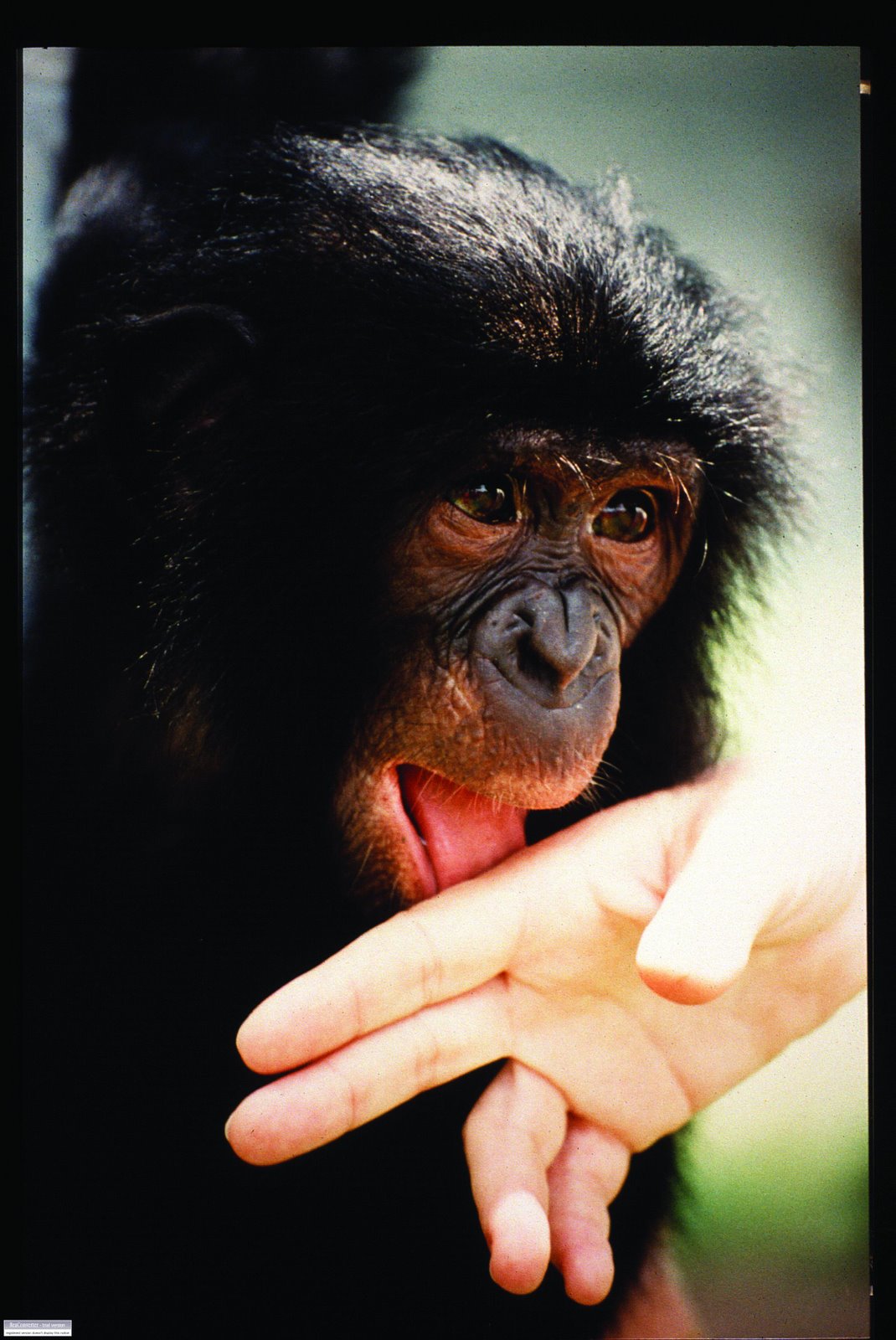
 This postcard illustrates a key mission of modern zoos -- to connect the zoogoer to animals in an impactful way. The use of glass enables the public to get very close to wild animals that they will never be able to appreciate in any other way. In the wild, an encounter such at this would be highly dangerous, yet in a zoo, it is a safe "thrill."
Creating a connection to wildlife is a powerful tool for today's zoo. If a zoo links its animal collection to conservation projects in range countries, it comes full circle with an environmental message. The visitor can springboard from emotion (awe, admiration, respect) to actions (sustainable biodiversity). Actions do not have to be dramatic: "green" locally focused behaviors are a first positive step.


 You can't put a hog in a zoo--
There's no telling what he will do.
He may get loud
And charge at the crowd
Or just lie there not looking at you.
Roy Blount, Jr
The Jacksonville Zoo and Gardens has two female warthogs; a three year old female and an eleven year old female, who lost her companion last year. Warthogs are one of my favorite animals, because of their endearing "pigness." I used to raise pigs and enjoy watching the Zoo's warthogs acting like swine every time I visit them.
Pigs have a startle reaction to unusual situations, and they avoid confrontation by fleeing. The first reaction of a warthogs, also, is to try to escape by running away. They run with their tails stiffly raised, like a flag. The younger female is athletic and she sometimes shows off her racing form as she laps the exhibit early in the morning.
The pig family is social, and like all social species, there is always a hierarchy. The two "communicate" their differences head to head, through a series of squeals, grunts, low chattering, and high-pitched groans. They push each other fiercely, as if to test the other's ground hugging frame. The elder places her head high upon the younger's forehead, as if to say, "I'm the top hog here!"
But, after some jousting, the two make their peace, and settle down to the business of the day -- sleeping, plowing up the dirt in the yard, and waiting for the keeper to distribute a treat or two, which comes at odd times, and is pretty much hog heaven.
Photos by J. Reed

 I did a little of this and a little of that to make ends meet in Kinshasa, Zaire (now the Democratic of the Congo). The top image, a pen and ink drawing for the Bleu/Blanc magazine, was for an article about the local flies and pet dogs. The canine grimaces in pain as the biting flies buzz around its bleeding ears. The text recommends a daytime shelter (because the flies avoid the dark) and consulting a vet for a repellent product.