Search This Blog

Showing posts with label Bonobo Captive Management. Show all posts

Wednesday, April 1, 2009

Hands on Bonobo "Exam"


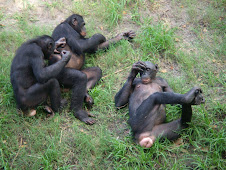
Cooperative participation in medical exams is a primary goal in modern captive ape management. Here, a keeper is focusing on a single bonobo at the Jacksonville Zoo and Gardens. A first "anti-distraction" technique is to train these highly social animals to separate from the group. Once animals understand the challenge of training, they often find it so engaging that they may squeal in delight in anticipation of a turn with the keeper.

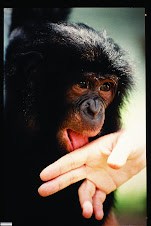
The photos show preparation for a cardiac, teeth, mouth, gums, and tongue check. The Zoo's two veterinarians stop in frequently to familiarize the animals with their presence, which is something that is needed for "house calls" from a doctor, with the backup training by the keeper.

Photos by M. Brickner

Tuesday, September 30, 2008

Bonobo Ear Check

Lorel, a bonobo at the Jacksonville Zoo and Gardens gets her ears checked by a zookeeper, while her daughter Lucy looks on. Lorel and Lucy have complete trust in the procedure, which is part of a body check that the keepers do to keep the animals healthy. As part of the protocol for close contact, the staff wears gloves and masks.

Photo by M. Brickner

Sunday, August 17, 2008

Play Pigs for Bonobos

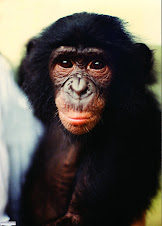
These bright orange, ear tasseled red river hogs from Zaire (now the Democratic Republic of the Congo) were allowed to go in with the young bonobos I cared for in Kinshasa. The pigs were not too crazy about the apes, probably because the bonobos liked to ride them like horses. The pigs were enrichment for the bonobos, but the practice was discontinued when the bonobos grew larger.

My observations on how well the bonobos interacted with red river hogs led to some facilities, like the Columbus Zoo, putting these two species successfully together in the same exhibit. However, unlike my scenario, the zoo pigs are physically separated from the bonobos by hot wire.

Photo by D. Messinger

Tuesday, August 12, 2008

A Bonobo Shot in the Arm

Kuni, a female bonobo at the Jacksonville Zoo and Gardens, gets a practice "shot" with a needle-less syringe. She is trained by her keepers to hold still and accept an injection, to reduce the stress of veterinary treatment. Previously, animals had to be darted with a remote injection dart which was psychologically traumatic for them (and stressful for staff as well!).

Today, the positive reinforcement training is accomplished in small desensitizing steps: first by showing the syringe, then by touching the arm with its blunt end, and then by snapping the skin with a rubber band to simulate the sting of the needle.

Only when the bonobo is comfortable that the "ouchie" is bearable and that there is a treat reward, will saline sometimes be injected. The keepers rarely inject the animals as practice, but can give the real injections as needed by keeping the training current with the practice steps.

The bonobos are extremely trusting of their caretakers, and the Jacksonville Zoo and Gardens keepers are trained to give injections, such as a tranquilizer that is needed before anesthesia for the annual physical done at the zoo hospital.

Photo by M. Brickner

Thursday, August 7, 2008

Brushing Bonobo Teeth

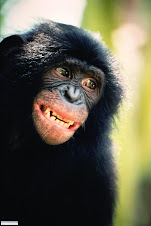
A bonobo keeper at the Jacksonville Zoo and Gardens provides oral hygiene to Lexi, a female bonobo. Lexi is a willing participant in her own care, due to a positive reinforcement training called operant conditioning. "Clicker," "target," or "whistle training" are other terms that may be familiar to those who use positive reinforcement in dog training.

Animal training at the zoo is not for tricks. Many of the behaviors sought are related to providing optimal stress-free veterinary care, such as examination of the mouth and brushing teeth. Sometimes behaviors sought are to facilitate management or safety goals (training animals to shift easily in and out through doors without crowding or aggression, training animals to separate from each other without anxiety).

Another benefit of training is that apes enjoy the challenge of learning. As one can see in Lexi's expression, learning is its own reward. To top it off, she gets treats, such as grapes, for a job well done!

Photo by M. Brickner

Thursday, July 10, 2008

Bonobos Enjoying Popsicles

Kaleb and his mother, Kuni, enjoy cool treats in the form of fresh fruit frozen into juice popsicles, at the Jacksonville Zoo and Gardens. They also have ice and other, non-edible enrichment toys such as cardboard boxes and plastic containers. Frozen goodies are provided outside on hot summer days, and indoors, in the night quarters where they sleep.

Photo by M. Brickner