Search This Blog

Showing posts with label Conservation Education in Zaire (DRC). Show all posts

Saturday, July 18, 2009

A Student's Letter about Bonobos

The children's magazine received thousands of pieces of mail from readers, who answered the quiz questions, told us about themselves, and even mentioned how much they appreciated Bleu/Blanc.

The above was an opinion to a question on bonobo conservation. After many years, my French is rusty, but I translate the formal, stiff French of a student as the following:

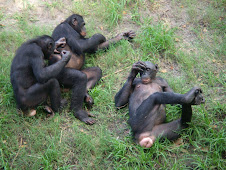
"Yes, bonobos are really in danger of extermination. For my part, to furnish you with what I think, one must analyse what is the cause of their extermination. First, there is the deforestation: yes, as trees play an important role for man, and serves for many uses, notably in the timber industries, etc.... By consequence, we must also hold that if the habitual deforestation continues, there will be enormous consequences for the nature, for the environment, and certainly on the fauna. Thus the people there (the deforesters) must understand the consequences and try to assure the protection of the life of our chimpanzees (bonobos).

"Secondly, the poaching: we must add to poaching; the stupidity and superstition. But when we look at poaching or the hunting of these animals, we must know that this is tied to various reasons, notably thought of as a way of life or a fashion of living. Why is this?

"The communities that live on the borders (of the Park) also called riverains (river people) are poor, and for the most part, they are hit by the unemployment and the lack of sufficient food , in brief, all of these country people are neglected. By the fact that they don't have anything to do, the poaching of these animals notably, the bonobos, have become their job, which is stupid and superstitious.

"This is why the government must take measures for these previous citations, for example, supply jobs equally to these thousands of country people, particularly the riverains. To kill the bonobo for the reason to acquire power from magic rituals, I find this absurd and insignificant. And also, one must have these people know that they themselves are destroying a good part of our fauna... our treasure. Thus, I solicit the intervention of the government as quick as possible, especially for the specific cases, to forbid them seriously in a manner that their (bonobo) protection and conservation will be assured."

What amazes me is that in spite of the wordiness of his letter (students use a flowery French), this student expresses his ideas on risks to bonobos, which includes the use of animal parts for "magic." Typically, bonobo bones (from kills) or fingers and toes (from living infants taken from mothers) were put in babies bath water to "make them strong." He recommends a strong hand of the government to provide jobs and protect the bonobo.

Tuesday, July 14, 2009

Special Edition Bonobo

The children's magazine, Bleu/Blanc (for the blue and white uniform of students) was designed to create a thirst for reading, through stories, puzzles, cartoons, and quizzes. Natural history subjects on the local fauna and flora were mixed in with topics that were sought after by the readers, like relationships between boys and girls, scholastics, and health.

In the Congolese culture, animals were not valued, so even this special "bonobo" issue had other subjects to intice readers. We had to slip in the animal stories in small doses.

Saturday, June 20, 2009

Domestication and the Basenji

Along with educating the reader, the children's magazine Bleu/Blanc tried to engender a sense of pride in those things Congolese. Few knew that the tough, quiet, little African hunting dog was a pedigreed breed overseas. In fact, small numbers of village dogs were exported from Zaire (now the Democratic Republic of the Congo) since the thirties. In 1987 and 1988, 19 Basenjis were exported and many of them became foundation stock for the breed.

The story of the Basenji was coupled with an explanation of agriculture and domestication (using a cartoon of a man using his dog Fifi to pull the lawnmower, as a "domestication trial"). A drawing illustrates the pointed ears, forehead wrinkles, short hair, curled tail, and the fact that the breed does not bark.

Wednesday, May 27, 2009

Meta, the Crocodile Girl

Meta, Fille de Croco, was the first "conservation tale" told in Bleu/Blanc. This story, told as a cartoon, was in a series, with each episode ending in a cliffhanger that built interest in reading the upcoming issue.

The story is somewhat familiar: Meta, an orphan, was overworked and mistreated by her aunt. She lost a plate while washing dishes at the river, and was told to not come home until she found it. Despondent, the girl ended up searching for the plate on the savanna, where she had adventures with helpful crocodiles, elephants, and zebras. The story ends well, with Meta finding plates to take back to the village.

The artwork and story of Meta was a cut above anything locally available, and that translated to a large readership for Bleu/Blanc. It was estimated that every magazine was shared with friends, family, and neighbors, with at least ten readers per issue.

Saturday, April 18, 2009

Thank You, Forest Doctor!


In the early 1990's, The Zairian Institute for the Conservation of Nature sponsored a educational pamphlet tied to a census of eastern lowland gorillas led by Jeff Hall of the Wildlife Conservation Society (Bronx Zoo). Kizito and I wrote and illustrated a culturally sensitive story that talked about gorillas and elephants. We used a play on words with "Monganga" which was the word for "Doctor" as well as the brand name of a popular bar soap.

The cover featured a forest scene with a village family. The riches of the forest were symbolically represented with a spear, fish, and a basket heaped with the harvest. The text reads:

"WE SHARE THE FOREST We have known our forest for many, many years. It is our home and will be the home of our children and children's children. The forest is bountiful to those who understand it. Here we find everything we need. We hunt and fish for the animals that feed us. Our forest gives us medicine, fruit, rope, nuts, paints, and candles.

"In return, we share the forest with other creatures. We need to take good care of our land so it will continue to sustain us. The following pages will describe the two largest animals we find in the forest. See how they are part of our world.

(Page two) "THE GIFT OF THE ELEPHANT The elephant is the largest animal in the forest. He is also its great protector. He could be called "Monganga Ya Zamba" (Forest Doctor) for the care he gives it.

"He is practically the master constructor of the forest, if you like. He knocks down trees to eat, which makes clearings for the sun to penetrate and start new plant life.

"But the greatest gift of our doctor is in his droppings. For these contain large seeds of giant fruits which only the elephant is capable of eating. These seeds are not digested, but deposited in the dung, which is ideal for germination. Some trees in our forest can only be planted by first passing through an elephant. (The illustration here is of a seeding thinking, "Thanks, forest doctor!" as it sprouts up from an elephant pile, complete with flies).

(Page three) "The gorilla is renown the world over for his huge size, his strength, and his intelligence. In truth, the gorilla does not use his enormous powers for aggression. The dominant male will charge anything that endangers his family. But he stops short, only to threaten with a roar. His size alone is enough to deter enemies.

"Gorilla infants pass their childhood with few worries. They spend their first years learning how to be a gorilla. They follow the family's examples to learn what is edible, what to fear and avoid (like snakes and toxic plants) and most importantly, how to become good parents themselves. Gorillas eat leaves, fruits, shoots, stems, flowers, and ants.

(Page four) "This man is a zoologist. His name is Sabuni and he is studying the relationship between large mammals and plants. In this image you can see that Sabuni has a certain rapport with an adult male gorilla! This is, because, near Bukavu and near Goma, specialists have habituated some groups to the presence of humans. Quietly and calmly approached, the gorillas do not flee.

"Often the zoologist wonders about the use of the surrounding forest. How will man take care of it in the next century, he asks? What will happen to us that depend on the forest if gorillas and elephants were no more?"

Our pamphlet was a labor of love. It was printed in Swahili and tested for interpretation by the intended audience. Humans and the relationship with and benefit from the forest was emphasized. It was printed in at a Kinshasa printer, and used only two colors, green and black, which meant delicate half-tones done by hand to achieve the greys and light greens. It. Even the spacing of the text around the half circle above the gorilla had to be adjusted one letter at a time on a template, due to lack of sophisticated computer software.

Friday, March 20, 2009

The Fascinating Congolese Animals

This was the first page of a draft cartoon that was called "The Fascinating Animals of Zaire" (now the Democratic Republic of the Congo). Kizito and I collaborated on the story and artwork in 1992.

In the tale, the main character, named Biselenge (a self-portrait of the artist), says, "In Kinshasa where I grew up, I was a kid without ambition. I went to school, I liked playing with my friends, and...in short, for me, that was all there was to life."

In the cartoon, Kizito's dad, seeing the boy coming home from a game of ball, exclaims, "Biselenge! Come here! You've been playing with your worthless friends again? He grabs Biselenge by the ear and says, "Playing, always playing, never time for homework! Well then, I think I'll send you to your uncle in Kisangani. He at least, will keep you under his eye."

Biselenge says, "It was at Kisangani where I got the taste of nature. I devoted my studies to zoology. Animals became my passion." He continues against views of a chimp and a herd of zebra, "I could observe animals for hours, whether they were in a zoo, or in complete liberty in the wild."

In the final panel, Biselenge is talking against the main street in downtown Kinshasa. One can almost smell the smells and feel the frenzy of the hustle. A thief with a stolen wallet is darting from behind a truck and a cop has stopped a dented yellow cab, while a scantily clad woman turns her head at honking.

Biselenge says, "I returned to Kinshasa, but everything has changed! Too much life for me: the crowds, the noise, the dust, the vehicle fumes....I suffocate. I miss the open spaces."

This booklet was designed to appeal to urban youth living in Kinshasa, the capital. We wanted the reader identify with a local kid who comes home, and then goes on to talk about unique and interesting local wildlife.

Wednesday, February 25, 2009

Malaria and Geckos

In Kinshasa, Zaire (now the Democratic Republic of the Congo), The Bleu/Blanc magazine integrated message of civics, health, scholarship, and conservation. On this page, there are four separate messages, of which the first two are letters to the editor -- "you are the future of the planet" and "don't cheat." The next section is about malaria, a potentially fatal disease, which is transmitted by mosquitoes.

The article suggests that cans that collect water outdoors will permit mosquitoes to breed, and collecting and burying these containers will reduce malaria. The drawing shares the idea that geckos are beneficial because they eat mosquitoes. The geckos are talking about all of the mosquitoes they are eating, in a scene littered with opened food containers.

In the Congolese culture, geckos (and all amphibians and reptiles, besides) are universally hated, and often killed. The lesson that a reptile fits within a food chain that can have a positive effect on humans is one way to change attitudes about animals that are typically seen to be evil.

Monday, February 16, 2009

"Thank You, Forest Doctor!"

These two pages were taken from a pamphlet created for the New York Zoological Society, for a gorilla survey being conducted by Jeff Hall, in Eastern Zaire (now the Democratic of the Congo). It was printed in Kinshasa in Swahili, using only two colors (black and green). The shading effect that gave depth to the artwork was done using dotted screens (Kizito and I learned this technique, by trial and error.) The text was typed over and over, to make the words fit on the plastic overlay template that was attached to the artwork.

The description on the gorilla explains the foods eaten, the family life, and behaviors. For the elephant, we chose to discuss the growth and fertilization of seedlings in elephant manure, as this was a tangible benefit for the forest, and by consequence, to local peoples. The elephant was said to be a "doctor" because of its effect on the health of the forest ecosystem, by planting trees, by creating ponds and clearings, and by making trails that other animals use.

Our visual joke was a pile of elephant dung, with a young plant saying, "Thank you, forest doctor!"

Saturday, January 24, 2009

Lions at the Zoo in Kinshasa

In the draft of "The Fascinating Animals of Zaire," the main character, seen in the white lab coat says, "Happily, I found a job that I liked. In the center of the town, there is a "taste" of nature. It is here that I can do my personal work, to show to the citizens of Kinshasa the fascinating animals of Zaire. This is Zoo-Kin."

With the visitors (the little girl is hiding behind her momma's skirt), the text reads, "Is the lion the king of the animals? Everything leads to this impression: his majestic look, his impressive mane.... but what do the two females behind me say! It is the females who hunt, who assure the survival and education of the clan, during which, the Mr, well fed, can sleep 22 hours out of 24. He reigns, but he does not govern!"

Tuesday, December 9, 2008

On the Trail with Bleu/Blanc

The children's magazine Bleu/Blanc was founded in 1996, in Kinshasa, Zaire, now the Democratic Republic of the Congo. In a land where ownership of books (other than the Bible) was unknown, culturing the idea of wanting/needing a magazine was in itself, an accomplishment. Once the want/need was established, getting the magazine into reader's hands became the most difficult part of the process.

There was no functioning post office in the country, so even the initial contacts, made with the schools, were personal visits. Above, a Bleu/Blanc staffer had taken a taxi to one of the suburban areas, where he had to walk to a high school, due to lack of a decent road. His briefcase had burst open, spilling the materials down the eroded trail that he was vainly trying to negotiate.

Photo by M. Kizito

Tuesday, November 11, 2008

I've Eaten Too Many Mosquitoes!

The magazine Bleu/Blanc ran short stories about animals. The following is a single page that Kizito and I wrote and illustrated:

"Bats are the only mammals that can fly like birds. With 800 different species, this is one fourth of the mammals on the planet. However, they are difficult to see them, because they hide and sleep during the day.

"Bats are divided into two groups: the "large," that eat fruits (frugivores) and the "small" that eat insects (insectivores). The latter find these insects by a sophisticated system called "sonar." The bat has a call of a very high frequency, that causes a return of sound waves from its prey. This system is similar to radar (in aviation, the detection of objects).

"Bats are not yet well studied in our Congolese forests. Here, they compose half of the mammals and we only know some of them. Most of our bats are insectivores, and you can imagine the effect on nocturnal insects!"

The bat shown is thinking in the cartoon bubble, "BURP! I ate so many mosquitoes that I have indigestion! Well, how many did I eat? 100? 200? Oh, la, la, I have a belly-ache!"

Monday, November 3, 2008

Advertising for Recycling

This is an example of "social marketing" for publicity that Kizito and I created for the Bic pen company in Kinshasa. It ran on the back page of Bleu/Blanc, our children's mangazine, in 1999. The ad featured a boy named Vata, and was done in the popular comic style much appreciated by Congolese children and adults alike.

The title of the cartoon, Recylage, is French for "recycle." Vata comments on the beauty of nature and then he says, "When I think that my Bic contributes to ecological equilibrium, you might ask how?"

"The plastic is reclycled, that is to say, plastic is reused to make Bic pens. This is not like pencils. When a pencil is used up, it is necessary to cut trees to make other pencils."

Vata continues, walking along a stream, "It is not that I am against pencils.... but I want to affirm that you can use your Bic without danger to this beautiful nature."

The advertisement was notable because it introduced the concept of recycling plastics as well as the idea that pencils cost trees. As simple as it seemed, these cartoon ideas were new ones for the Congolese.

Monday, October 27, 2008

Apes: Don't Buy This Baby

Kizito and I produced a poster that school children could color. The three part text was simple, explaining the high death rate of chimpanzees taken for the pet trade, the very poor pets that they became, and the fact that chimps could carry disease to humans.

The poster was designed for the expatriate and wealthy locals, to educate on the pet trade in apes. It used chimpanzees as the example, since the majority of apes seen in the market were chimps (bonobos were indirectly included, since they were called pygmy or black-faced chimps). The poster was translated into French and Lingala. Students at TASOK (The American School of Kinshasa) colored the posters and distributed them to businesses in downtown capital.

Wednesday, October 15, 2008

Bleu Blanc # 5

Kizito and I had a strategy to get the children to read our Bleu/Blanc magazine -- a contest with multiple choice questions, with answers in the text. Students could send the completed coupons to their school administrators, who would forward them on to the magazine. Prizes included pens, pencils, notebooks, calculators, and other school supplies. The grand winners were announced on television, and all prizes were picked up at at a well-known toy store. The store handled all of the logistics of the distribution, in exchange for being the "site" for children to visit.

The title story (featured on the cover) was a love story, but, like all of our comics, it featured important information about the social issues of the day. For "Boyfriend-Girlfriend" a side story discussed the importance of blood banks (there were 300 people per day needing blood in Kinshasa, the capital, and many died due to lack of blood donors) as well as the biology of sickle cell anemia.

Every issue had science lessons. For number five, we had an article on the importance of tropical bats, raising chickens, and malaria.

For the ten questions in the issue, an example of four are:

--Among the following elements, only one can contribute to reducing mosquito populations: a) water, b) geckos, c) plants, d) empty containers, e) clothing. (The answer is "b").

-- Sickle cell anemia is called a double-edged sword because a) it causes blood loss, b) it is a genetic disease, c) the red-blood cells can clog the capillaries, d) it protects the carriers against malaria. (The answer is "d").

--To detect its prey, insectivorous bats a) makes a noise that can wake a sleeping person, b) makes a radar reconnaissance trip, c) uses a sonar system of received sound, d) carefully observes the prey sighted. (The answer is "c").

--The chicken was domesticated: a) 50 years ago, b) less than 5,000 years ago, c) more than 500 years ago, d) around 5,000 years ago, e) none of the above. (The answer is "d").

Tuesday, October 7, 2008

School Booklet from China

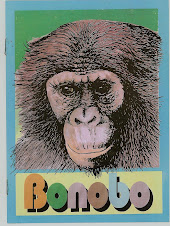
This is a standard school booklet, cahier, imported into Zaire (now the Democratic Republic of the Congo). Millions were sold in open air markets and they were all similar, with a map of the country on the front and the multiplication table on the back. They had low quality paper and muddy colors, but they were cheap.

Because the students often kept their lessons for years (and those who became teachers actually used their booklets to teach the next generation), Kizito and I printed natural history lesson cahiers, to be given away as prizes, or sold at a competitive price. We did booklets on bonobos, leopards, elephants, and leopards, some with essays on the inside covers. Needless to say, our locally produced, colorful booklets were a hit.

The "Good" with a check mark was a comment on a student's english lesson. English was the favored language studied in high school. Most Zairians spoke two or three languages (a mother tongue, a regional language such as Lingala or Swahili, and French), so learning another was relatively easy.

Monday, September 29, 2008

First Issue of Bleu/Blanc

The 32 page inaugural issue of Bleu/Blanc, the children's magazine that Kizito and I founded in 1996, featured "Honor for Mothers." There was a story about boyfriend/girlfriend relationships, a lesson on the importance of "thank-you," a French lesson, and an article "How to be First in Class." The natural history section was on chimpanzees and the bonobo, an ape found only in Zaire (now the Democratic Republic of the Congo).

Bleu/Blanc was named for the colors of the school uniform -- a mandatory white shirt and blue trousers for boys and a white blouse and blue skirt for girls. The mission of the magazine was to teach literacy while providing educational messages on many different topics.

The politics of the time were so tenuous and the possibility of success so limited that Kizito and I printed the first issue anonymously. For the cover, we could not afford a four color process so Kizito separated them laboriously by hand on sheets of acetone. The results were less than good, but already better than anything students were used to.

We printed only 10,000 copies of the first Bleu/Blanc, for distribution through the schools. There were few takers, and we ended up giving most of them away. But there was a hook that was hard to resist; due to the numbered copies (right lower corner) we were able to give away prizes in a Tombola. There was also prizes given out based on correct answers to a quiz that students mailed in. These goodies created a desire to own something (something to read) that had not existed before in the school culture.

Saturday, September 6, 2008

Location a Closely Guarded Secret

Here I was, In Kinshasa, Zaire (now the Democratic Republic of the Congo), standing at the entrance of a printing company, with the employees looking on. During that time, we never let leak where the children's magazine and school notebooks were actually being printed. There was a good reason for that. From Grains of Golden Sand:

"Donors astonished by our circulation and wishing to verify the numbers often asked where the thing was printed. “Oh, out in the cité,” was our hemmed and hawed response.

"“Why won’t you give us the name of the print shop?”

"Grin. “If we do, we will have to kill you.”

"In fact, the volume of work was so great that the printer was worried that if his name were broadcast, the company would become the target of more than the usual coterie of tax collectors. Like so many other businesses in Kin, it hid behind a blank wall with nary a sign. The whereabouts of Bleu/Blanc’s print shop was—and is—a well-guarded secret."

Sunday, August 31, 2008

Our Ancestor Saved by Bonobos

Kizito and I created an eight page educational booklet for the Milwaukee County Zoological Society. In it we told a local legend from a village where bonobos were not hunted:

"Once, in a village not far from Lake Mai-Ndombe, there lived a courageous young woman named Miesi. One day Miesi decided to go by herself to the fields, as her sisters were busy. But the forest was dangerous because of a great tribal war. On the path deep in the forest, she was surprised by a group of warriors from the enemy tribe. They demanded nastily, “Whoa, where are you going, woman?”

“I am going to my field of bananas,” she responded bravely.

In spite of her fear, she kept her wits and reproached them: “Watch out. My husband, the celebrated great warrior, is behind me with his band of hunters. Run away quickly before they find you here.”

The warriors broke out in laughter; they did not believe her story. “We are not blind, woman! We can see that you are by yourself! Ha ha! Prepare to die!” With that, they pointed their spears at her. Trembling, the poor Miesi thought that her last hour had come.

Just as they were about to dispatch her, a great war cry burst like thunder from the forest. Behind the young woman, the trees tossed violently. The men were petrified. Then a band of bonobos surged forward, throwing branches toward the enemy and screaming their cry of attack. The warriors, who knew the strength and intelligence of the species, pleaded to Miesi, “Pardon us, woman! Have pity!” But the bonobos continued to advance. The warriors abandoned their weapons and fled.

Miesi went back to her village and told her astonishing story, which was transmitted from father to son until our days. Maman Miesi was the ancestor of today’s tribe. To repay the debt for Miesi’s life, the people don’t eat bonobos."

Friday, August 22, 2008

Leopards; Cats Eat Rats


Kizito and I befriended a telecommunications company in Kinshasa, Zaire, called Telecel. In the early 90's Telecel was a monopoly, and had no real need to advertise its expensive ($10.00 per minute) service by clunky portable telephones.

We cajoled Telecel into hiring us for an advertising campaign that included cartoons, billboards, and educational help for schools. We used what is called "social marketing", where a community service is provided and marketed. In one of our actions, we designed locally printed school notebooks which were small booklets with a few dozen blank pages that students copied their daily lessons into, from the blackboard.

The notebook above was writtten and illustrated by the two of us working together. The cover stated, "Telecel Likes African Animals." The inside front and back covers discussed the natural history of the leopard and on the back outside, there was a lesson on the natural ability of the domestic cat, in hunting rats. (Cats were feared and rarely kept; yet rodents were terrible pests and few could afford rat poison.)

In our strategy, 10,000 notebooks were sold on the market by a local printer. The extra cost for the color printing had been subsidized by Telecel, so the price was competitive with the school notebooks that were imported from China, and the printer got a profit. (All of the imported notebooks had a crude map of Zaire on the cover and a multiplication table on the back).

As our notebooks were unique, what happened was that the color plates were stolen by another printer and uncounted copies were produced, which got our conservation story out even further. We, and Telecel, were delighted.

Wednesday, August 13, 2008

Okapi School Notebook

Kizito and I did community service projects for Telecel, a telecommunications company in Kinshasa. We identified a school that trained girls in sewing as a trade. Their machines (sewing machines were hand operated, due to the lack of electricity throughout the country) were old and worn, so we talked Telecel into sponsoring a half-dozen new machines. We held a ceremony and gave each student okapi notebooks and pencils, to commemorate the gift of the sewing machines.

This notebook was the first one we designed, and the text was simple, "The Okapi: unique in Zaire," and "Telecel likes Zairian Animals." These booklets had a few dozen pages inside with lines (for text), grids (for math problems), or blank (for art) and were used to copy the lessons off of the blackboard. The schools did not have textbooks, so the completed notebooks were kept for years.

The okapi, a beautiful black and white striped animal related to the giraffe, occurs only in the Democratic Republic of the Congo (DRC, formerly Zaire). It is one animal that the population recognizes as "special."