Search This Blog

Showing posts with label Life on Edge. Show all posts

Monday, July 20, 2009

Art on the Edge


I did a little of this and a little of that to make ends meet in Kinshasa, Zaire (now the Democratic of the Congo). The top image, a pen and ink drawing for the Bleu/Blanc magazine, was for an article about the local flies and pet dogs. The canine grimaces in pain as the biting flies buzz around its bleeding ears. The text recommends a daytime shelter (because the flies avoid the dark) and consulting a vet for a repellent product.

The second image, taken from a pencil drawing, depicts the stripped hindquarters of the okapi, a giraffe for the Ituri region of the country. The okapi artwork was used for a school notebook that was distributed by the cellphone company called Telecel.

Art by D. Messinger

Monday, June 22, 2009

At the Zoo

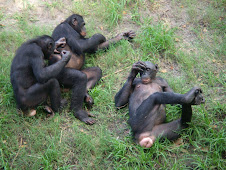
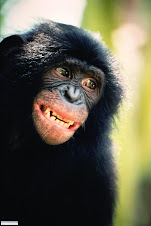
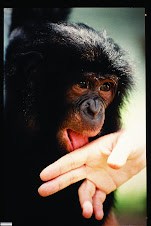
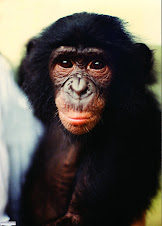
In September 1991, with the eruption of the looting and military mutiny across the capital of Kinshasa, Zaire (now the Democratic Republic of the Congo), 15,000 expatriates fled the country, leaving only a few hundred behind. Robert Weller, a journalist with the Associated Press wrote an article about how I repelled the rioters by painting the word AIDS in sheep's blood on the entrance wall of the compound where I worked and lived. I was shown with a bonobo clinging to my neck -- the reason that I stayed was to protect the animals.

Weller wrote, "But the soldiers who ransacked Kinshasa's stores, businesses and residences for three days in September kept clear of the center until French Foreign Legionnaires arrived to restore order and supervise the evacuations. For anyone who couldn't read her "AIDS" warning, it didn't hurt that Messinger also had a reputation locally as a handler of vipers and pythons. Indeed, when the Legionnaires saw the snakes, they left too."

Wednesday, April 22, 2009

Rain Rain Go Away

The world's rainforests straddle a narrow belt along the equator, and represent only six percent of the earth's landmass. I do not know exactly how much it rained where I was, but I guessed that it must have been around 100 inches a year. There was the "big wet" which was around six months long, the "little wet," around three months long, and the "dry" season, also three months long.

Traveling and working among the local peoples of Zaire, now the Democratic of the Congo, slowed me down and made me appreciate the elements. For example, no matter the urgency, everything came to a halt when it rained. Weather it was working, or meeting, or going to school, conducting business, or taking a trip -- nothing happened when it rained.

The above photographs shows a village, where I was cooped up in a hut for several days, while it rained, and rained, and rained. I was working with the local people, trapping small mammals for a monkeypox study, and we were all stuck. Such was the life of the village -- people were not bored; they sat around and talked, sang, worked on small projects, ate, and slept. The kids fiddled around with small home made toys or helped the women with indoor tasks.

Sometimes I use these images in presentations to describe the life in a Congolese village. The last photo comes with the remark, "Well, at least we had running water!"

Photos by D. Messinger

Monday, April 20, 2009

Monkeypox Office at Night

In this photo, I am preparing the notes from the day's work, during a long field trip in Zaire (now the Democratic Republic of the Congo) to study human habits in relationship to the rodents found around the villages and agricultural areas. Because there was no electricity where I worked, lighting was limited to kerosene lanterns.

The large notebook mapped out the location of nests, and distance from a point along a transect, of the rope squirrels that we were studying. Due to many variables, the time spent in an single location was too short to learn actual density of the squirrels, but this was a quick way to get relative density indications for various areas that I studied.

The folding table belonged to our team and was the "office." This photo was taken outdoors, in front of the main house of the village chief. Like other local activities such as cooking, relaxing, working, and visiting, my study was not done in a hut. Mud huts were primarily for sleeping and for escaping the torrential equatorial rains.

One of the things not seen was my audience. The people -- adults, kids, and assorted dogs and chickens hung around to see what I was doing. They would quietly talk, work, or play and keep me company, partially as a favor. In the culture, being alone was anathema. And I was a stranger, doing strange, and unfathomable things, that would be talked about for years. I always had onlooking eyes, even here in the soft nighttime air under the stars.

Monday, April 6, 2009

Telecel Bon Voyage

To make ends meet, Kizito and I created ads for Telecel, a telecommunications company. At that time, in the mid 1990's, Telecel ran a monopoly in the capital, and did not really need to advertise. But Jim Galan, the American director, had a soft spot for our conservation projects and orphaned bonobos. He paid for a dozen one page cartoons and then hired us to manage the postings in the local newspapers.

This four color ad fit in with the "social marketing" that we used for our copy. Each told a good story, gave some interesting lesson (here, it was geography), and advanced our overall goal of creating interest in reading.

In Bon Voyage, TELECEL, a jumbo jet is deplaning passengers. The first pane announces, "A tropical morning....the arrival from Europe." Then we see a man, dressed in a puffy jacket with a Topeka Zoo and happy face patches, waving good-by to the air hostesses, "See you next time, my dears!"

In the crush of passengers, he exclaims, "AWESOME! HO! My brother is here!"

The two meet, the loud bother greeting the conservatively dressed brother with, "What's up, Bro?"

They hug, and the brother asks, "How was the trip?" "FANTASTIC!" (The man likes to talk in capital letters.)

The next scene is a depiction of the crazy hubbub at the Kinshasa airport, where the two brothers are seen as tiny figures in the background, laughing.

In the third row, left pane, the two are waiting for their baggage. The loud brother throws out his arms, "I was in London, Madrid, Athens, New Delhi, Paris, Brussels...!!"

He continues, admonishing his stay at home brother, "...you need to get out and breathe the air of progress in exotic places, isn't that so, brother!?! His brother raises one eyebrow and responds softly, "Maybe..."

While the loud brother is laughing in an uproar, we notice the other brother's hand holding a cellular telephone that suddenly begins ringing, "Lo lo lo lo! Lo lo lo lo!"

A finger punches a button, while the loud brother, tears still in his eye from laughing, shows surprise on his face.

The quiet brother answers the phone, saying, "Hello... Los Angeles?... O.K.! I'll call Singapore immediately to confirm... Good bye!"

The loud brother, eyes wider, listens to this conversation. Then, with a broad wink, the quiet brother says, "You see, brother... I travel too, with TELECEL!"

Tuesday, January 27, 2009

"International Conservation Project"

Dr. J.J. Salaun, the French Director of the INRB, seen with a baby red forest hog, was an animal lover. He wrote a "certificate" that the resident Pan panicus, (bonobos) did not belong to the institute, and that they were being held for an international conservation project.

The document went on to say that the animals' maintenance and food was assured by Mademoiselle D. Messinger. Knowing that, at the time, there was no such "international conservation" project, it was foresighted, and courageous of Dr. Salaun to protect the bonobos with this creative document.

In fact, within a few months, the French were forced to abandon the institute. Fortunately, I was able to use Salaun's paper to show INRB's successors and government officials that the original plan for the bonobos was conservation. The culture's respect for signed and stamped paperwork stood me in good stead.

Monday, January 19, 2009

Pony Mare and Foal


When I was twelve, the family moved to a farm south of Austin, Texas. There, I was given a old Thoroughbred gelding, and a pony mare, named Missy by some neighbors. From Grains of Golden Sand:

"The pony was a half-wild creature that had never been trained properly. Because my father had left the military to return to school, we were poor, and with six kids, always on a tight budget. The family had little money to care for horses properly or to buy grain, a saddle, or even a decent fence. None of this mattered. I was determined to make it work.


"My parents bought enough wire to construct a triangular pen anchored by three cedars where the animals could be kept, with ten bales of hay as my Christmas present. On weekends, I rode a half-mile to the main road whose shoulders presented a lush crop of weedy Johnson grass. There, cutting my fingers until they bled on the serrated blades, I pulled grass by hand, tied it into bundles and hauled it home. No sacrifice was too great. Every morning I arose at 5:30 to care for my beasts before school. Those were the best years of my childhood.

"Horses set me free. I fashioned rope bridles and rode bareback. I became an explorer and rediscovered America. As a rancher, I scoured the range searching for lost steers. I was a hungry Indian scouting for bison. I stood on my steeds’ backs to steal the out-of-reach peaches and plums within a ten-mile radius. I imagined what it would be like to take a cayuse and follow the railroad right-of-way across America. I’d read about the Pan-American Highway and wondered if I could actually take a road all the way to Tierra del Fuego."

The top photo shows me bareback, with a rope bridle on Missy, while the bottom is of Missy and her filly foal. The farm life ended three years later when my father took a job in Pennsylvania. I sold the pregnant Missy and foal at side for 100 dollars.

Tuesday, January 13, 2009

A Snake on My Shoulder

Just before high school my family moved from Texas to urban Pennsylvania. I missed the horses and farm life terribly, but made the best with what was available. From Grains of Golden Sand:

"I became a passionate amateur herpetologist and kept dozens of snakes, lizards, and feed-mice in the family dining room. I housed them in aquariums, cages, boxes, and one glass-fronted closet, generously given to me for “the critters.” Although still in high school, I audited university courses on botany, herpetology, and entomology.

"I wandered the town, stripping fruit from trees bowed down with the season—dozens of varieties of apples, pears, and cherries, along with raspberries, blackberries, and grapes. Pennsylvania honed my interest in survival skills. Where Texas had little wild provender, Pennsylvania made up for it in an abundant array of edible foods on the green slopes surrounding the town. I ate fiddlehead ferns, dandelion buds, lambs-quarters, Indian cucumber-root, and made salt by scorching colt’s foot leaves.

“Pretend you’re in the bush,” I told my family and served cottontail rabbit (found dead on the road that morning), miniature wild strawberries, and cattail-pith salad. As they picked at the food, the single comment came from my baby sister. “Mommy, if I die, please don’t let her cut me up like she did the poor bunny.”

The above image is me with a boa constrictor, which was a prop in the senior class play, You Can't Take it with You. I snuck the snake into the school a week ahead of time, and carried it around the halls on my neck, in defiance of the rules. I was only one step ahead of the principle's wrath, who heard about it, but couldn't find the animal. I kept moving it from locker to locker, and the teachers covered for me.

Monday, December 29, 2008

The Animalerie at the INRB

I lived on the grounds of the INRB, a medical reference diagnostic laboratory for Zaire (now the Democratic Republic of the Congo) for many years, in exchange for overseeing the care of the laboratory, mice, rats, rabbits, and sheep.

The virology building is on the right, with the courtyard and the "animalerie" on the left, and the bonobo building behind. Left to right, the vehicles are my "Texas," the virologist's car, and Kizito's yellow and white former taxi.

At first for the French, and then for the Zairians, the tacit understanding was that I would take care of my living expenses through grants. After the civil unrest in 1991, the grants dried up and were mostly replaced by freelancing. I did conservation education projects for zoos, advertising for a telecommunications company, consulting work for field research on zoonotic
viruses, and health care for expatriate owned cats and dogs.

Also, as part of the agreement, I was allowed to keep other animals on grounds for conservation projects. That is where the small group of orphaned bonobos came into being.

Sunday, December 28, 2008

Congolese Coffee


One of the things I liked about African life was the coffee. The best arabica beans from the mountainous Kivu region came in one kilogram bags (2.2 pounds). The instructions to keep the coffee in the freezer in the plastic bag was in French, Swahili, English, Lingala, and Arabic. This product rarely found its way to faraway Kinshasa, the capital of Zaire (now the Democratic Republic of the Congo) where I lived.

The rest of the country, and me too, relied on the lowland robusta coffee -- the poor person's morning jolt. Every marketplace sold the watered down stuff, cooked up in huge, open topped pots, liberally sweetened with powered milk and sugar.

I learned the village method to roast the beans. Green beans were heated in a flat pan, with a tiny amount of palm oil added to keep them from burning. They were then pounded into grounds in a wooden mortar and pestle. The coffee produced was earthy, smoky, and rich in flavor.

After returning to the US, I found American coffee to be bland and stale. I now buy green beans off of the Internet and prepare them every few days, in a small household roaster.

Saturday, December 27, 2008

I Know What I Want

Kizito and I created advertising for the telecommunications company in Kinshasa, Zaire (now the Democratic of the Congo) using social marketing. Telecel marketed cellphones, and one of their units, was called a "Telecel." Our sell tactic was a positive social message, such as the one above, where the kids are aspiring to be successful adults. We always developed the stories as a comic strip, as this was an accepted literary format. From Grains of Golden Sand:

"The story begins with kids who are jumping trampoline-like on old tires in the cité. The children argue about what they want to do when they grow up. One boy declares that he will be an Olympic champion. Another wants to be a pilot, and a little girl (with hearts in her word balloon) says that if her boyfriend wants to be a pilot, she’ll choose flight attendant. A second girl says she will study medicine and be a famous doctor. The children argue about their future professions—Lawyer! Businessman! Professor! One little boy hasn’t spoken, and the group teases him for wanting to stay a baby all his life. When pressed, the boy says, “…Ahhh, I don’t know what I want to be…”

"Then his eyes light up and he shouts, “But I know what I want to have—a Telecel!”

Saturday, December 13, 2008

Snake as Security


This was a "guard" snake I kept in an aquarium at my apartment in Kinshasa, Zaire (now the Democratic Republic of the Congo). Mild mannered, this Honduran milk snake was usually calm, but if he was handled more than a few minutes, he would calmly turn his head and bite the closest object. I got him from a Belgian man in town who kept snakes as pets.

The advantage of a non-indigenous, brightly-colored snake was that no one knew what it was. It was assumed to be extremely dangerous. Everyone was universally terrified of snakes, so this one made a great personal protector.

I let everyone know that I kept snakes. For trips to the field, I took the milk snake in a bag, as pictured above, in a metal trunk that contained the funds for expenses. I would show the snake to the villagers, and then place it in the trunk, to let them know what a risk it would be to try and steal the money. It never failed.

Wednesday, December 10, 2008

Leopard T-Shirt

Telecel, the cellular telephone company gave projects to Kizito and me, which helped keep us solvent. This T-shirt was the only artwork that we ever did that was printed outside of Zaire (now the Democratic Republic of the Congo), as can be seen by the high quality of the image.

Telecel had the shirts made up in the United States and shipped to Kinshasa. They were handed out to politicians, customers, and VIP visitors. There was some symbolism here, because the leopard was the totem animal of the then-president Mobutu.

The text read, "Telecel likes African Animals." We worked on it together, looking at dozens of photographs to get the leopard's spots right. Kizito had a difficult time with the branch, so we set up hunks of bark to sketch up close for the texture.

Wednesday, December 3, 2008

Wild Animals I Have Known


A book that influenced my career choice was written many decades before I was born. It anthropomorphised wild animals by giving them human qualities of love, loyalty, and integrity. In spite of some exaggerations, the tragedy of what happened when wildlife ran aground of man's hubris had a profound effect on me -- to my young, impressionable mind, wild animals were noble creatures that suffered without voice.

I happened to catch a PBS Nature show called The Wolf that Changed America on the author Ernest Thompson Seton. Seton was an anomaly -- a professional hunter who was also an observant author and artist. His epiphany began with a wild wolf named Lobo that he was hired to kill, in the Currumpaw region of northern New Mexico, in 1893.

The hunter Seton attributed near supernatural intellect to Lobo, who could not be shot, trapped, or poisoned. Determined to win, the clever Sexton managed to corner Lobo's female, a pure white animal called Blanca, who was killed by two lassos thrown around "the neck of the doomed wolf, and (we) strained our horses in opposite directions until the blood burst from her mouth, her eyes glazed, her limbs stiffened and then fell limp."

The story turns ever more graphic and tragic as Sexton writes how Lobo seemed to be crying for his mate, so even the cowboys commented that they had never heard the like. It was clear to the reader, as Sexton writes, that Lobo must die. The reader weeps with the writer, who is already regretting his actions, but says, "It cannot be otherwise."

Continuing the story in a straightforward manner, Seton wrote that he used Bianca's carcass to draw the male to an area set with leg-hold traps. Later, Sexton finds Lobo, with each foot caught in a trap, immobile and exhausted from two and a half days of fighting his fate.

Sexton decides to take Lobo alive and he describes how he manages to get a lasso around his neck, tie his jaws shut over a wooden stick, and haul him back to the ranch. Staked out, the wolf is indifferent to everything around him, and although food and water are within reach, he stares fixedly at the far horizon. Sexton was surprised that he did not call to his band. Lobo was dead in the morning.

The death of Lobo must have shaken Seton to his core. In the film, he writes a single word "Why?" as if to question the absurd cruelty of what he had done. For the rest of his life, he never killed another wolf.

Some speculate that the story was made up. Astonishing is the photograph of the downed wolf that Seton claims was Lobo, with traps seen on the three feet that are visible, (seen in the Nature film). I believe that the story was true. The capture of Lobo was realistic, and the description of the wolf's demeanor and death is typical for the blood loss, trauma, dehydration, and shock of days spent in the traps.

Wild Animals I Have Known was printed in 1898 and it was an instant success. It has been in print continuously to present. The Lobo story was the lead in a book that covered many other "named" animals such as Siverspot, a crow, Raggylug, a cottontail rabbit, the Springfield fox and Redruff, a partridge. There were also two dog stories (Bingo and Mully), and one on the Pacing Mustang.

Seton went on to found the Woodcraft movement which led to the Boy Scouts. He influenced Teddy Roosevelt and he lobbied for federal legislation for migratory birds and the setting aside of wilderness for National Parks.

As a child, when I read the story of Lobo, as well as the other animals that paraded across the pages of the musty old book, I had no inkling of the history behind it. All I remember was the searing story of the faithful wolf that died undefeated. As I have found out, the story of that single wolf influenced generations of environmentalists.

Tuesday, November 25, 2008

The Kinshasa Art Market

From Grains of Golden Sand:

"Ironically, the main market in Kinshasa for live, wild pets faced the American consulate, the USAID offices, the U.S. Information Service Library, and diplomats’ residences. This was a large market where the mostly expatriate clientele shopped for malachite jewelry, sand paintings, cowry-shell Kuba masks, and village-woven raffia tapestries. Anything—from carved chess sets to old Belgian Congo money, to baskets and spears—could be had in this marketplace that ringed the terminus of the Boulevard de Trente Juin. There were potted plants, dried flower arrangements, fruits and vegetables, seasonal “Christmas trees,” carved ivory statues, and even cheap elephant-tail hair bracelets (the “elephant” fiber was actually smoked and darkened palm rib filaments)."

Seen above are paintings done on flour sack cloth, stretched over wooden frames. They are propped up with sticks and rocks. It was a unsettling experience to shop at the art market because the sellers were pushy in the extreme. Buyers were mobbed, followed, and even physically pulled in one direction or another. But there were hidden rules that were useful, if only people knew how to use them. If one started looking at something, the other sellers crowding around were supposed to cease and desist. One had to shout this out, and make the primary seller enforce the "union" rules, so one could bargain in peace.

Another tactic concerned negotiating. It was ill-mannered (truly!) to pay the asking price. One demeaned the seller by denying the challenge and thrill of the give and take of bargaining. A theatrical discussion, with humorous twists, was always appreciated. One of my stock tricks was to counter the asking price (say, 100 Zaires) with a ridiculously absurd low ball (like 3 Zaires). The seller would explode with surprise.

"Oh!" I would reply, pointing up to the sky, "You started up in the clouds, I had to come down to the earth, and dig a hole for my price!" This icebreaker brought a belly laugh, warmed up the watching crowd, and let everybody know that, although I was an expatriate, I was a haggling force to reckon with.

Finally, the best trick of all, was to go first thing in the morning. It was imperative that the first item that was discussed had to be sold, as this would give extra good luck for the rest of the day. Few people knew about this, but the sellers all agreed that they would always give a rock bottom price for the day's first sale.

Photo by: D. Messinger

Wednesday, November 5, 2008

A Remote Bamboo Grove

The Democratic of the Republic, DRC, (formerly Zaire) is a most beautiful country. As large as the United States east of the Mississippi River, it probably has only a several hundred miles of decent, black-top road. To be fair, in DRC, many "roads" are rivers but lack of fuel is a limiting factor for the movement of boats.

This photograph was taken on a remote track in Equateur, Zaire (now the Democratic Republic of the Congo), in the mid-eighties. The bridge was in excellent shape, which was the reason for my stopping to admire it. Some stalks were a full six inches in diameter at the base, and later, I learned that this bamboo was a giant species. These groves were planted by missionaries; bamboo was used as a building material by the villagers.

Photo by: D. Messinger

Saturday, October 25, 2008

Eckert's Wild Season

Wild Season, published in 1967, was a book that influenced my life and my career choice. The author, Allan Eckert, explained in a simple, matter of fact style, the circle of life, during thirty days of a spring month.

On the first day in May, the reader follows the metamorphosis of a tadpole into a bullfrog. Just as a great blue heron is poised to spear the frog, the young frog, in a fortuitous fraction of timing, leaps at a mayfly, and narrowly misses becoming the bird's meal. Eckert deftly describes the events that happen to the frog in the next 24 hours after it leaves the pond. The reader is completely absorbed in the frog's struggle to eat and not be eaten.

But then, the frog makes a fatal mistake by bobbing carelessly on the water's surface while swallowing a beetle. He is snapped up by a large-mouthed bass. The frog becomes fuel to drive the female fish to spawn in a nest (a "redd") and her roe is inseminated by a male who will guard the eggs until the babies hatched.

On the third day of May, the female bass is caught by fishermen and dispatched for their dinner. Her entrails and bones are thrown in the river and Eckert vividly described the life that comes to feast on the remains of the fish. Finally, a raccoon comes and makes off with the head. As the days of May trickle by, plants, animals, and people travel on interconnected paths -- a raccoon, meadowlark, a bot fly, a grain of wheat, a rabbit, a snapping turtle, a boy who wants to kill a bull snake, and others.

Reading Eckert's book now, I am struck by his bias -- the ugly water snake, the wicked-looking head of the snapping turtle, and the decidedly ugly creature, a bot fly. Today, these anthropomorphic comments are out of style, but I didn't dwell on the negativity when I first read it. What made Wild Season an earth-shattering book for me was the ending, which brought everything full circle, and made the hair stand up on the back of my neck.

As Eckert himself wrote, "For in nature's book, everything has its place and its time; there exists a persistent interdependency of its creatures one upon another." Wild Season may be over 40 years old, but it is still a great read, and used copies are available online.

Wednesday, October 8, 2008

Caring for the Care Takers

In Kinshasa, Zaire (now the Democratic of the Congo), after the civil unrests in 1991 and 1993, I fed the guards who stayed overnight and the animal caretakers who came in to work. Here, Stani is cooking rice over charcoal in a "babula." We are in the yard in front of my apartment, where we grew crops to feed the bonobos. Behind Stani are bananas, papayas, and a variety of sweet potato called matembele that was grown for its leaves.

Photo by D. Messinger

Monday, October 6, 2008

Catching Snakes

While going to school at Wichita State University, I retreated to the wild for a break from studying. Here I am, at El Dorado Lake, on the outskirts of town, catching reptiles. I have a water snake in hand, and a snake bag tucked into my belt loop for anything interesting that I wanted to keep. I visited creeks and ponds and cruised rural roads at night, looking for (honest!) rattlesnakes that crawled up on the warmed asphalt. Actually, I never found a rattlesnake that way, but the thrill of adventure was enough to keep me looking.
Sunday, September 14, 2008

Insurance for Texas

Insurance for my truck (named Texas, by the way, because it was a tough name, and Zairians were enamored with re-runs of "Dallas") was a joke. If you were in a accident, you never got a claim settled by the local rip-off insurance companies.

In a bizarre twist, the older the vehicle, the more expensive the insurance. I checked and was told something about the older a vehicle was, the more chance it had mechanical problems, would be involved an accident, and kill somebody. It had nothing to do with the replacement value of the vehicle. So, insurance for my 15 year old truck was expensive, about twice as much as in the US.

I struggled for years to cover the 850 dollar annual cost, and then discovered a brilliant option that the Zairians used. The "I lost my insurance" paper, featured above, could be had from any local gendarmerie. This cost three dollars and was good for 20 days. Do the math.