Search This Blog

Showing posts with label Congolese Culture. Show all posts

Tuesday, July 28, 2009

Kinshasa Market Scene

The Polaroid camera I gave to the market informants enabled me to get snapshots of how business was transacted in Kinshasa, Zaire (now the Democratic Republic of the Congo). The upper left was of three stolen logs loaded in a metal cart. It would be sold to market women for firewood to brew the hard alcohol called lotoko.

In the top right, the smoked fish in the woven vine basket came from tributaries off of the Zaire River. Each basket weighed from 35 to 45 pounds and cost 650 million Zaires. At a rate of one million Zaires per US dollar, that was just over 72 dollars.

The lower left picture shows another scene at the market: a man has been hired to climb a palm tree to collect the palm nuts. In public places, a tree was "owned" and the fruits belonged to an individual or family. The last picture shows Kela, who sold potted plants and dried arrangements. He had other business on the side -- at the time of this picture he was trying unsuccessfully to sell monkeys to the Russians who were at the port in Matadi.

Saturday, June 27, 2009

The Challenges of Field Work


"As we proceed with the Bososandja forest plans, our goal is to organize and fund a large mammal inventory (using a consistent methodology) for the entire Lukenie-Sankuru forest block and the Lusambo forest block. Only with this data can we make an unequivocal case for the importance of protecting a particular area (the Bososandja). This effort will continue to rely on provincial, territorial, and local (groupement, localité) review, as we have done in the past to ensure that they have a say in the process and geographic boundaries. Critical to the process is formal mapping that will assure that authorities (government and traditional) are very clear what we are discussing."

These words, so straightforward, were recently written by Dr. Jo Thompson, who studies bonobos in the Democratic Republic of the Congo. What is not apparent are the physical hardships that are part and parcel of working in the field. One has to deal with slippery log bridges across steams, stinging insects, thorny plants, exhausting days, and lonely nights of solitary work. On the human side, one faces demanding officials, deals with a foreign language and culture, and endures the high costs and unavailability of almost everything. The lack of transportation, communication, and access to health care requires a fearless approach to life. Many may dream romantically about studying wildlife, but few have the ability to do so.
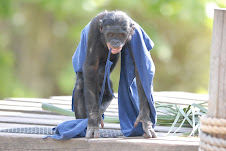
Photo by R. Ross

Wednesday, May 20, 2009

Truck Stuck


Traveling the "bush" for six months, stopping in remote villages to conduct research on monkeypox, meant that one needed to carry all needed supplies and equipment, including a portable short-wave radio to keep in touch with the World Health Office in the capital. Negotiating impassible roads in the center of Zaire (now the Democratic Republic of the Congo) meant that the equipment included metal skids, shovels, an electric wench, and a chainsaw for situations.

The top photograph shows the Toyota high-centering in a sandy road in Bandundu. Digging, putting grass, skids, or other traction under the wheels or using the "come-along" were all options. Often, when the ruts were very deep, the best tactic was to strike out across the virgin savanna on a parallel track. The unbroken grass provided good traction for a new road, but, over time, the ruts would get deeper and more eroded, until that, too, was abandoned for another path. In some places, there would be a dozen side-by-side roads, wandering and twisting through the savanna, in various stages of wear. It was a challenge to chose the best road.

The middle picture shows where we fell through a small bridge over a stream. Here, it was impossible to extricate ourselves, so after a few hours, we managed to signal our distress to a village, a few miles distant. The villagers were all to happy to enjoy the excitement of a passing vehicle, busted through a rotten spot on their bridge. Joking and laughing at their fortune, they picked up the truck's rear end and placed it back on better timbers.

Where was I? I was knee deep in the water, cooling off, taking pictures, and laughing at the absurdity of it all. I suspected that the villagers may had actually set up the bridge as a truck trap. There were so few vehicles passing in this area -- only a couple a month -- that perhaps this was the local taxation. Being Zaire, it was not out of bounds for Zairians to go to extraordinary lengths for a few dollars.

The last image is of the "one that didn't make it." Mungbau, the driver had to stop and get his picture taken by the upside down cab and trailer of what must have been a horrific accident. Usually, the metal from abandoned trucks was pulled off and recycled, but this area was too remote for such piracy.

Photos by: D. Messinger

Wednesday, May 13, 2009

An Abandoned Village

This village, photographed in the vicinity of Djolu, Zaire (now the Democratic Republic of the Congo) was at the edge of the secondary forest on a tertiary road. As explained, the entire village had been abandoned when the chief had died -- the people had picked up all of their belongings and moved to a new site. It was said that a village might also move when the local resources had been exhausted as the result of too much human pressure on the fragile ecosystem.

That is one of the reasons that the maps I saw were so inaccurate. Villages named no longer existed as depicted, or they had moved to another place, and were the same name, or the name had been changed to "big such-and-such" or "new such-and-such." A perfect case of recycling, the left behind houses decayed and melted back into the earth, and eventually the land was engulfed again by forest.

Photo by D. Messinger

Wednesday, April 22, 2009

Rain Rain Go Away

The world's rainforests straddle a narrow belt along the equator, and represent only six percent of the earth's landmass. I do not know exactly how much it rained where I was, but I guessed that it must have been around 100 inches a year. There was the "big wet" which was around six months long, the "little wet," around three months long, and the "dry" season, also three months long.

Traveling and working among the local peoples of Zaire, now the Democratic of the Congo, slowed me down and made me appreciate the elements. For example, no matter the urgency, everything came to a halt when it rained. Weather it was working, or meeting, or going to school, conducting business, or taking a trip -- nothing happened when it rained.

The above photographs shows a village, where I was cooped up in a hut for several days, while it rained, and rained, and rained. I was working with the local people, trapping small mammals for a monkeypox study, and we were all stuck. Such was the life of the village -- people were not bored; they sat around and talked, sang, worked on small projects, ate, and slept. The kids fiddled around with small home made toys or helped the women with indoor tasks.

Sometimes I use these images in presentations to describe the life in a Congolese village. The last photo comes with the remark, "Well, at least we had running water!"

Photos by D. Messinger

Wednesday, February 18, 2009

Working Women in the Congo

These African women, on their way to the agricultural fields with empty baskets slung over their shoulders like back-packs, were already worn out from a lifetime of hard labor. The woman in the foreground is carrying a mat, while the other has a staff to lean. Both were barefoot, posing for my photo near leaves for a roof laid out to dry.

In the subsistence culture of Zaire (now the Democratic of the Congo), the women worked from sun-up to sundown. Depending on how far away the fields were meant a hour to several hours walk (distant fields might not be tended daily, but at critical times, the family would camp out on site). The baskets were filled with the harvest, which would include beans, peanuts, squash, corn, manioc, bananas, and local greens. One important product -- firewood -- was cut and transported to the village in the backpack baskets. Full packs weighed between 50 and 75 pounds.

Children helped their mother in her daily duties. They would help weed and chase off animal pests that were constantly testing and tasting the harvest. Children also played "house" and "hunting" and boys would practice building snares, and ferreting out nests, looking for small animals such as rats, squirrels, porcupines, and bats, which would be cooked and eaten on site.

Men did not work in the fields. Their only contribution to cropping was that they cut down and burned the biggest trees in the so-called "slash and burn" system (the ash from the fire gave a fertilizer boost to the normally poor forest soil). Another contribution of the men was the meat brought in by periodic hunting.

Photo by D. Messinger

Monday, February 9, 2009

Wattle and Daub

The side of this house in remote Zaire (now the Democratic Republic of the Congo) shows the construction technique called "wattle and daub." This environmentally friendly technique has been used worldwide and is at least 6,000 years old. Wattle and daub uses a framework of wooden timbers typically "infilled" with a combination of clay, soil, sand, dung, straw, and other fibers. The material is durable, as long as it is kept dry, and there is 700 year old wattle and daub in existence.

The wattle is the term for the timber, seen exposed above. The upright, load bearing timbers are "staves," while the lattice of horizontal timbers are called "withies." The deteriorated building illustrates the result of the equatorial rainfall on wattle and daub in the tropics, along with the use of leaves or thatch roofing. Termites also are a problem, as they eat the wood from within. Usually, the buildings last only a few decades before they melt back into the earth.

Photo by D. Messinger

Wednesday, February 4, 2009

500 Proof Liqueur

These Poloroids are snapshots in time that illustrated the everyday lives of the people of Kinshasa, in Zaire (now the Democratic of the Congo). The first, an image of a smiling, seated woman, seems mundane. In fact, the photographer told me that she was the famous "Maman GOODYEAR." That wasn't her real name, of course.

Goodyear was her nickname, given in respect for her ability to, like the tire commercial, "Goodyear tires go everywhere." Maman GOODYEAR made her living bringing farm and forest products from the village to sale in Kinshasa. With the money made, she would purchase supplies, like soap, salt, matches, and cigarettes that could, in turn, be transported back and sold in the interior.

The upper right picture shows another business, run by a woman from West Africa. In this case, the brightly colored, stripped plastic sacks hold manioc tubers for sale. She also sold "magic" and medicine -- one popular product was a grey clay sought by pregnant women to ease their huger for minerals lacking in the diet.

The lower two images were of a home-made factory that made the local strong liqueur called "lotoko." The boy in front of the corn and manioc mash covered barrels is helping mind the fire. The last image is of the actual still, with the middle barrel over the fire and the pipes running through the water-cooled end barrel to drip into the white plastic bottle. A plastic tub floating in the water is used to pour water over the pipes to help in the distillation.

"Lotoko" was a bitter, dirty-tasting, strong alcohol, called "500-proof." Local advice was that it contained dangerous trace elements from the barrels, because the metal was not certified for food preparation. However, it was cheap and easy to make.

Monday, January 26, 2009

Parrots and Peanuts for Sale

These Polaroids were taken to document transactions in the markets of Kinshasa. The top is a type of hard shelled fruit, laid out on a rough wooden table from the region called Bandundu. The fruit, sold in packets, is counted out and laid out in neat piles.

The mundane looking wood has an interesting story. The bark is called "Ngola," which is from the tree that gives the red color, which has cultural significance. (The bark is ground into powder, mixed with palm oil, and molded into solid blocks of "red," to be smeared on bodies or artifacts). At the market where this photo was taken, petty thieves steal by chipping off bark pieces with machetes. The red shavings were sold to Malian women who used the color to make "fetishes," (magic).

The photo on the bottom right is a smiling woman with unshelled peanuts. She buys peanuts, transported from agricultural regions, a sack at a time. She sells raw peanuts, or she may grill and shell them for a higher price. Peanuts were a staple of palm oil based sauces for meat.

The final image was of two market sellers with a cage full of fledgling African grey parrots. The birds all had dark eyes of young birds. These birds came from near Mbandaka, a center on the Congo river. According to the middlemen, the parrot trapping season should have been closed during the two month nesting season, due to the high mortality.

Thursday, January 8, 2009

Fresh Caterpillars

During the nineties when these pictures were taken, paranoia in Zaire (now the Democratic Republic of the Congo) was at a high level. In the culture, taking photographs was stealing souls and it was also outlawed in public areas. To obtain these Polaroids, I had one of my people go to the port market called "Ndolo" to document the types of food that were available. They asked for permission to take Polaroids and they would always hand out another one as a gift.

The upper left photo shows a basin filled with live caterpillars called "mpombe" (singular, "epombe"). The freshly steamed mpombe are piled on the cloth in small packets, and priced to sell, to be cooked into other dishes. The seller remarked that this caterpillar only was found in one kind of tree, from the savannas.

The upper right photo shows cocoons filled with live caterpillars called "belanga," from the rain forest. As the seller explained, belanga eat leaves when they are small. When they get big, they move in a single-file line and go up in the trees, where they make the cocoons that are harvested and transported to the capital, for sale. Some people put baskets in trees where the caterpillars will nest.

Two things that were interesting about belanga was that seller said that they lined up and climbed trees at the same time -- he said it was around two in the afternoon. He also remarked that the belanga never pooped in their cocoons. This was a preferred food, because it was very fatty.

The lower left image was of fish being steamed in a "liboke," or tied up basket of leaves, over a grill. The soupy fish or eel chunks combined with onions and hot peppers kept the leaves wet enough so they did not burn in the heat from the fire. Liboke was the "fast food" for populations in towns and cities.

The final Polaroid was of a commodity called "bushmeat," or meat hunted in the forest and transported distances to be sold. The carcass is a smoked monkey that came by small boat into the port. It looks flattened because the organs had been removed and the body cavity had been opened and spread by wooden sticks for smoking. Meat thus prepared would keep for a couple of weeks, although it might need a "freshening" up by additional smoking. Smoked meat was rehydrated for preparation. Because it was expensive, smoked meat was added in small pieces to other dishes, such as greens.

Sunday, December 21, 2008

Kinshasa Local Market

In Kinshasa, Zaire (now the Democratic of the Congo), I used a Polaroid camera in places where photography was frowned upon or even illegal. This way, the people were "paid" by a gift of a picture of themselves. I kept a notebook were I documented everyday life, such as the above market place.

The bananas on the upper right were a variety that were relatively cheap, because they were not preferred; on the upper right were the highest quality of bananas.

The fruit and vegetables on the metal cart were being taken to the market where expatriates frequented. The metal body of the "pousse pousse" had handles in front and back for pushing or pulling, and sat on car tires. The carts were hired to carry goods throughout the city and were quite common.

Some local farmers had learned expatriates tastes, so they grew zucchini squash, cucumbers, large tomatoes, green beans, leafy lettuce, and small dark green watermelons. These products were rarely eaten by the locals. Because of the lack of long daylight hours, the vegetables were specific varieties, (many species will not fruit in the tropics). Due to the high rainfall, the crops were grown in raised beds to prevent root rott.

Shown in the bottom right photograph was a "grande valise," or big suitcase, of dried fish from Kisangani, The "suitcases" came in standard sizes from the villages, and these were the largest, brought in on the Zaire (Congo) river.

Thursday, December 11, 2008

Zaire Conservation Cloth


These faded remnants of cloth are all I have left of the first piece of material that I purchased, in 1984, in Bukavu, Zaire (now the Democratic of the Congo). I was a Peace Corps trainee with only pocket money to spent. Because the standard six yard length was too expensive, another trainee and I bought one and split it.

Little did I realize that I would never see this "Universal Conservation of Animals" again. I suspect that some organization commissioned the design, similar to publishing a book in this country . Cloth, made locally by a few factories was used as a sort of billboard for expressing sentiment, celebrating an event, proselytizing, advertising, or for political propaganda.

The Congolese culture did not appreciate animals, so animal motifs were relatively rare. That is why I cherish this one piece, with the circle of a dozen animals -- some rare, some not so rare, circling a map of Africa. For example, Zaire was the only place in the world with the northern white rhino (and they may now be genetically extinct), yet chameleons, zebra, and butterflies were quite common.

And although it was possible to venerate the rhino, I could tell that no one had consulted with the local people to come up with the list of animals. Chameleons were universally despised throughout the country, and impossible to touch. Their look could emasculate men, and, although they were captured to sell to expatriates, it was always hands off, with the use of a long, slender pole.

Monday, December 8, 2008

Elephant at Kinshasa Zoo

"Kwanza," Swahili for "gift" was one of a pair of elephants that in the '90's the Zairian government captured at Garamba Park, and flew to Kinshasa for the zoo. The female of the pair died shortly after arrival, and only the young male was left. Without any thought for long term management, the project was doomed to failure. From Grains of Golden Sand:

"Wandering about the zoo grounds for days like a gray ghost, the elephant was herded with branches like a wayward milk cow. When Kwanza became obnoxious, the keepers chucked rocks to keep him away from the public. Desperately hungry for the food that lay beyond his reach, he knocked down the Ugandan kob and sitatunga paddock walls, releasing the animals onto the zoo grounds. Not one fence they had could retain him. At seven one morning, Kwanza rushed the main gate and escaped. The young bull elephant bolted down KasaVubu Avenue, pursuing the fruit-selling mamans that fled before him. The pachyderm was too famished to bother the women; he was after their wares. The vet lured him back into the zoo with bread, and the affronted market women were paid off."


Photo by D. Messinger

Thursday, December 4, 2008

Boat Party

These young men are traveling on a small boat from Inongo, on Lac Mai Ndombe, to Kinshasa the capital of Zaire, (now the Democratic Republic of the Congo). They are singing, drinking, and having a good time on the roof of the vessel. The man barely seen on the right is dancing to the home made rhythms tapped out with spoons and sticks on beer bottles and metal objects.

The hold, packed to the gills with sacks of manioc, corn, smoked meat from the forest, and live goats and chickens was dirty and hot. That meant that the cooler roof was an ideal place to party and even lay out a mat for sleeping. Most of the people down below were the women who stayed there to keep an eye on their wares. They made a living selling rural products in Kinshasa. The women then purchased cloth, soap, matches, and medicine to return and sell in the villages.

The men in the photo were looking for family and/or school or employment in the capital city. Kinshasa was a magnet for villagers who had heard that its streets where paved in gold.

Photo by: L. Tembe

Sunday, November 30, 2008

100 Makuta Bill 1967


This worn bill is the oldest that I have, from 1967. It was worth one hundred Makutas, or one Zaire. The young President Mobutu started his regime with good intentions and a good reputation. He is seen on the reverse of this money rolling up his sleeves to work with the people.

But Mobutu's money soon began to spiral out of control with inflation. He and his family sucked the riches out of the land and impoverished the population.

Wednesday, November 19, 2008

Don't Mess with Me Messinger

Here I am, with the World Health Organization Toyota, studying monkeypox disease on the road in remote Zaire (now the Democratic Republic of the Congo). I am wearing my flying-geese-with-yoke-embroidery dress to present myself to the immigration officials in a regional governmental district. I usually wore flip flops (to ward off fungus), but here I must have kicked them off in favor of being barefoot.

I am also wearing my "just make my day" scowl used to face down Zairian authorities, both fake and authentic, who tried to threaten, intimidate, or coerce me into giving them something. The guns were real and there were plenty of stories of people being jailed or manhandled over trumped up charges. I don't know why, but, over the years, keeping myself out of trouble had become one of my favorite games.

In the above scenario, I gathered up my papers signed by the central government, put on my flip flops, and presented myself to the office of the local immigration official. Rarely would they see me, but they would hold my passport for "approval." I would call their bluff, saying that they had better stamp my papers and deliver them, because our team was already behind on our important health work and we needed to start immediately.

That was the beginning of a dance that was short or long, simple or complex, based on the artfulness of my dance partner, (the official), and his minions. I looked forward to the testing and refining of my techniques and in the Africa art of getting by, I believe that the officials also enjoyed the exercise.

In the end, I always won. One thing about the game was that, although the end goals were serious, everyone recognized that it was a game, and the losers were (usually) good sports.

Sunday, November 9, 2008

Growing Up in Zaire

It was difficult to get candid shots of Zairian children because I -- being an outsider -- was the center of attention anywhere I went.

It was a lazy Sunday. Most of the villagers had gone to the rude mud church a dozen doors down, and, that afternoon, the men were relaxing in the shade, while the village women were gossiping while they prepared the evening meal.

Our team had been working in this village for almost two weeks, and the people had gotten used to me and my camera. They had also gotten gifts of Polaroids, which was necessary, if one ever wanted permission to take pictures in the first place (one never took a picture without getting permission).

That Sunday afternoon, I watched out of the corner of my eye as a group of kids lounged on some broken chairs, and watched me as though I was television. I had spent hours taking pictures of the most mundane sort around the encampment -- trees, the thatch roofs of the houses, our work table, my own mosquito bitten feet, termite hunting ants, the chickens, the outhouse, and so on.

I continued to move about, pretending to take pictures, for fear of running out of film. Finally, the children got bored with my activities, and they began to play. At last, I turned about and snapped a few shots. The little boy was giggling in surprise as if it was a joke that I stopped to take his picture.

Photo by: D. Messinger

Sunday, October 26, 2008

Mountain Gorillas in Danger


On the news today, rebels under General Laurent Nkunda seized the Virunga Park in eastern Democratic of the Congo, home to 200 of the 700 known mountain gorillas. After fierce fighting with the army regulars, 50 park rangers were forced to abandon their posts and flee for safety through the forest.

The rebels have set up roadblocks on the main road heading north into Goma, which is close to the Park headquarters. Although it is doubtful that the rebels would deliberately harm the gorillas, (they are seen as an important economic resource in the area), animals may be killed in crossfire, or by displaced people desperate for meat.

Twenty-three years ago I stayed at the Virunga park for 5 days. The wildlife was plentiful and the park boasted the heaviest concentration of hippos in the world. The six of us Peace Corps Volunteers had the entire park to ourselves -- there were no other visitors.

I remember fishing with bamboo poles, along a cliff overlooking hundreds of hippos bathing and wallowing on mud flats in a river. after we caught around twenty tilapia, the workers cooked them with local potatoes and carrots, for our lunch.

And then a small plane flew overhead, following the winding river, as if it was a landmark highway. Far away, and then closer and closer as the airplane approached, the hippos lifted their heads and bellowed their honking grunts as it passed overhead. Their hippo noises faded in the distance with the parting drone of the plane.

I have learned that most of the hippos I saw years ago have been slaughtered in the internecine conflicts that have raged back and forth across this beleaguered land. That is bad enough, but due to its restricted range, the mountain gorilla is dependant on fragile, volatile political systems.

One hundred years from now, no one will know or care about what is transpiring today in the affairs of man. But the extinction of a species of ape, so similar to us, will be a tragedy that mankind won't be able to easily erase.

To see a video about the fighting near the Virunga Park, see
http://www.cnn.com/2008/WORLD/africa/10/26/congo.gorillapark/index.html#cnnSTCVideo

For further information about the Gorillas of the Virunga visit http://gorilla.cd/

Photos as posted by: CNN

Thursday, October 2, 2008

New Government: New Money

When the rebel Kabila took over Zaire in 1997, everything changed. The famous "three Z's" under Mobutu -- the country, the river, and the money -- hearkened back to an older name: Congo.

The country is now the Democratic Republic of the Congo, the river is now the Congo River, and the money became the Congolese Franc. The lion, Kabila's totem animal, replaced Mobutu's leopard. A male on one side, and a lioness with cubs is seen beautifully engraved on a 20 Franc bill.

Wednesday, September 24, 2008

The Bill That Fueled a Rebellion

This crisp, never spent five million zaire note is associated with the downfall of a country. Through the late eighties and early nineties, the double digit inflation was spiraling so quickly that an expatriate like me needed to get my dollars changed to Zaires (or "Zs") and spend them immediately on the same day, to maintain parity.

The price of goods climbed higher and higher, as the government printed larger and larger denominations to prop up the economy. As soon as the money was printed, it lost value, and most bills were worth only pennies, nickles, and dimes. Older bills (like the issues of 1, 5, 10, 50, 100, 200, 500, and so on) notes were used as scrap. At any time during this period, the most valuable bill was worth only about a dollar or so. I used to change dollars into "bricks" (a brick was 25 bundles of 25 Zairian bills, or 625 bills) and stuff a big sack with money, for groceries.

In late 1992, the government ordered up five million bills to replace the one million bill as the largest denomination note, and distributed it to the military as pay. When the soldiers went to the markets to purchase goods, the market sellers were incensed. They had had enough of Mobutu, the inflation, and their starvation lives. They joked obscenely about the five million bill, calling it a "prostate," because Mobutu was being treated for prostate cancer.

Finally, in January 1993, Kinshasha erupted into open rebellion again, because a few armed soldiers shot and killed market women who refused to take the newly minted money. The town went crazy again, turning their frustrations into vandalism and looting that swept the city.

That was the straw that broke many expatriate backs. For the second time, expatriates evacuated, embassies closed permanently (including Sweden, which affected the progress of finding a home for my bonobos in that country), and businesses that were just getting back on their feet after the "events" in 1991, collapsed. Non-governmental organizations went into hibernation for years, because of the distrust for any future stability.

The five million Zaire note was never accepted by the population and it never circulated. It remains a curiosity for collectors.