Search This Blog

Showing posts with label Excerpts Grains of Golden Sand. Show all posts

Wednesday, March 11, 2009

Cat Wants a Wife

For many years, I made ends meet in Kinshasa, Zaire (now the Democratic Republic of the Congo) by providing health care for expatriate pets. I saved the actual note above, stained and blurred, to illustrate a funny story in Grains of Golden Sand:

"Spaying and neutering were the most requested surgeries for pets in Kinshasa. Because no invasion of the body cavity is called for, castrating tomcats is a simple procedure and I had been doing it for years. But spaying females was abdominal surgery and this was another thing altogether. By 1994, I was asked so often for this operation that I knew I had to make the effort to master the technique.

"Fortuitously, the American Embassy Recreation and Welfare Association, AERWA, was swarming with wild cats. As a favor, I agreed to trap them. I caught more than 30 cats and euthanized the weak and sick ones. A few males were neutered and released, and I “practiced” spaying a half-dozen females. They all survived and were released back at the club. I then spayed two of the institute’s cats and a few for a doctor friend. We were in the neutering business. Of the 60 cats and a dozen dogs that I spayed, all survived. A compulsive note-taker, I kept an anesthesia record of each operation, total surgery time, and even the type of sutures used.

"Surgery added new dimensions to my knowledge of medicine and rounded out our clinic’s ability to help animals. My earnings permitted me to cover personal expenses and even save for travel home once a year. I kept a few letters from satisfied “customers,” and my favorite is the felt-penned explanation that arrived one morning with a yowling tom in a pink plastic airline crate.

"Good morning, how are you? I’m sending you “Mimo,” his vaccination card is with you. He needs to be “Castré.” I don’t know how to tell ya in English, he wants a wife so he’s feeling hot. This morning he wants to kill himself from my verandah. Since yesterday 20:00 I’m not giving him food. If you can make the operation for him today I will appreciate. If not, please keep him until tomorrow, I send food, because I’m afraid he’ll kill himself.

"It was requests like that, so easy to “fix,” that made me realize that caring for pets was a contribution, no matter how minor, to the overall health of the restricted expatriate existence in Kinshasa. After all, who else could have prevented lovesick tomcats from committing suicide by leaping off high-rise apartment balconies?"

Tuesday, January 6, 2009

Mmm, Tasty: Giant Snails

This village woman from Zaire (now the Democratic Republic of the Congo) shows off the preparation of an escargot dish, a la Julia Child. She is chopping the snails with a machete, in a wooden platter. From Grains of Golden Sand:

"The Congolese people are a diverse group of many tribes, clans, and families. Each district has distinctive art, legends, dance, dialect, housing construction techniques, hunting traditions, fishing styles, and eating patterns. What people traditionally eat and cannot eat is a part of their culture. Forest game animals have individual significance: some foods are permitted; some are rejected; others are favored; several are magical; and a few are only for men.

"I once spent a few days in a remote village just north of the Zaire River, 50 miles west of Lisala. It was March, which happened to be snail season. All other activities were put on hold while villagers frantically harvested the giant forest snail. The people had laboriously hauled water into the now seasonally dry wetlands and made a kind of mud bait, which was spread about to attract the snails. Men, women, and children collected the six inch long gastropods and hauled them by the thousands back to the village. Live snails were packed and sold to passing river traffic for resale in the capital, and many were consumed on the spot. I was treated to a meal of forest escargot---cleaned with citrus juice, minced fine, and fried in palm oil with onion, hot red peppers and lots of garlic. Finger-lickin’ good!"

Photo by D. Messinger

Friday, January 2, 2009

Moonlighting in Kinshasa

The photograph shows me with a client and her dog, in Kinshasa, Zaire (now the Democratic Republic of the Congo). I was treating the German Shepard for dermatitis, a common problem due to a lack of commercial diets. Owners often tried rice, palm oil, and canned sardines which was an incomplete diet.

From Grains of Golden Sand:

"It seemed that everyone moonlighted in Kinshasa. The more ambitious had a combination of three or four full and part-time occupations. Most of the institute’s staff worked in other labs or hospitals or were studying different professions in schools. A few of our own department heads, such as a parasitologist and virologist, were professors who part-timed at the INRB. After an unsuccessful attempt at raising chickens, Karhemere began teaching part-time. The institute’s administrators looked the other way when he came in at noon or was entirely absent.

"Without exception, government employees weren’t given a living wage. A physician working in a state hospital might earn three or four dollars a day, plus an abysmal benefits package. Worse, civil servants were paid only at random intervals. Months would go by before there was enough pressure and threats of strikes to force the government to release a chunk of the budget for its workers.

"In the Zairian way, I too found something else to do. My first job was the animal department and my second was the artwork, so “veterinarian” was my third. Unlike the others, I didn’t seek the calling; it was thrust upon me.

"Curiously enough, my first “consultation” was with a human. It was probably in 1992 when she swept in—an influential grande dame in the Belgian community, tall, refined, and wearing a chic short dress. She must have considered me a fright in my usual rubber-tire-bottomed flip-flops and faded African print smock.

"But that day her mind was not on haute coutiere. She came to ask me to help her daughter, who had foot dermatitis. “You must be mistaken,” I said. “I’m not a doctor. I work with animals.” But she insisted that I listen to her problem. The reason Madame came to me, she said, was that she remembered Dr. Salaün remarking how the bonobos I cared for suffered from human afflictions. She’d tried several physicians without success, and now the latest one wanted to test for fungus. She needed advice on how to have the test run at the INRB. Otherwise, she was determined to take the girl back to Europe for treatment. Voice breaking, she explained that she was at her wit’s end because her daughter had been suffering for months. The pre-teen girl had cracks so deep in the bottoms of her feet that they bled and every step was painful.

"I agreed to help and explained that fungus was both difficult and slow to grow in culture. Luckily, the tests were still available at the institute, and she could bring her daughter in to have a technician take a sample. I asked her what anti-fungal treatment was being used because it would need to be discontinued so as not to interfere with the test.

"She explained that the latest approach in a long string of trials was strict asepsis. The girl’s feet were kept covered day and night with clean white socks, removed only twice a day when the feet were soaked in bleach water. “Hmm,” I said. “That seems a strange recommendation for fungus.” I withheld further skepticism of the remedy but said that for the test her girl would have to skip the bathing. “And remove those socks and open those feet up to fresh air,” I advised. “Don’t let her wear shoes. Open sandals should be fine; look, like these,” and showed her my woe-begotten pair.

"The lady and her daughter didn’t show on the prearranged testing date, and I wondered if she had indeed taken the girl to Europe. Months later, she breezed into my office and plopped down a box of Belgian chocolates on my desk. “What kind of miracle was that?” she asked. “As soon as we took off the socks, it started getting better. Within two weeks, her feet were completely healed! Bravo!”

“No miracle; just good sense ,” I replied. “Due to the high humidity, a lot of people suffer from skin problems in the tropics. Without testing, we’ll never know now if it was fungus, but many skin afflictions respond to a simple uncovering and drying. We lucked out that the easiest thing worked.”

"That success rippled throughout the expat community. Scuttlebutt had it that there was a woman with a certain proficiency in common-sense doctoring. Many seemed to think that if there was an animal nurse who could cure a human, imagine the wonders she could work with Spot and Kitty. By 1993, we were practically the only vet game in town. From a handful of magic beans, I’d cultivated a rich crop of skills, and, it seemed, almost endless opportunities to learn more."

Monday, December 15, 2008

One Wet Photographer Coming Up!

Marbles loves the tools of the trade, so to speak. Here he is as a young adult, when I knew him at the Sedgwick County Zoo, in Wichita Kansas. Marbles is still alive, the venerable patriarch of the zoo's chimpanzee troop.

The following is a story about Marbles from Grains of Golden Sand:

"Marbles particularly liked to imitate the keepers cleaning cages. He would pretend to wipe the walls and public glass of his enclosure while the keeper worked. A
few times he accidentally got the keeper’s broom or squeegee, and before demolishing it, he would diligently scrub or squeegee his floor. The ape-keeper’s joke was that someday he was going to give Marbles a bucket and brush and then nap while the animal tidied up.

"However, one day the keeper forgot to lock a door between him and the outdoor area where Marbles was. The keeper was hosing down the floor when he heard a noise. He
looked up and there was Marbles, coming at him through the passageway, hair erect with excitement. Without thinking, the keeper threw the hose at Marbles and skeedaddled. Slipping on the wet floor, he managed to get out of the cage and bolt the door behind him. He looked back, expecting to see the chimp hot on his heels. Instead, Marbles was standing there, looking with surprise and delight at the pouring hose in his hands as if to say, “Hey, cool! It’s my turn to rinse!”

Photo by K. Wright

Saturday, November 22, 2008

Dr. Kankienza

In 1991, After the French pulled out, the Assistant Director, Dr. Kankienza, was placed in charge of the INRB. Kankienza had a live and let live attitude and he allowed me to stay and work at the institute. With the change in the government under Kabila, Kankienza lost his post.

Two years after leaving the country, I went back in the year 2000 for a visit. I learned that Dr. Kankienza had been "rehabilitated" and was the director of a tuberculosis clinic. I took a taxi (an adventure in itself) and found him in his office. From Grains of Golden Sand:

"Kankienza sat behind an enormous desk piled high with papers. When he saw me, he leaped up and exclaimed, “I never expected to see you here!”

"While we made chit-chat, I noted his overflowing ashtray, an old topic of good-natured bantering between us. He boomed a laugh. “Remember I told you that my physician said to stop smoking or it was going to kill me? Guess who kicked the bucket? Ha! My doctor!”

“Look at me—the picture of health!” He grinned. “Now I’m told that I should lose a little weight. Personally,” he said “I think it is the same bum advice as for cigarettes!”

"Kankienza still had his cherub cheeks and beaming smile, but he seemed somewhat gaunt with a lot less chrome on the chassis than before. Now, with a regular salary, I imagined that his outline would creep back to its former corpulent contour.

“Hey,” I said “I brought my camera. How about a photo?”

"Kankienza was delighted at the suggestion. I posed him next to the orange Fanta soda-pop calendar—the only bright spot on the chalky white-washed bureau wall.

“So what did you do when you weren’t working, Dr. Kankienza?” I asked.

“Hung out at the house.”

"Kankienza harbored not a sliver of remorse from losing more than a year of employment. As he explained, the new government needed experienced administrators; he’d always known that it would be just a matter of time before he was summoned back."

Wednesday, September 3, 2008

Papayas in a Storm

These three papaya trees (they all had fruit, nestled close to the trunk at the base of the leaves) were silhouetted against an approaching storm. During the wet season, a rain would blow up nearly every afternoon. From Grains of Golden Sand:

"There is an unusual rain in the tropics that is legend. This thunderstorm occurs only during daylight hours and begins with dramatic, tall clouds racing forward and darkening the sky to gray-magenta. Magnificently, the wind whips the treetops and shreds the tender new papaya and banana leaves. Ozone stings the nostrils sharply while lightening bolts crash to the ground. Then, moving audibly across the landscape like the thudding of thousands of tiny water bombs, comes a hard, driving downpour so sudden and heavy that all life—in villages, on the bare grassy hillocks, and along the dank trails of the great forests—scramble for cover. The fury roars through the land at antelope speed and rattles the metal roofs so that all conversation stops. In towns, pedestrians take shelter under eves, miserably chilled, backs flattened against the buildings, while the water pours from the roofs like Victoria Falls.

"Raindrops prance in the inch-deep microfloods they create, too fast for the astonished land to absorb. Mercifully, the shower is brief and tapers off abruptly as the storm thunders on. Just as it ends, the sun bursts out and the last of the rain falls through the slanting light that breaks the gloom of departing clouds. The raindrops glisten brightly like a billion beads of quicksilver."

Photo by D. Messinger

Friday, August 29, 2008

Kinshasa's Mystery Man of Adventure

I've had these pictures for years, but have never shown them, because "Luc" (his pseudonym in the book) liked to hover in the shadows of anonymity. In respect for his wishes, I have now used digital technology to mask his face.

Luc was an adrenaline junkie friend. One time he took the bonobo researcher Dr. Jo Thompson on a tour of Kinshasa as a favor. While on the road, he and Thompson came across an overturned beer truck with soldiers already at the accident scene. Of course, Luc had to stop to take pictures (he carried a "Press" card expressly for the purpose), probably because, the paranoia of the local politics made photographs expressly forbidden.

The next thing Thompson knew, Luc was wrestled to the ground with machine guns pointed at him. His film was confiscated, but somehow they managed to wiggle out of that predicament. Jo said that I had some wild crazy friend, and no thanks, she didn't need anymore Kinshasa tourism.

In 1993, Kinshasa erupted for the second time in civil disorder, with rampaging soldiers prowling the streets, looting stores, and looking for trouble. I should have learned from the first time, but still being somewhat of an adrenaline junkie myself, I got talked by Luc into going out in the foray.

Luc's truck broke down when the wiring burst into flames under the dash. We were surrounded by soldiers and forced to accompany them back to the institute. Fortunately, Luc got the wounded truck started, but it died permanently as soon as we arrived. I made Luc spend the night on my couch. From Grains of Golden Sand:

"In the light of day, we saw that a bullet had ricocheted off of an animalerie wall and smashed neatly through the exact center of Luc's windshield. We found the bullet nestled in the driver's seat. Luc was enormously proud of this keepsake and insisted that I take a photo of him and the grinning guards with his holed windshield. He also wanted one of the singed wires. He said that a headlight fuse had melted, the fault of a friend's limited electrical talents. Luc repaired his car by bypassing the frayed wiring and was able to cruise out, a smile on his face. He promised news and food. I couldn’t help but admire his guts and joie de vivre."

The three photos show Luc with the melted wiring, holding the spent bullet, and showing the bullet hole and the Press card in the windshield.

Photos by D. Messinger

Saturday, August 23, 2008

Making Ends Meet in Kinshasa

One of the ways I made money to stay in Kinshasa to care for the bonobos was through advertising for a telecommunications company called Telecel. From Grains of Golden Sand:

"“Mr. Telecel” became the figurehead on our billboards, grinning and straddling the planet Earth. His outswept hands, one gesturing with a cellular phone, embraced the notion of the logo: Ca, c’est Tout a Fait Telecel! This is Totally Telecel! By accident, I overheard a comment from an expat who regarded the proud, black billboard man and his electronic toy. He laughed aloud: “Only an African could come up with that ad!” I was flattered."

Kizito and I went to the factory to inspect one of the billboards that was being painted by hand. Since they hadn't painted Mr. Telecel yet, we both posed for a photograph, against the "Totally Telecel" slogan.

Thursday, August 14, 2008

"Saved" by French Paratroopers

This is the only photograph I have of me during those tumultuous several days following the "events," or uprising of the local population and the Zairian military, in September, 1991. I am in an African print dress in the middle, with a few white coated workers, surrounded by the armed rescue force. French paratroopers had been sent in to secure the downtown, which included the ferry across the river to Brazzaville, in the Republic of the Congo, for a massive evacuation of expatriates ("expats," or foreigners).

On the third day after the uprising, I had a late night visit from a convoy gathering the expatriates for evacuation. From Grains of Golden Sand:

"We walked across the institute compound to the waiting convoy of four vehicles that were rounding up expat families to spend the night in safehouses in town. They were to cross the river to Brazzaville in the morning. My friend nervously mentioned how dangerous it was in Kin and said I could leave with his group if I wished. His family had already evacuated.

"You shouldn't stay here,” he contended. “You need protection.”

I told him that I didn't feel threatened now that the situation, with the arrival of the French, looked safer. I needed to stay and take care of the animals—including his own dogs.
“Okay. But don't you have weapons for protection?” he asked. “Do you want me to get you some?”

“Sorry, no. Guns scare the bejeebers out of me. I hate the noise, and I'd shoot my foot off if I tried to fire one.”

We were nearing the convoy, and their headlights turned Jacques-Pierre's form into a large hulking bear. “Here, let me show you,” my friend persisted. “This is the piece I carry.”

With that, Mr. Boulet whipped out the tiniest pug-muzzled pistol I had ever seen. His paw of a hand completely encompassed the peashooter.

“I can leave this baby with you since I'm out of this God-forsaken place tomorrow.”

I had to stifle a snort. “No thanks. You keep it.”

Back at the apartment, I giggled for a half-hour about my scaredy-cat friend and his itty-bitty gun. It was great to laugh for the first time in what seemed like ages. I was certain that my own brand of protection delivered a far louder bark than his revolver's bite…er, nibble."

Sunday, August 3, 2008

A Snake in Texas

Here I am, with the ZRE, for Zaire, sticker on Texas. How she got her name and how I used her to keep people out of an unlocked building, and how I protected her from theft, during the looting, from Grains of Golden Sand:

I drove my own truck, nicknamed “Texas,” against the door to block it. (Zairians give their vehicles brawny names, such as “Jet Engine,” or “Tough Bullet.” Claiming Texas as home base, I deemed it a handle meeting Zairian standards.) Then I called over a guard and showed him how I'd obstructed the workshop door. He pointed out that now my vehicle was vulnerable to attack since it could be seen from the street.

“I know,” I said. I showed him a five-foot African rock python in an aquarium. “And this is my specially trained watch-snake.” I tipped the snake out onto the front seat, closed and locked the truck. The guard's eyes widened in surprise.

“You put a snake in there!” he yelped. A gesture of astonishment, his hand flew, palm outward, to cover his mouth.

“Bien sûr”—Darn tootin’, as we would say in Texas—“and the python will stay there until this is over. You tell the others what I did. I needed you to witness this so you can prevent disaster if someone tries to rip off my truck.”

Tuesday, July 29, 2008

Super-Snake, Super-Weapon

This was a hybrid viper I kept in Kinshasa, Zaire (now the Democratic Republic of the Congo). In September 1991, civilians and military went on a rampage, and when the worst had settled down, the French sent their troops in to see what had happened to the facility where I lived and worked. It was very late at night, but I agreed to tour them around. From Grains of Golden Sand:

"Their commander admired my AIDS sign at the entrance but seemed reluctant to leave France’s ten-million-dollar facility in untrained hands.

“Oh, sir,” I said, “maybe I'd better clarify. You haven't heard about my super-weapon?”

“No,” the chief gave a Gaelic shrug. “Can you show us?”

“I'd be delighted.”

“Just make my day,” I thought as I walked over to a big plastic container hidden in the courtyard recesses. “I have these things scattered at strategic locations, including my apartment. You'll have to gather around to see.”

"The contents of the blue tub were impossible to discern, and the officials and soldiers eagerly crowded close. I was standing over the cage, a hooked metal pole in hand.

“Oh, a little closer,” I coaxed. They inched in, bunching together.

“Okay, please don't be scared,” I said. With one hand, I slid open the screen top and smoothly hooked out, at eye level, an enormous viper.

“Behold, my super-weapon!”

"The mass of men recoiled in unison as if choreographed. Collective squawks, curses (Merde! Putain! La vache!), whoops, shouts, and whistles greeted the sight. An exaggerated ophidian phobia kept some men reeling backward until they nearly toppled down the shallow courtyard steps.

"I stood there holding the viper that was balancing angrily on the thin metal of the snake-hook. She hung there, hissing with the slow suck-in and forced exhalation of a creature sublimely calm with deadliness. The bolder military rank and file gravitated closer while the others circled warily in the background.

“Don't be afraid. She can't strike you at this distance,” I assured them. “She can't even reach me.”

"Fascinated by this impromptu natural history lesson, the men ogled and asked a dozen questions. I explained that the snake was still quite deadly, as it was cruel to remove the venomous glands. African vipers are hazardous to pin and hold by the head, as experienced herpetologists will attest, because they have the longest fangs in snakedom. These hollow teeth are independently suspension-operated and can reach back to inject a careless thumb. However, with heavy bodies and sluggish temperaments, vipers can easily be contained on snake hooks.

"This beauty was unique, a cross between the Gabon and rhinoceros viper. I had collected her in the bush three years earlier, and the local villagers admitted that they'd never before seen such a snake. Unlike a typical viper, she had never settled down in captivity and bluffed loudly and dramatically any time that she was disturbed. The epitome of hybrid vigor, she was always ravenous, and always pissed off. A perfect super-weapon.

Monday, July 21, 2008

Christmas Cops in Kinshasa

My truck Texas has just arrived from the market. Mayolo is on the left on the tailgate and Innocent, the driver is on the right. I am in the back with Lupangu. One of the funniest stories I ever remember is when Mayolo and Innocent ran up against a false traffic arrest. As told in Grains of Golden Sand:

"Christmas was nearing and the small gang of cops clustered on the sidelines under a convenient tree wanted “bonuses.” December was known as a free-for-all for con artists and it was a risky month for law-abiding citizens.
Dutifully, Innocent pulled out the registration papers and his driver’s license. “Oh, no!” Mayolo declared. “Hold on a minute. This car is the work vehicle of the famous INRB.” (Not true, and Texas didn’t have the government license plates to prove it.) A weak ploy that didn’t wash with the gendarmes.

Politely, Innocent tried to explain that he had broken no law while Mayolo fumed in the seat next to him. “Well, we are on duty for our boss who works at the INRB!” Mayolo spouted. This took them aback: it was clear that Mayolo was wearing the white smock with a red cross insignia, often worn as identification by medical workers. That was a good counter, but the policeman—backed by his brood of fellow extortionists homing in for the kill—said that one of the officers would have to accompany the truck to jail where Innocent would have to pay “restitution.”

Suddenly, the passenger door flew open and Mayolo leaped out of Texas. Without a backward glance, white tails flying, he strode up the block, shouting, “They’ve arrested a poor work-truck of the INRB! We poor workers are going to lose our jobs! We work for a famous doctor! We have done nothing wrong! Our truck has been arrested!”

On and on Mayolo proclaimed, building steam as he went. Startled, the officers watched him march boldly down the sidewalk, singing his litany of hideous torture at the hands of the cruel and terrible forces that hammered downtrodden workers.

It was a masterful counter-bluff. The traffic goons had merely their numbers and their powers of intimidation. Against Mayolo’s rage, they were chaff in the wind. They had not one weapon, car, motorcycle, handcuffs, radio, or telephone. They couldn’t call in reinforcements, and they were just a little afraid of the strange apparition working himself into a spittle-flying frenzy.

“Nothing! Nothing! We’ve done nothing wrong! We’re workers of the state! A truck of the state! How can they do this to us?”

Mayolo crossed to the other side of the street and continued his diatribe at the top of his considerable baritone. Pedestrians shortened their stride and swerved to avoid him. Others, curious, turned and stared as he passed. Shopkeepers came to the front of their stores and peered out to see what was happening. Passing cars slowed and honked.

At first the cops tried to ignore Mayolo. They turned back to the task at hand and put the screws to Innocent who sat obdurately in the car. A few drifted back to their original modus operandi and continued fishing for other small infraction-committing fry. Mayolo, however, was just warming up. Ten minutes into his oration, he had woven a neat pattern—up the sidewalk a block, across the street, down the other side past the West African textile wholesalers, jaywalking the thoroughfare again where Texas was detained, and starting the rounds over. He chanted his lament of grave injustice like a holy incantation.

The cops had become a little embarrassed by now. One walked over and upbraided the chauffeur. “Hey, what gives? Be reasonable. Tell him to stop.”

“Stop? That one?” Innocent waxed poetic. “Sir, that is like telling a man not to eat, lovers not to meet, a baby not to teat. The only thing to stop that one is to let his vehicle go.” The constabulary huddled briefly and then tried to continue as before, but it was becoming difficult to work the traffic scam with onlookers staring at the dude carrying on like a cross between a religious zealot and a crazy man. Shoppers loitered in the shallows of the swirling foot-traffic to see if something worth watching might occur. Five minutes more passed and the tirade seemed to have settled in for the long haul, although Mayolo was becoming a little hoarse.

The Yuletide cops had been out-buffaloed at their own game. They milled uncertainly, then, abruptly, made their decision. A patrol officer went to the driver’s window. “You win, you clever bastards. Call off your dog. Get out of here.” And, to save face, “Don’t ever do it again.”

Wednesday, July 2, 2008

Cattle Egrets

From Grains of Golden Sand, 1991:

"I heard zinging as the bullets flew overhead and I started running toward the buildings. I must have looked foolish. Terrified, I sprinted, crouching, thinking to make a smaller target for the ricocheting slugs.

Then I saw the cattle egrets directly overhead, winging their way to the rookeries as they did every evening about this same time. It was just a small glance, seized in fright. The bullets flying by did not faze them. The birds never faltered, their graceful snake-like necks folded back, their wings sure and steady. Suddenly for me, time expanded, quivered, then stopped. Cattle egrets....

I was a Peace Corps volunteer. There was a knocking at the door. Another interruption in my afternoon of classroom preparation.

Two boys, shy, eyes downcast, proffering between them three live cattle egrets. To eat. I refused to buy but hefted one to measure the meat at the price. The bird was amazingly light, offering nothing more than long white feathers on a scant frame. Yellow gaze unblinking, it stared balefully at me, not comprehending its fate. Maybe four ounces of flesh, double that if one ate the innards, head, feet, and bones, as people here were wont to do. "How do you catch them?" I queried. "They haven't a mark on them."

The next day, I went to the school soccer field. There, I saw, on hands and knees, a "herd" of schoolboys, moving slowly in the grassy yard. Each of the six had draped a sheet over his back. Perfectly, they mimicked ruminants, head up, then down, then move forward, then stop, then graze again. Moving cautiously among them was a group of cattle egrets, fooled into believing they were with sheep or goats, snatching insects that the boys stirred up by studied pawing of ground. After much waiting, there was a lunge with bare hands. But this time the birds were too quick. They billowed up, escaping doom, and flew directly over my head, squawking in irritation."

Cattle egrets have evolved to follow both wild and domestic herds to eat the insects that the animals disturb. They have also learned to flock to agriculture equipment moving about fields for the same purpose. The students used their knowledge of the birds' natural feeding strategy to capture them.

Image Credit: URL Image, http://www.ecuador-travel.net/biodiversity.birds-egret5.jpg

Tuesday, July 1, 2008

Why Call It Bonobo?

Belgian colonialists ponder chimp-like animals in a crate mislabeled "BONOBO" in this cartoon that Kizito and I created for a children's pamphlet. In Lingala, the men, from left to right say:

"Bolobo?"

"They look like chimpanzees to me."

"I think this is something else."

"Where did they come from?"

"I think they came from bonobo."

From Grains of Golden Sand:

"Natural history books cite 1929 as the year when the bonobo was discovered by a Belgian scientist who questioned the fused sutures on a small “chimp” skull that had been in a museum for years. The name “bonobo” is thought to be a corruption of “Bolobo”—a frontier outpost from whence specimens may have originated. Thus, the bonobo joined the short list of large mammals first described by science in the 20th century.

"But was it? Careful sleuthing led scientist Jo Thompson of Oxford to consult old, obscure documents. It turned out that a “southern chimpanzee” had been discussed and photographed many times before 1929. According to her investigation, the first scientific naming of the species was in 1887 by a German named Noack, who called it the “marungensis” ape. Following taxonomic rules, the first name takes precedence, so Pan paniscus should really be Pan marugensis. Taxonomists agreed that Thompson’s arguments for marugensis were sound, but they preferred the newer, less valid label due to custom, usage, and tradition. Thus, the name endures: Pan paniscus."

Friday, June 13, 2008

1993 Kinshasa Uprising

In 1993, Kinshasha erupted again in violence and looting. Luc, a Belgian daredevil friend, convinced me to dress like a nurse (as a sort of psychological ploy to disarm bad intentions) and go with him to look for a mutual friend. Unfortunately, his truck broke down and burst into fire. And that is when the trouble started. From Grains of Golden Sand:
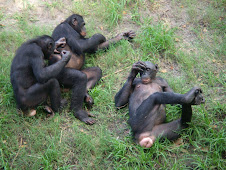
"Busy fighting our fire, we didn't notice the two cars slide into the parking lot and brake to a shuddering stop. I heard the noise and looked up from frantically searching under the vehicle for more flames and smoke. My heart nearly stopped. A pair of yellow taxis—probably commandeered—were bursting with uniformed military. They stared for a brief second then, menacingly, they clambered out like Genghis Khan’s warriors dismounting dun-colored ponies. Efficiently, they surrounded our wounded truck.
Luc straightened up from the hood, water pail in hand. I saw his fist tense up on the bucket as he faced the troops.
“What the hell are you doing here?” barked the jut-jawed leader. He was a clean-cut officer, younger than half his henchmen. His squad glared at us belligerently with drawn AK47s. They bristled with barely restrained violence.
Luc started forward and the men lifted their weapons higher. Luc stopped, mouth working soundlessly.
“Did you hear me?” This time a bellow: “What the hell are you doing here?”
“Hey man, can't you see? Vehicle broken down!” Luc hollered back. He stabbed a finger at the cab. “Look at those fuses!”"

Monday, May 26, 2008

Grains of Golden Sand: Cows and Chickens
In the Peace Corps, learning a foreign language at the age of thirty was incredibly difficult, but what was more difficult was having to teach high school vet students in my labored French. From Grains of Golden Sand:
"No matter how I tried, I could not make myself understood. I struggled with lesson planning each night, spelling out by candlelight the next day’s lessons in phonetic longhand. I cheated by using the blackboard to outline the lesson with pictograms of stick cows and chickens and fences and connecting arrows. It was of little use; I was the laughing-stock of the entire school. I was nearing despair. At the rate I was progressing, my French would become decipherable just as I was finishing my Peace Corps tour.

Three weeks into the first semester, two things happened to change all that. I was struggling, red-faced, at the blackboard. It had been a morning of frustration. The torrent of rain clanging on the metal roof was so loud it was impossible to hold class. I was stuck in the dimness of the mud-walled room and chill of the tropical downpour, while the kids went wild in their boredom—there was not a scrap of reading material among them. They were not picking on me personally; that was just the way it was, but I was exasperated beyond expression. The downpour soon ended, but the distraction had thrown me. At that moment, I hated the school, my job, and the kids.

Laughter. Then twittering and chirping. From my position, I could see a gaggle of elementary-school boys in their blue and white uniforms hanging around outside the windows. They were giggling and pointing and egging on my students in Otetella, the local dialect. Discipline, in a school system known for its rigid and rough punishment of even minor infractions (for instance, Otetella was strictly forbidden in school) had reached a seemingly incurable low in my classroom.

Against the wall, just in front of where I stood, was a mound of crushed rock. It had been stored in the room—for some construction project, I supposed—for as long as I’d been teaching there. (Later, I was told that the classroom, locked at night, prevented theft of the valuable commodity.) I strode over, scooped up a double-handful of gravel, sneaked back, and hurled it out the window at the loiterers; stinging their legs and making them run for cover. I yelled, shaking my fist, “You! Get back in your classrooms where you belong!”

My own students broke into guffaws. I laughed with them to see the children, many of whom were little brothers, run off chastised.

“And you, too, listen up now!” to my students. Immediately, my classroom quieted. The young men gravely lifted their eyes to see what was coming next.

In slow, tortured French, I said, “I-am-your-teacher. All-of-you, not-me, must-take-the-state-exams.” I strung together the words, “If-you-want-to-pass, you-will-excuse-my-bad-French.”

That was the beginning of a new understanding. I continued to struggle with the language barrier and to draw pictures on the blackboard, but at least I had begun to win their respect."

Friday, May 23, 2008

The Writing on the Wall

In September 1991, the Zairian military went on a Kinshasa-wide rampage. The unrest quickly spread to the civilian population. To keep the hordes out of the compound where I and the bonobos lived, I slaughtered a sheep, and with its blood, wrote "AIDS" on the institute's walls. It worked. This photo was taken a few days later, with some of my workers. From Grains of Golden Sand:
"From the tub, I sucked the sheep-blood slurry into the syringe. In three foot tall letters, I spray-painted the word “SIDA”—“AIDS” in French—on the cement block entrance wall. The blood ran dramatically in long, red fingers down the pale ramparts. It was a word that evoked cold dread. In those early years of the sickness, many believed that AIDS was an anti-African plot hatched by outsiders. Skeptics joked that the letters “SIDA” stood for Syndrome Imaginiare pour Décourager les Amoureux, the Imaginary Syndrome to Discourage Lovers. But people were learning that this so-called imaginary disease was a killer."

Photo by: D. Messinger

Tuesday, May 20, 2008

Grains of Golden Sand Excerpt -- Mushrooms

I did not arrive in Africa until I was 30, but my journey started long before then. As a youngster, I longed for the tough and the untamed. I didn’t care for dolls. I was, instead, a strange little girl who played strange games, amusements that came from places in my mind that I could not fathom. Although generally well-behaved, I had bizarre compulsions to experience the outdoors and did so clandestinely when I suspected that it was a no-no, and openly otherwise.

When I was four, we lived on a farm across from a cranberry bog near South Carver, Massachusetts. One day my mother, who had already noted my distaste of indoor confinement, found me in the woods, stuffing mushrooms into my mouth. I refused to spit them out. Instead—I’d show her—I swallowed. Mom rushed me into the house, called the hospital, and followed their instructions. To induce vomiting, she made me drink heavily salted water followed by a mustard solution. Her report: the kid drank it all, glared furiously at her, and still refused to give up the mushrooms. When grilled, I admitted that I’d been consuming them for days. Finally, she relented, thinking, “All right, you little sneak”—perhaps that wasn’t the exact phrase—“you haven’t died yet.” I’m sure it stands out in her memory, but I don’t remember the details of that particular episode. In truth, I had sampled odd foods from the time I could walk. (I also stole snacks from the fifty-pound bag of dog food stored on the porch.)

When I was six, we moved to Waco, Texas. We were an Air Force family and mobility came with father’s uniform. Where before there were the lush woods in which I wandered at will, picking and pruning and gleaning the blueberry bushes like a wild creature, now it was rows and rows of boring, sun-baked suburbia. Here and there were precious strips of fallow, but the only wildlife they held were giant red ants and the horned toads that ate them.

Lacking untamed spaces—and perhaps rationalizing that it was my birthright—I began my career of childhood mischief. I persistently raided the neighbors’ fruit trees and wild plants, pretending that I was a deer browsing through, fattening myself for the coming winter. I was never apprehended, possibly because much of the fruit was left to rot anyway and possibly because I always took along my mongrel dog Pepi, who was really a “wolf” and loyal protector. From day to day, escapade to escapade, I was a feral creature, a Cro-Magnon, a trailblazer, an Australian aborigine, thriving by wits alone. There were no other people in my world, no buildings, no cars, no electricity. There was just nature and me.

I became the ringleader of a group of adventuresome friends. We raided squirrels’ nests, explored mossy drainage culverts under the streets, fished in rain puddles with bent safety pins, and cut open dead animals to see what was inside. In winter, during a rare Waco snowstorm, I built an “igloo” and pretended to be an Eskimo. I imagined killing seals, being pulled by huskies, and wondered what blubber would taste like. I pondered the rigors of glacial temperatures and whether I could survive wearing ten shirts, ten pairs of pants, and ten pairs of woolly socks.

Then, pursuing my father’s graduate school dreams, the family moved again. This time it was to 25 acres of undeveloped scrub south of Austin. There we lived for months in a shell of a condemned house that my dad purchased cheap at auction. It had been sawed into three pieces, moved to our property, and nailed back roughly together. While the well was being dug, we had no water and the north wind whistled through a building with no heat. This rurality was my delight and I could hardly be forced inside. I made a pact with the family that all my chores would be outdoors, which would excuse me from housebound duties.

Despite a dearth of edible plants, I continued to eat and taste wild foods and became, at least in my own mind, a wildcrafter. I chewed on mesquite beans, tried cooking cactus pads, chased armadillos, and hollowed out a den at the base of a sprawling cedar. I dined on mistletoe berries for years and then read somewhere that they were poisonous. I reasoned that the books were wrong because birds ate the sticky, translucent things. Surely they were edible, just as they were meant to be glued by bird beaks to branches for spawning fresh parasitic plants—if they were good enough for birds, they were good enough for me.

A few months after we moved to the ramshackle place, I was given two horses that the owner had no use for and didn’t want to feed. (She felt sorry for me because I had joined the pony club but had no horse to ride.) One was a 28-year-old, broken-down Thoroughbred, the other a blue-eyed white pony mare. The gelding’s name was “Biggie,” an ill-tempered, shaggy, sway-backed beast whose bony withers towered above my head. The pony was a half-wild creature that had never been trained properly. Because my father had left the military to return to school, we were poor, and with six kids, always on a tight budget. The family had little money to care for horses properly or to buy grain, a saddle, or even a decent fence. None of this mattered. I was determined to make it work.

My parents bought enough wire to construct a triangular pen anchored by three cedars where the animals could be kept, with ten bales of hay as my Christmas present. On weekends, I rode a half-mile to the main road whose shoulders presented a lush crop of weedy Johnson grass. There, cutting my fingers until they bled on the serrated blades, I pulled grass by hand, tied it into bundles and hauled it home. No sacrifice was too great. Every morning I arose at 5:30 to care for my beasts before school. Those were the best years of my childhood.

Horses set me free. I fashioned rope bridles and rode bareback. I became an explorer and rediscovered America. As a rancher, I scoured the range searching for lost steers. I was a hungry Indian scouting for bison. I stood on my steeds’ backs to steal the out-of-reach peaches and plums within a ten-mile radius. I imagined what it would be like to take a cayuse and follow the railroad right-of-way across America. I’d read about the Pan-American Highway and wondered if I could actually take a road all the way to Tierra del Fuego.